
500 Lire Paper
Updated:
The 500 lire paper notes are one of the most important and sought-after historical pieces in Italian numismatics. Let’s explore the long historical journey and the vicissitudes of this 500 Lire banknote on this page.
The 500 Lire Banknote of the National Bank
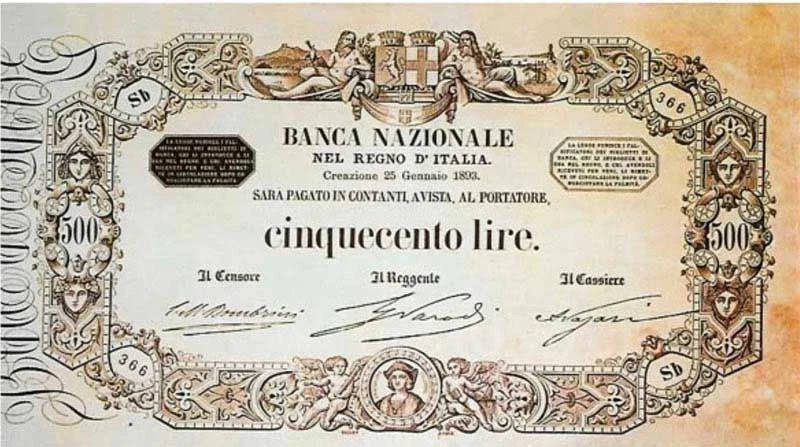
The 500 lire banknote was printed in Italy for the first time in 1874 by the National Bank in the Kingdom of Italy. The period in question was that of the Kingdom of Italy and King Vittorio Emanuele II.
Originally, this Italian banknote was printed on one side only and featured the inscription of the “National Bank“, the value of the banknote as well as the coat of arms of the cities of Turin and Genoa and the bust of Christopher Columbus at the center bottom.
The dimensions of the first 500 Lire banknotes were 220 X 130 mm. This banknote was printed under King Vittorio Emanuele II in the years 1874 – 1875 – 1876 – 1877. Subsequently, it was also printed under King Umberto I in the years 1881 – 1885 – 1887 – 1889 – 1893 and by the new Banca d'Italia in 1894 – 1895
500 Lire di Carta del Banco di Sicilia del 1876
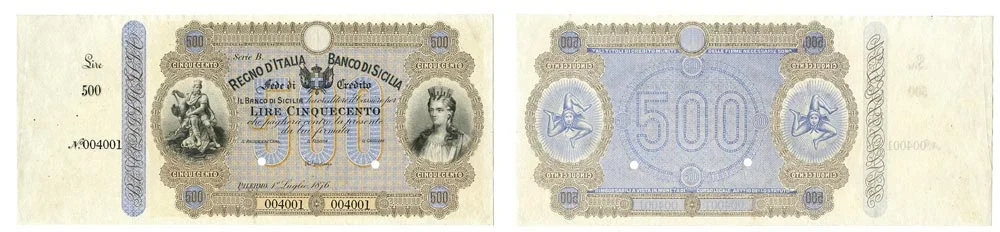
These particular Italian paper banknotes are highly sought after. If kept in good condition, they can be worth as much as €3,000. A truly interesting and noteworthy amount.
The 500 Lire Banknote of the Banco di Napoli
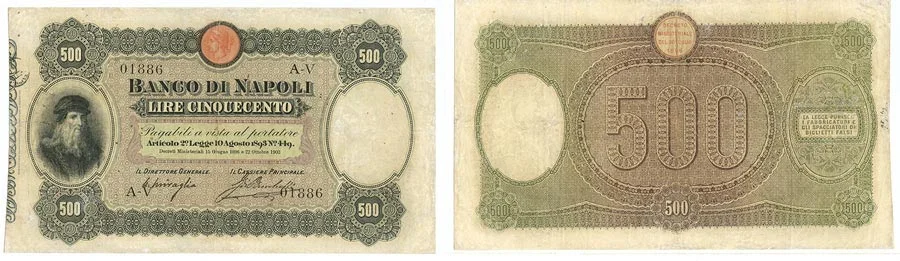
The 500 lire banknotes of the Banco di Napoli, if kept in good condition, can be worth as much as €7,500. A banknote depicting Leonardo da Vinci printed in 1903 and restored is worth even €6,500. Therefore, even if the banknote has been restored, it retains significant economic value.
500 Lire di Carta “Grande C”
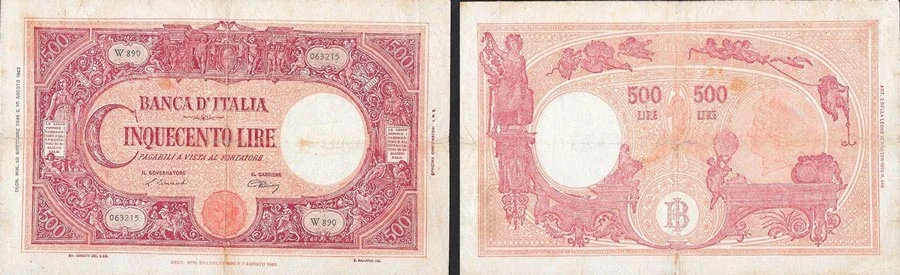
Subsequently, the Bank of Italy made changes to the first 500 lire banknote. In fact, the 500 lire paper notes were illustrated by the Sienese artist Rinaldo Barbetti in 1896. This particular edition is also called “Grande C“. Do you know why?
Thanks to the size of the “C” in the word “Cinquecento”. The same banknote, with slight variations, was also printed in 1950 and was declared out of circulation in 1953. The 500 Lire banknote designed by Barbetti remained in circulation for a remarkable 57 years.
Value of the 500 Lire di Carta Grande C
If you own a 500 lire banknote from 1950, you might have a piece of history worth over €10,000
The 500 Lire Banknote by Capranesi
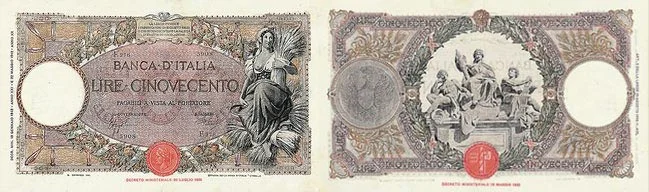
This Italian banknote was printed for the first time in 1919 and was designed by Capranesi.
The 500 Lire banknote by Capranesi features on the reverse one of the two sculptural monuments that triumphed above the facade of Palazzo Koch on Via Nazionale in Rome, which at the time was the headquarters of the Bank of Italy.
The three sculptures represent, from left to right, Industry, Agriculture, and Commerce. The sculptural group was created by the chisel of Nicola Cantalamessa Papotti. Later, in 1930, the sculptures were removed to protect the stability of the facade itself.
Surrounding the depiction of the monument is a crown of leaves and two smaller ovals flanking the central one.
On the right is the circle reserved for the watermark, on the left is the one depicting the royal eagle with the Savoy coat of arms. On the front, the figure of the reaper is represented sitting on the sheaves with the sickle in hand.
This banknote was printed from 1919 to 1943 and its total mintage was over 63 million pieces.
Value of the 500 Lire Banknote by Capranesi
If you own a 500 Italian lire banknote like this, you should know that its value is around €900.
The 500 Lire Banknote “Ornate with Ears of Wheat”
Here is another version of the Italian 500 lire banknote. This particular one was issued in 1947 and signed on the watermark by Luigi Einaudi, who was the governor of the Bank of Italy at the time.
For this edition of the 500 lire, the banknotes were transformed by reducing the size to 146 X 70 mm. The printing was carried out by the Banknote Printing Office of the Bank of Italy.
Made on white paper with a watermark in the pulp, this 500 lire features, on the front, a part of the painting by Raffaello Sanzio “Venus, Juno and Ceres”, created by the artist in the Loggia of Psyche at the Farnesina in Rome.
The painting by the Tuscan artist allegorically symbolizes Italy, and on the banknote, there is a depiction of the face of Ceres adorned with ears of wheat. Hence the name of the banknote.
The banknote, known as “Italy Ornate with Ears of Wheat,” circulated until 1953 along with the previous versions, after which they were all withdrawn from circulation on June 30 of the same year.
From 1953 to 1958, no 500 lire banknotes circulated in Italy.
Value of the Ornate with Ears of Wheat 500 Lire Banknote
If you own a “Italy Ornate with Ears of Wheat” banknote from 1947, you can easily sell it at auction (on this site) and find a bidder for €400.
The 500 Lire Silver Coin with the Caravels
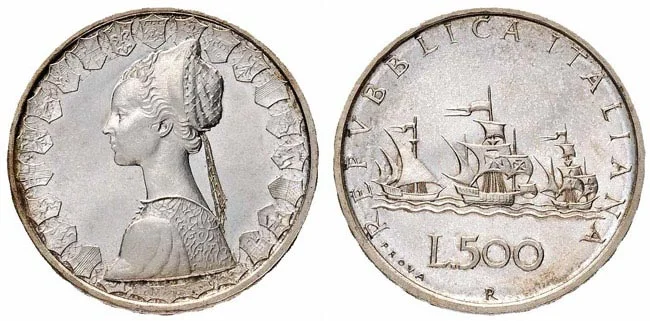
After a long pause from the 500 Lire paper note, in 1858 the State tried again and issued a silver coin with a value of 500 Lire. This is the famous 500 lire silver coin that we have discussed extensively on its dedicated page: the 500 lire silver with the caravels.
However, this silver coin was soon replaced due to the excessive production cost. If you want to know more about the 500 lire silver coins, on this page you can find all the information about this coin, current market prices, mint errors, and the various mintages that occurred before their final disappearance.
Value of the 500 Lire Silver Coins
The great peculiarity of this silver coin is the Flag of the Caravel. If the flag is waving to the right (in the direction of the wind), it is a common specimen. If the caravel's flag is waving to the left (against the wind), it is a very rare and highly sought after coin by numismatic collectors around the world, and its value could fluctuate around €15,000.
The 500 Lire American Notes “AM-Lire”
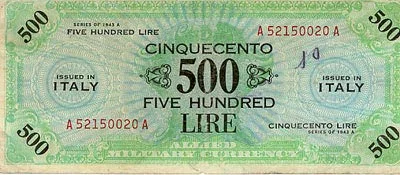
After the fall of Mussolini's Government, during the years between 1943 and 1946, Italy experienced a transitional period and the United States Command had the AM – Lire banknotes printed. “AM” stands for “Allied Military Currency.”
The AM – Lire were banknotes the size of American dollars and displayed their value in both Italian and English. Of course, there was also the 500 AM – Lire banknote.
On the back, they featured the 4 freedoms enshrined in the American Constitution in both the original language and in Italian: Freedom of speech (libertà di parola), Freedom of religion (libertà di religione), Freedom from want (libertà dal bisogno), Freedom from fear (libertà dalla paura).
It was a legal tender. Used throughout the Italian territory subject to Military Government for payments of any amount! No one could refuse to accept it. These 500 lire notes circulated throughout World War II with the following denominations: 1, 2, 5, 10, 50, 100, 500, 1000 Lire.
At the end of 1946, specifically on December 12, the AM lire officially became Italian currency and no longer American. They remained in circulation until June 30, 1950, before being definitively withdrawn from circulation.
Value of the 500 AM-Lire Notes
This banknote, controversial and a witness to such a particular historical period for Italy, if in good condition, can be worth over 1,000 €
State Note “Aretusa” of 500 Lire
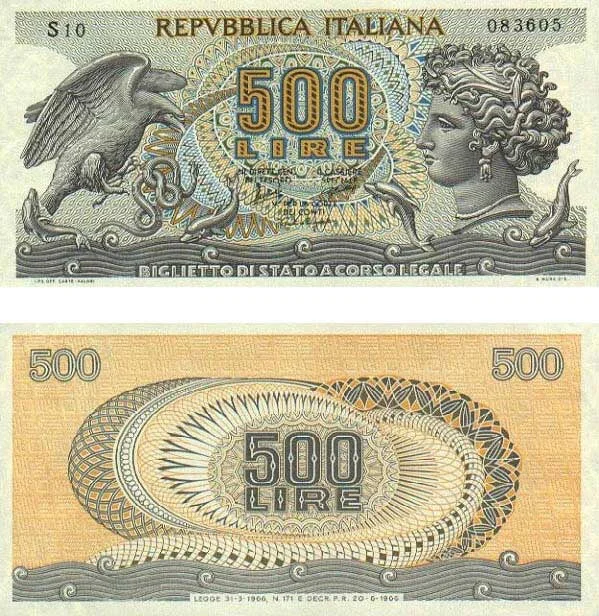
Subsequently, in the sixties and specifically in 1966, a State Note with a value of 500 Lire was printed. This 500 lire note was printed by the Istituto Poligrafico e Zecca dello Stato, signed by the treasurer of the Ministry of Treasury.
It was not a banknote issued by the Banca d'Italia but a title from the State, thus the seigniorage belonged directly to the State. In fact, the wording is no longer Banca d'Italia but “Repubblica Italiana”.
The Aretusa State Note was introduced to replace the 500 lire silver coin (the one with the caravels), whose production costs became too high due to the rising price of silver.
The dimensions of the new banknote, further reduced compared to previous banknotes, are now 110 x 55 mm. On the front, the banknote features the head of the Nymph Aretusa surrounded by symbols of Dolphins, the Eagle, and Serpents. With cornucopias on the watermark.
Value of the Aretusa State Note
A 500 Lire Aretusa banknote in good condition from 1975 can be worth around €300. Owning a very rare version (from the replacement series B6) could even earn you over €600. A site we recommend for buying and selling banknotes both Italian and from around the world is this one.
State Note “Mercury” of 500 Lire
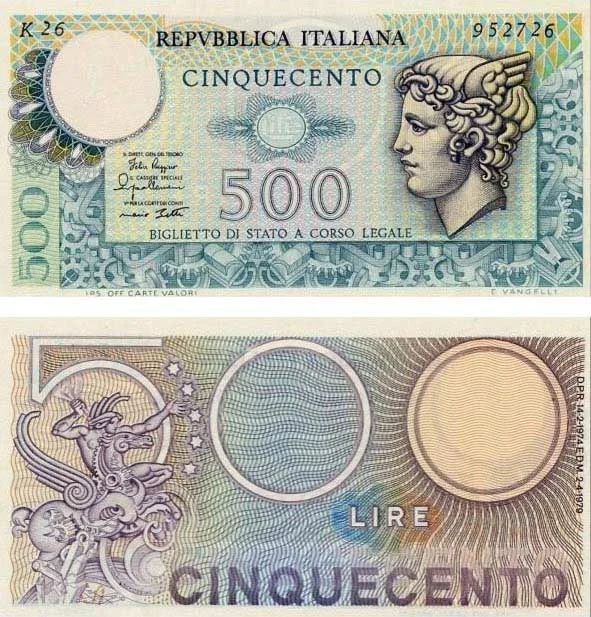
The year 1974 saw the issuance of a new State Note with a value of 500 Lire, printed by the State Polygraphic Institute. The dimensions of the new banknote slightly increased compared to the previous version and became 115 x 59 mm. The State Note “Mercury” was printed in the years 1974 – 1976 – 1979.
This particular denomination of Italian banknote, depicting the head of Mercury on the front, became the last republican issue in paper. In fact, in 1982 it was replaced by the Bimetallic Coin.
This is an excerpt from an article dated February 25, 1986:
February 25, 1986 – OUT OF CIRCULATION FROM FEBRUARY 28 THE 500 LIRE BANKNOTES
ROME – On February 28, the 500 lire notes will leave the scene to make way for the bimetallic coin of equal value, already in circulation. Those still in possession of the banknote have until this date to “spend” it or exchange it at the bank. After February 28, the 500 lire banknotes will go “out of circulation” and to exchange them, it will be necessary to go to the counters of the Bank of Italy or the central Treasury. No new 500 lire banknotes will be issued.
Value of the Mercury State Note
If you own a “Mercury” state note, you should know that its value is around 70€ /100€
The Bimetallic 500 Lire Coin
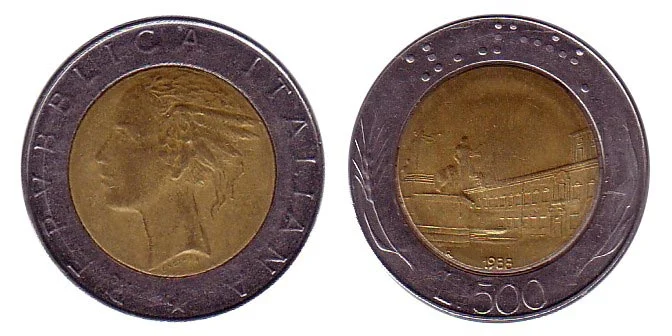
In 1982, the new bimetallic 500 Lire coin was issued after the silver one featuring the caravels.
The coin was made of two metals. The innovative use of multiple metals was necessary to combat the high counterfeiting of coins.
The patent for the production of the double metal and double color coin was proposed to the Ministry of Treasury in July 1981. Another innovative feature was the appearance of the Braille character and the discontinuous edge.
The metals used in Italian production were Bronzital and Acmonital. It is no surprise that their combination was defined as “Italian Marriage”.
Curiosities about the Bimetallic 500 Lire
Throughout the year 1982, more than 162 million bimetallic 500 lire coins were produced.
One of these is preserved and displayed at the British Museum in London, and many were collected right away by tourists visiting Italy. You might even have one in your attic and not know it!
Didn't find what you were looking for? Check out these topics on lire:
- Here you can learn everything about the 1 lira, 2 lire, 5 lire, rare 10 lire, 20 lire, and 50 lire.
- The 10 centesimi of lira are here, the 20 centesimi are here, and here are the rare 50 centesimi of lira.
- If you are looking for the 1 centesimo of lira, look here and here for the rare 2 centesimi and the 5 centesimi of lira.
- If you want info on the 100 lire and their value, you can find it here, as well as that of the 1000 Lire of the Italian Republic.
- We have covered the 200 lire and their value here.
- We talked about the Telephone Tokens that were worth 200 lire on this page.
- We also discussed the 500 lire silver, the 500 bimetallic lire, and the 500 paper lire
- For German-speaking collectors, we have created a dedicated version of the catalog of rare coins found here “MoneteRare Deutschland”.
Where to sell or buy coins
Do you own coins like these, a lot, or a rare piece? Register on Catawiki and place your first bid, or submit a lot for sale — signing up is free. For years we have used this auction site, our partner. Browsing auctions is not enough: start with registration and a first action (a bid or a listing). Register and start.