
Euro Coins: Value and What They Look Like
Updated:
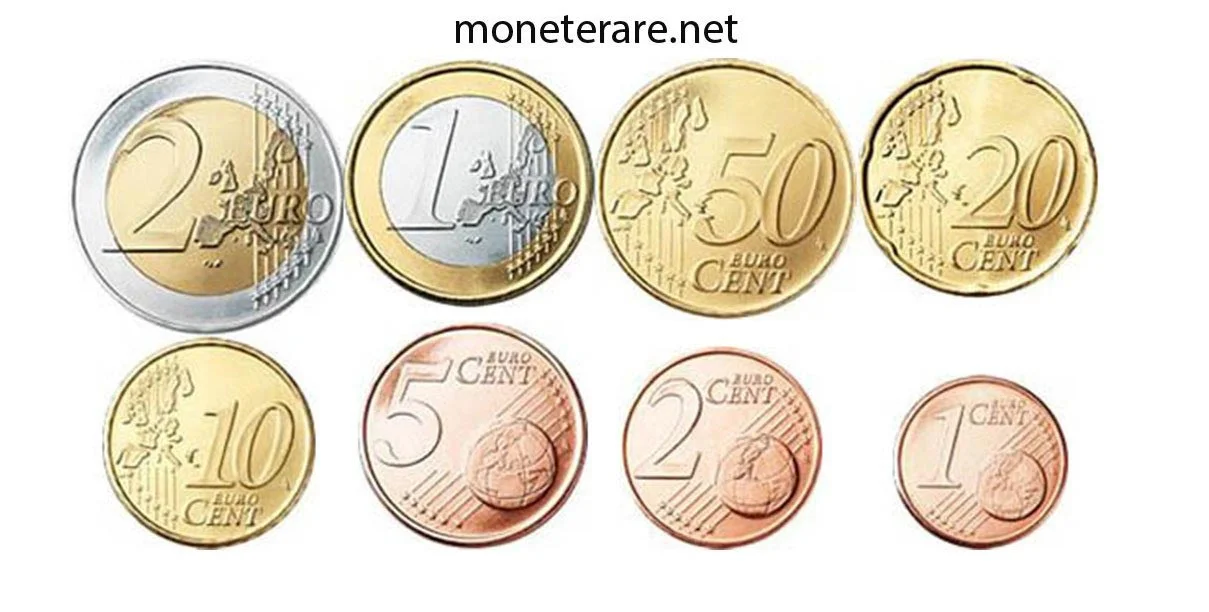
Euro coins run from 1 cent to €2, in eight denominations. Each coin has a common side, the same in every country, and a national side that shows who issued it. The face value is the number on the coin. A higher collector value depends on the country, the year, and the condition.
To see what euro coins look like, start with the two sides. The common side shows the denomination, the word EURO or euro CENT, a map of Europe, and the 12 stars. The national side changes by country: a monarch, a monument, a plant, or a historical figure, always with the 12 stars and the country name. The eight coins are copper-coloured 1, 2 and 5 cent, gold-coloured 10, 20 and 50 cent, and bimetallic €1 and €2. Designs for each state are in what euro coins look like and in the country catalog on this page.
In everyday change, a euro coin is worth its face value. A collector price above that is typical of low-mintage commemorative €2 coins, pieces from Monaco, San Marino, and Vatican City, and uncirculated sets. Those prices are on the rare euro coins, rare 2 euro, and rare cent pages. This hub is the map of the series, not a second rare-coin list.
Eurocollection is the name collectors use for gathering and classifying these coins: circulating pieces, division sets, Euro Starter Kits, and commemorative €2 coins.
Looking for this guide in German? See the German edition on MoneteRare Deutschland.
Catalog of coins from each European Nation
Introduction to the Euro Coin Collection
Precisely on January 1, 2002, the single currency made its first appearance among the European States. The States consequently renounced their individual currencies. However, it should be noted that as early as 1999, in Italy and in other European countries, the new currency was, so to speak, already “present.”
On this date, the Euro was recognized as the official currency (even though it was not yet physically present) and was used for electronic payments, credit instruments, and all those payments that can be defined as non-physical. Furthermore, on January 1 of the same year, commemorative 2 Euro coins were issued, referred to as “2 Euro UEM,” an acronym that indicates the European Monetary Union.
History of the Euro
The history of the Euro has, contrary to what one might think, much more “ancient” roots than the actual date of issuance.
Its history actually originates in 1957 in Rome, the year in which the treaties were signed to establish the birth of the E.E.C. This was nothing more than an immature form, so to speak, of what would later become the European Union. For more information on this, you can consult the official website of the European Union.
It is in 1988 that the Euro takes its origins. Specifically, it was in this year that the European Council, which brings together Heads of State and Government of the European Community, assigned to a committee, mainly composed of central bank governors and led by Jacques Delors, the task of creating a project aimed at the gradual implementation of economic and monetary union.
In particular, there were three important phases:
- The first was the liberalization of capital flows through the abolition of all restrictions on the free movement of money between member states.
- In a second moment, with the creation of the European Monetary Institute (EMI), there was a strengthening of relations between central banks.
- Finally, in a third phase, starting from January 1, 1999, there was the gradual transition to the single currency.
The Name of the Coin: EURO
The name Euro has a very interesting history that anyone interested in the world of Euro collecting must absolutely know.
The official name was adopted in Madrid by the European Council in 1995 to replace the acronym ECU that had been used until that moment.
ECU indeed stood for “European Currency Unit” or in Italian “Unità di Conto Europea” and was an anglicism used in official treaties until 1978.
However, there are several reasons why this type of denomination was discarded in favor of the one we all know today. The main reasons are linguistic in nature, as ECU was an acronym that, in terms of the English language, undoubtedly made sense while for other countries it seemed a bit anonymous and in some cases even cacophonous.
The acronym indeed made sense in the English language, from which it was derived, and in French as écu means shield, a name that recalled an ancient French coin. However, for other countries it had no meaning and for Germany, it represented a real problem. The Germans would have had to call the coin ein Ecu, which sounded very similar to eine Kuh meaning “a cow”.
In the end, it was decided to opt for the name Euro, which represents nothing more than the abbreviation of the term Europe for which the acronym is indeed EUR.
The Symbol of the Euro Coin
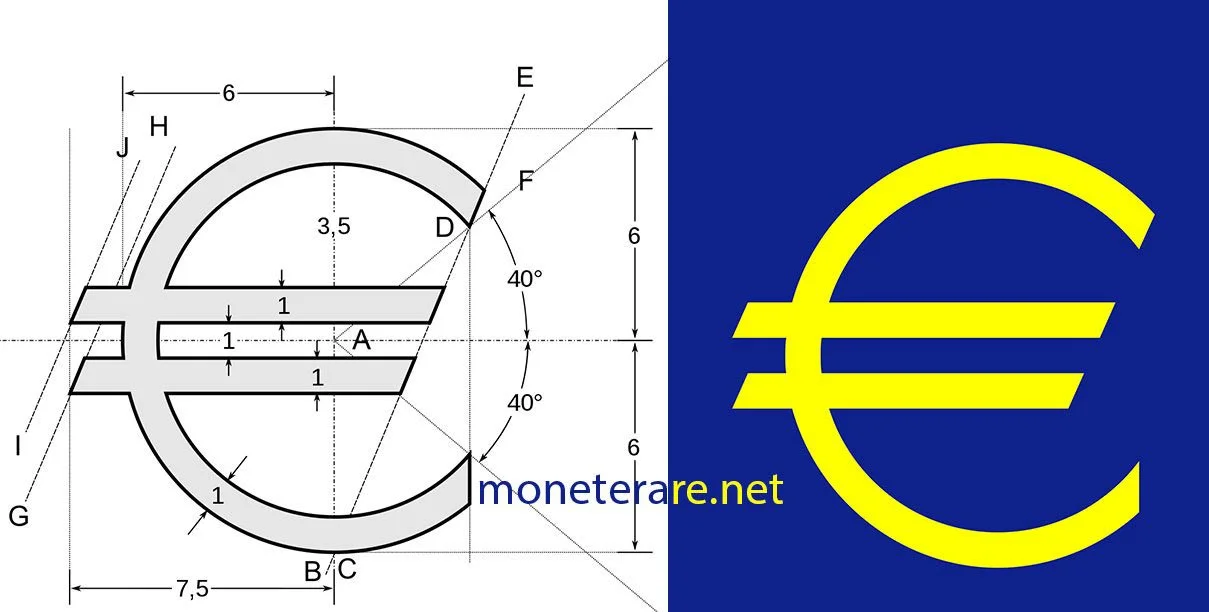
The symbol of the Euro that we all know also has a history and is the result of a very careful selection process. In particular, the original designs were ten and all featured characteristics that defined what would become the identifying symbol of the single currency.
Thanks to a survey, only two designs were selected as the most valid. In the end, it was the European Commission that declared the winner.
The original symbol was created by a team of four experts, although their names have never been officially released. Currently, the design of the symbol is unofficially attributed to the Belgian Alain Billiet.
The symbol is inspired by the Greek epsilon, with a clear reference to the “E” of Europe and two horizontal lines representing the stability of Europe.
The glyph also features the official colors declared by the European Union, specifically yellow in the foreground and blue in the background.
Moreover, its position was clarified from the very beginning: the symbol must always be placed after the number and the two characters must be separated by a space. This rule does not apply in English, Irish, Maltese, and Latvian, where the symbol is always placed before.
What Euro Coins Look Like
What euro coins look like depends on the side you are holding. One side is common to every country. The other side is national, and that is the design you see in the country images linked from this page.
So what is the Euro Collection? As the term “Euro Collection” itself clarifies, it refers to the collecting of Euro coins, which can undoubtedly be a very fascinating activity. The various coins of the European Union, in fact, not only vary among themselves in terms of denominations (1€, 2€, 0.50€ etc.) but also from State to State.
Specifically, these coins have two faces or sides. The first is the common side, which is the same for all countries, while the second is the national side, which, as is easy to understand, is specific and personalized for each nation.
The collector, the enthusiast of euro collection, or the numismatist is therefore in search of different coins based on the various countries in order to possess as many specimens as possible.
Naturally, there are exceptions for particular coins which are much more sought after and essentially differ into two main types: special coins due to minting errors and commemorative coins for particular or historical events.
The Common Side of Euro Coins
As mentioned earlier, the common side of Euro coins is a side that features identical graphics for all States and allows for a sort of identification specifically for this type of coin. Specifically, it was designed by the Belgian Luc Luycx, who won a competition for the creation of this “side”.
The common side primarily represents the value of the coin accompanied by the inscription “EURO” or “euro CENT” depending on the denomination. Additionally, there is a representation of the map of Europe.
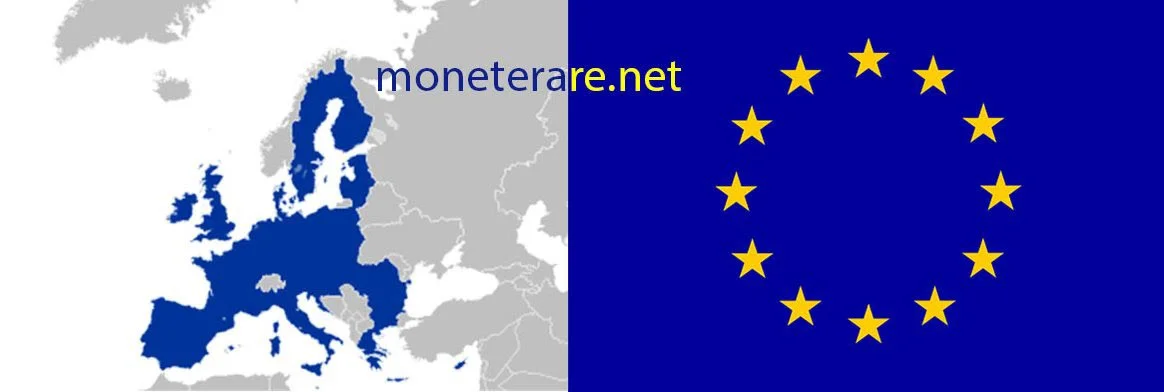
In this regard, it is useful to emphasize that between 2007 and 2008, the common side was modified for coins excluding the 2€, 1€, and 0.50€ denominations to present a view of the European continent without any borders. Furthermore, on the common side, there are 12 stars representing the 12 States.
The National Side of Euro Coins
The national side, on the other hand, is the one that changes from State to State and is what allows one to understand from which country the coin actually comes.
Each State, therefore, had the opportunity to customize its coin in such a way as to give it a unique appearance. The only directives from the European Union regarding this practice were to include the 12 stars on this side as well and to include the name of the Nation in full or abbreviated form. Due to this last directive, some countries were forced to modify their coins in the course of action (we are talking about Germany, Belgium, Austria, Finland, and Greece).
Regarding representations, each State chose to include what are characteristic elements. For example, for States where the Head of State is a monarch, it was decided to include their likeness. Other States opted to include aspects such as important monuments, characteristic symbols, historical figures, but also characteristic plants.
At a later time, however, numerous States modified their coins, even though the Mint expressed its desire not to do so before 2008 unless the Head of State depicted changed.
The €2 Commemorative Coins
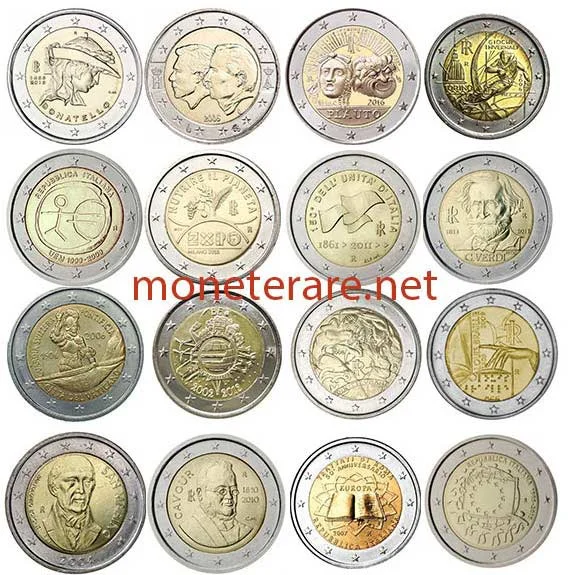
At the end of 2003 and effective from the beginning of 2004, the European Commission granted member states the possibility to produce and circulate a commemorative €2 coin which would have full legal tender status.
The limits imposed by the EU stipulated the issuance of only one coin per year, although starting from 2013 this limit was extended to 2 coins.
Commemorative coins, as the term itself suggests, are €2 coins that represent some important event. A striking example is the Greek €2 coins issued for the 2004 Olympics, which were indeed issued for that particular event.
Among these coins, the most sought after today are those from Finland 2004, Slovenia TDR 2007, and those from mini-states such as the Principality of Monaco, the Republic of San Marino, and Vatican City.
Our country, on the other hand, boasts almost the record for commemorative coins issued, and you can find them all on the 2 Euro Italy page.
Regarding commemorative coins, it is also necessary to talk about those defined as common issues. This specifically refers to the issuance of commemorative coins that occur jointly for all states on the occasion of events of particular importance for the Union.
Usually, these are the same for all countries, although the specific name of the nation is always indicated.
So far, the common Italian €2 commemorative issues have been 3: 50th Anniversary of the Treaties of Rome, UEM 2009, and the 10th Anniversary of the Euro's introduction into circulation. We have discussed this topic extensively on the commemorative €2 coins page.
The Euro Starter Kit
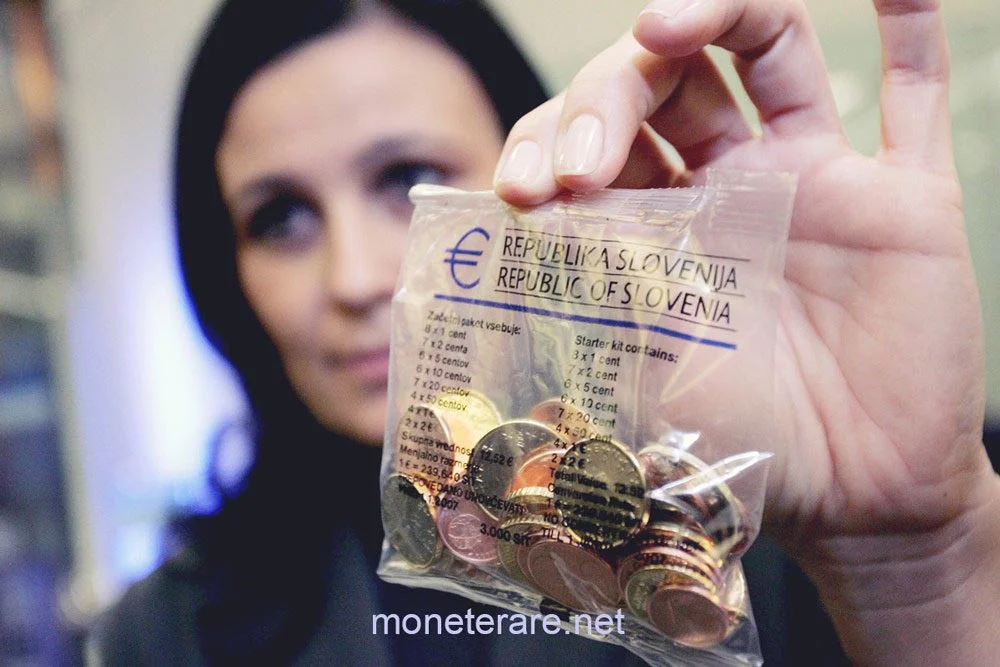
Now let's talk about what are the Euro Starter Kits. These are nothing more than completely sealed plastic bags containing Euro coins in all 8 denominations.
Specifically, these Starter Kits were created to allow people from the new Eurozone countries to become somewhat familiar with this new currency. In this way, people had and still have the opportunity to start understanding its denominations, shapes, sizes, and values.
In general, two types of Euro Starter Kits have been produced. The first is intended for “ordinary” people and is made as previously seen. The second, however, is intended for merchants and usually contains many more coins which are collected in rolls rather than in bags.
The distribution of Starter Kits began in 2001. Just think that in this same year, on the occasion of the entry of the first 12 countries into Europe, more than 150 million Kits containing about 4.2 billion coins worth 1.6 billion Euros were distributed.
Only in Italy, for the transition from the Lira to the Euro, 30 million Starter Kits were distributed. Many people then became passionate and started their “Euro collection.”
Value of the Euro Starter Kit
As we have seen, the Euro Starter Kits are “starter packs” if we can call them that, which allow you to actually come into contact with the new currency. Regarding the value in Italy, the starter kit contains coins in all 8 denominations for a total value of 12.91 Euros.
Collecting, therefore, is based more on slightly rarer Starter Kits. It is still possible to find Italian Starter Kits for sale, but with a slightly higher value than the actual contents of the bag: roughly from €20 to €49
Division Sets
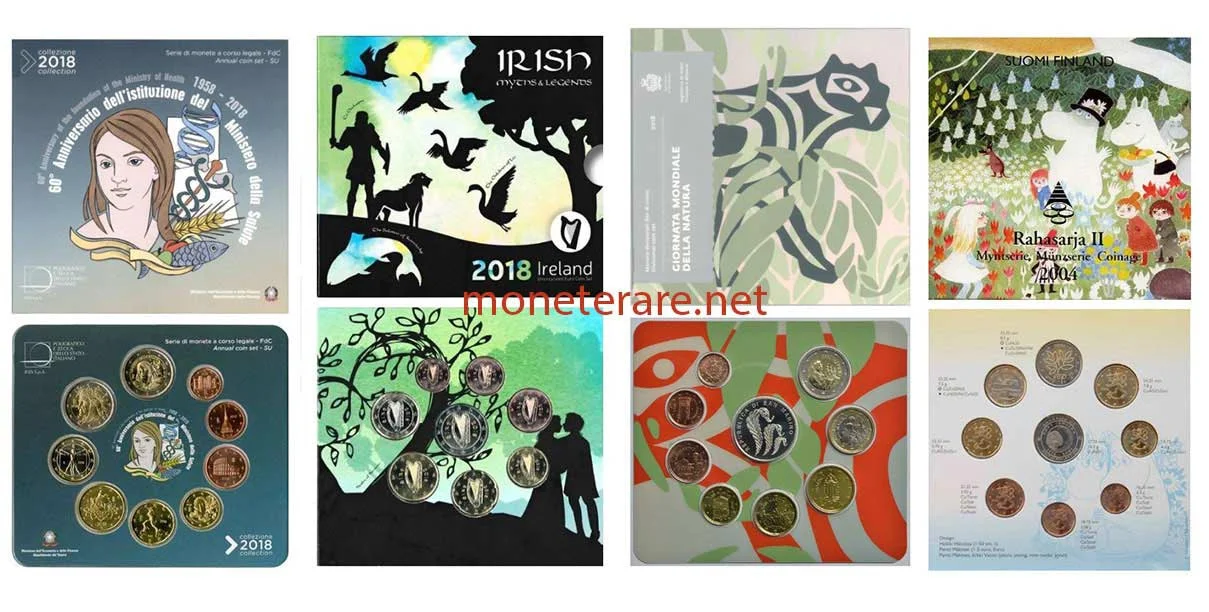
A separate discussion can be made regarding the Division Sets. In this case, we are talking about actual packages created to contain the sets of coins issued each year by each individual country.
As is obvious, these “boxes” change every year since the coins issued will be different each year.
There could indeed be silver coins, commemorative €2 coins, or simply the 8 base coins. In any case, they are unique pieces as each year the State modifies something so that the new coins issued can fit perfectly.
Of course, the coins and the packaging are in Brilliant Uncirculated condition (the highest possible) and are subjected to very thorough checks to identify even the smallest defect. The Proof Division Sets are usually issued in a special box with the coins sealed and encapsulated.
Frequently asked questions
What is the Eurocollection?
The Eurocollection is the gathering and classification of euro coins: circulating divisionals (1 cent–2 euro) by country, division sets, Euro Starter Kits, and commemorative €2 coins.
Where can I find euro coins from each country?
In the section «Catalog of coins from each European Nation» on this page, you will find links to the country hubs (e.g., Euro Italy, Euro Germany) and the related catalogs of commemorative €2 coins.
What are commemorative €2 coins?
They are €2 coins with a special subject issued by member states, different from the permanently circulating division coins. Each country has a dedicated catalog linked from this page.
What is the Euro Starter Kit?
It is the kit of euro coins distributed at the introduction of the single currency (or at the entry of a new country into the euro). On this page, you will find the dedicated section and information on collectible value.
What are euro division sets?
They are the complete sets of denominations from 1 cent to €2 minted for circulation or for collectors (BU/FDC). Each country hub describes the characteristics, mintages, and values of the individual denominations.
What do euro coins look like?
Each euro coin has a common side and a national side. The common side shows the value, the word EURO or euro CENT, a map of Europe, and 12 stars. The national side is different for every country. There are eight coins: copper-coloured 1, 2 and 5 cent, gold-coloured 10, 20 and 50 cent, and bimetallic €1 and €2.
What is the value of euro coins?
In circulation, a euro coin is worth its face value, from 1 cent to €2. A higher collector price depends on the country, the year, the mintage, and the condition. The country catalogs on this page describe each series. Rare pieces are covered on the rare euro coins, rare 2 euro, and rare cent pages.
What does a 2 euro coin look like?
The €2 coin is the largest circulating euro coin. It is bimetallic, with a gold-coloured outer ring and a silver-coloured centre. The common side shows the denomination and a map of Europe. The national side changes by country. Commemorative €2 coins keep the same size and common side, and change the national design.
Where to sell or buy coins
Do you own coins like these, a lot, or a rare piece? Register on Catawiki and place your first bid, or submit a lot for sale — signing up is free. For years we have used this auction site, our partner. Browsing auctions is not enough: start with registration and a first action (a bid or a listing). Register and start.