
Thaler
Updated:
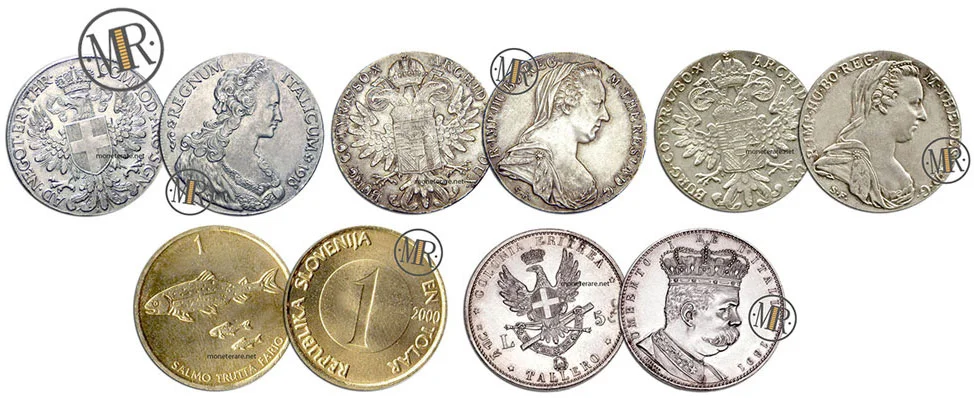
If there is a coin that has traversed numerous centuries and continues to have heirs even today, it is the silver Thaler!
The history of the Thaler coin begins in the mid-1400s, when an early form of the Thaler can be traced back. This coin has undergone many variations, culminating in the famous Thaler of Maria Theresa, a large silver coin that became common and was also used in Eastern Countries and Africa.
Let’s explore the different types of thalers that exist, whether they are rare coins or not, and of course their value.
Introduction to the Thaler Coin
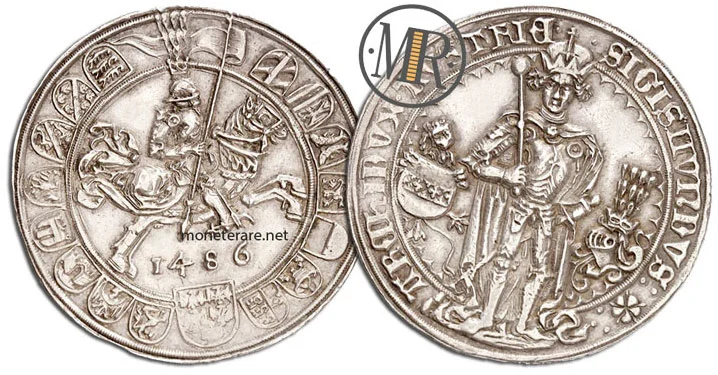
If we look for the origins of the Thaler, we must go back to the late 15th century, when large silver coins called Guldiner began to spread in the Germanic countries.
In 1486, Archduke Sigismund of Tyrol initiated the minting of Guldengroschen or Guldiner. From then on, these coins became so successful that they began to be minted in many other states.
The Meaning of Thaler
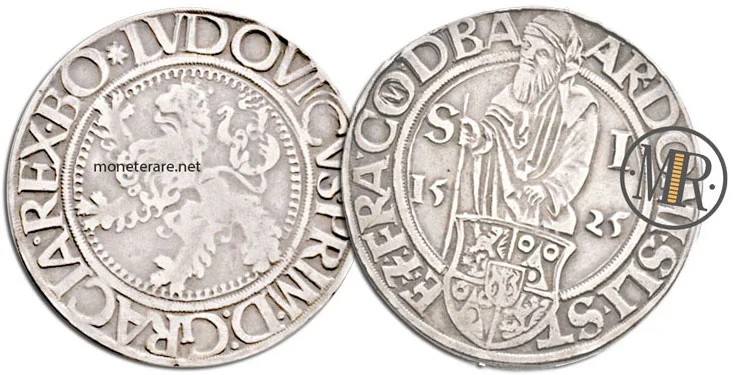
The name Thaler comes from the Joachimsthaler, large silver coins minted in Bohemia since 1520 in the valley (thal) of Saint Joachim, where new silver mines were discovered and where a Mint was located.
On the obverse of these large silver coins is the rampant lion of Bohemia, while on the reverse is depicted Saint Joachim. From Joachimsthaler, the name simply became Thaler, and finally Taler, that is Thaler.
The Maria Theresa Thaler
Until around 1750, the year the Konventionstaler was introduced, many thalers were minted by various states, including many Italian states. But we will discuss these later on this same page.
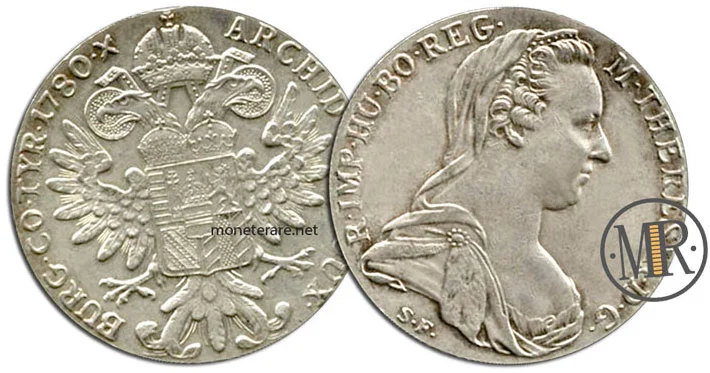
Now let's talk about the Maria Theresa Thaler from 1780 and its importance and spread.
Certainly, an interesting fact to know is that the Maria Theresa Thaler from Austria is a coin still used today in some African states and in the Middle East.
Description of the Maria Theresa Thaler from Austria
Since 1780, the year of Maria Theresa of Austria's death, the Maria Theresa Thaler has never changed its representations on the obverse and reverse, always showing the date 1780.
The Maria Theresa Thaler minted by the Vienna Mint is a large silver coin, with a thickness of 2.5 millimeters and a diameter of 39.5 millimeters.
The total weight of this Maria Theresa Thaler is 28.0668 grams, of which 23.3795 grams are silver, corresponding to a fineness of 833/1000.
On the reverse, there is a profile, facing right, of Queen Maria Theresa of Austria, with her head covered by a veil and a button holding her dress.
In the circle, the inscription “M • THERESIA • D • G • R • IMP • HU • BO • REG •” can be read, and below the bust of the empress are the letters “S • F •”, initials of the officials of the Günzburg mint.
On the obverse, the field of the coin is filled with the bicephalous eagle of the Austro-Hungarian Empire, with the coat of arms of the Habsburgs on its chest.
In the circle along the edge, the inscription “ARCHID • AUST • DUX • BURG • CO • TYR • 1780 • X” can be read.
History of the Maria Theresa Thaler 1780
Since its introduction, the Maria Theresa Thaler experienced a tremendous spread worldwide, quickly becoming one of the most widely used coins.
It was minted, always maintaining the same characteristics, by numerous mints including:
- Birmingham
- Bombay
- London
- Paris
- Utrecht
- Brussels
- Hall
- Günzburg
- Karlsburg
- Kremnitz
- Prague
- Vienna.
In Italy, it was minted:
- In Milano from 1790 until around 1840.
- In Venice from 1815 to 1866.
Following an agreement with Austria (July 9, 1935), the use of the Maria Theresa Thaler minting was granted to Italy for 25 years, and the Rome mint resumed its minting for trade with the Middle East.
Value of the Maria Theresa Thaler from Austria
The Maria Theresa Thalers minted in Rome are classified as common, while those from Milano and Venice have a rarity ranging from R2 to R5 for those minted in Venice in 1815.
- Therefore, a Thaler from the Rome mint can be purchased in online auctions for about €50 (as in this now-closed auction), while a Maria Theresa Thaler from 1815 from Venice is a much rarer coin and will have a much higher value.
Eritrean Taler
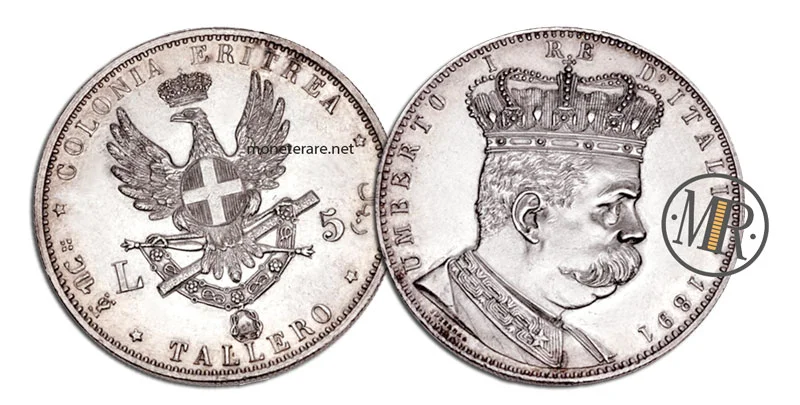
In Eritrea, the Taler of Maria Theresa had been circulating for a long time, and in 1890, following the annexation of the Eritrean colony to the Kingdom of Italy, it was decided to mint coins similar to the Taler with a value of 5 lire.
Description of the Eritrean Taler
The Eritrean Taler differs from the regular Taler of Maria Theresa in several aspects, starting with the silver content (900/1000) present in the coin.
It weighs 28.125 grams and has a diameter of 40 millimeters. The edge is reeded.
On the obverse, the crowned profile of King Umberto I is visible, with the indication of the author “SPERANZA” (Filippo Speranza) below the bust, and around the edge, the inscription “UMBERTO I RE D'ITALIA •”.
On the reverse, the field of the coin is occupied by the Savoy eagle, with the royal crown. It holds a scepter and a staff with the collar of the Annunziata hanging from it in its claws. The value “L.5” is placed to the left (in Amharic) and to the right (in Arabic) of the eagle, and around the edge, it reads “COLONIA ERITREA” at the top and “TALLERO” at the bottom.
History of the Eritrean Taler
These Eritrean Talers were minted only in the years 1891 (in 195,999 specimens) and 1896 (with 200,000 specimens).
However, many fakes of the Eritrean Taler are known, so caution is advised.
Value of the Eritrean Taler
Both the Eritrean Talers of 1891 and those of 1896 are classified as rare.
- An Eritrean Taler of 1891 in FDC condition was sold at auction in 2015 for €2,950
- The Talers of 1896 can also reach prices well above €1,000
The Italian Thaler
There were numerous states in pre-unified Italy that minted coins similar to the thaler in the 16th and 17th centuries, especially for trade in the East.
They were minted by the Savoy, in Modena by the Este, by the Tizzone in Desana, by the Medici in Florence, and then in Genoa, Mantua, Parma, Dubrovnik, etc.
In this article, however, we will focus on only the Thalers minted by the Kingdom of Italy.
Taller of Italy (or Italicum)
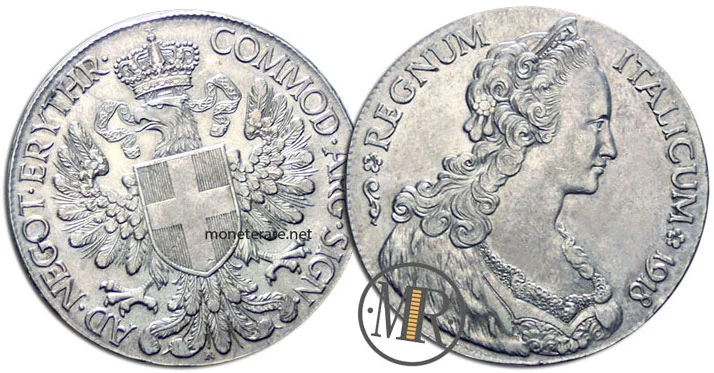
In 1918, an attempt was made to mint a new taller, the Taller of Italy, also known as Italicum.
Description of the Taller of Italy
The Taller of Italy, or Italicum, has a diameter of 40 millimeters and a weight of 28.07 grams, with a silver content of 835/1000.
On the obverse of this coin, there is a bust of a woman facing right, adorned with a three-pendant diadem and ermine. The inscription around the edge reads “REGNUM ITALICUM 1918” and at the bottom is the artist's indication “MOTTI”.
On the reverse, there is a crossed shield on the chest of the Savoy eagle with a Royal crown.
The inscriptions around the edge are “AD • NEGOT • ERYTHR • COMMOD • ARG • SIGN •” and at the bottom left is the mint mark “R”.
History of the Taller of Italy
These Tallers minted by the Kingdom of Italy for trade with the Eritrean colony did not achieve great success.
Due to the differences between the Italicum and the Maria Theresa Taller, the local populations did not accept this new coin, which was in fact minted only in 1918 in 510,000 pieces.
Value of the Taller of Italy
- This coin, the Taller of Italy, is classified as uncommon, and its value can reach high levels in FDC or qFDC. In 2015, one was purchased at a coin auction for over 1,800€!
Italian Maria Theresa Thaler
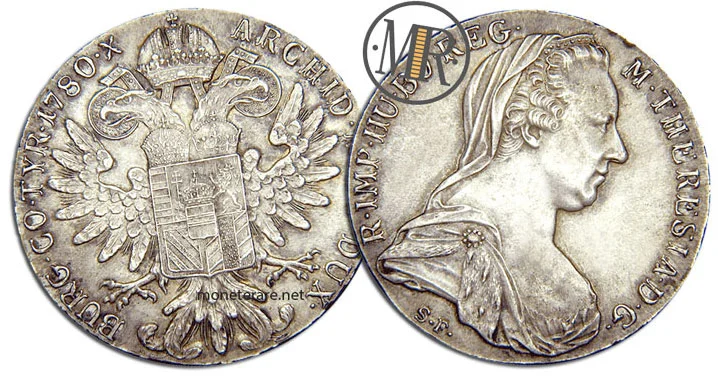
As we have already seen, following the agreements with Austria in 1935, the minting of Thalers resumed for trade with the colonies, this time featuring the same designs as the Austrian Thalers.
Description of the Italian Maria Theresa Thaler
These Thalers minted in Rome differ from those of Vienna by having a higher silver content (835/1000 instead of 833) and a slightly smaller diameter (40 millimeters instead of 42).
On the obverse, the bicorne eagle stands out with the Austrian coat of arms on its chest and the inscription “ARCHID • AUST • DUX • BURG • CO • TYR • 1780 • X” around the edge.
Some differences from the Vienna minting include the configuration of the eagle's tail feathers (one on top, three in the middle, and one on the bottom) and the two outer tail feathers.
On the reverse, the bust depicted is that of Maria Theresa and around it is the inscription “M • THERESIA • D • G • R • IMP • HU • BO • REG •”.
History of the Italian Maria Theresa Thaler
These thalers were minted, as noted, from 1935 until 1950.
In 1961, Italy returned a pair of dies to the Austrian mint while a second pair was moved to the Museum of the Roman Mint.
Value of the Italian Maria Theresa Thaler
- The mintage of these Italian Maria Theresa Thalers, from 1935 to 1939, was 19,446,729 pieces, and this thaler is classified as common.
This makes it a more accessible coin; in BU condition, it can be worth 120€.
The Slovenian Tolar
The last European nation to abandon the use of the Tolar was Slovenia in 2006.
In fact, from January 1, 2007, Slovenia replaced the use of the Tolar (which derives from the German Thaler – Tolar) with the euro, the single European currency.
Description of the Slovenian Tolar
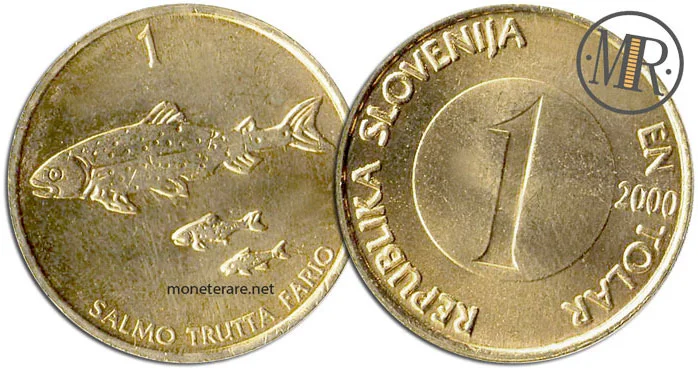
The Slovenian Tolar is a brass coin with a diameter of 22 millimeters and a weight of 4.50 grams.
On the obverse of the 1 tolar coin, the value 1 is inscribed in the center, enclosed in a circle. Around the edge, “REPUBLIKA SLOVENIJA” is written on the left and “EN TOLAR” on the right. Between the words “EN” and “TOLAR,” the year of minting can be seen.
On the reverse of the 1 tolar coin, several specimens of Brown Trout are depicted. At the top is the value 1 and at the bottom the Latin name of the subspecies “SALMO TRUTTA FARIO.”
History of the Slovenian Tolar
In Slovenia, the minting of Talers began in 1991 and continued, as noted, until 2006.
As for the coins, those minted were 1, 2, 5, 10, 20, and 50 tolars, and 10, 20, and 50 stotin, fractions of the tolar.
On the reverse of each of these nine coins, nine typical animals of Slovenia are represented.
These are:
- 10 stotin – Proteus (Proteus anguinus)
- 20 stotin – Common Owl (Asio otus)
- 50 stotin – Bee (Apis mellifera)
- 1 tolar – Brown Trout (Salmo trutta fario)
- 2 tolar – Common Swallow (Hirundo rustica)
- 5 tolar – Alpine Ibex (Capra ibex)
- 10 tolar – Lipizzaner Horse (Equus)
- 20 tolar – European Stork (Ciconia ciconia)
- 50 tolar – Bull (Taurus taurus)
Coins of 100 and 500 tolars were also minted, but they did not have animals depicted on the reverse.
Value of the Slovenian Tolar
The 1 tolar coins minted from 1992 to 2001 and those from 2004 are considered common.
- Rare are those from 2002, 2003, 2005, and 2006, issued only as sets and with a very limited mintage.
These coins, however, do not have a high value in euros, so they are easily purchasable by anyone. - A Slovenian tolar from 2006 is worth about 4€.
How to Recognize a Fake Thaler
Both the Thalers from 1918 and those from Eritrea have counterfeit numismatics.
These fakes can be recognized by various details that a keen numismatist's eye can identify.
The reliefs of the figures and inscriptions are indeed less pronounced than on the original coins, and the weight is also a great indicator.
The Thaler “Italicum” from 1918 weighs 28.07 grams, while the fake weighs only 26.25 grams! The same applies to the Eritrean Thaler. The original weighs 28.12 grams, the fake only 27.30 grams.
So always be careful when purchasing coins and rely on portals that guarantee the quality of the coins.
Where to sell or buy coins
Do you own coins like these, a lot, or a rare piece? Register on Catawiki and place your first bid, or submit a lot for sale — signing up is free. For years we have used this auction site, our partner. Browsing auctions is not enough: start with registration and a first action (a bid or a listing). Register and start.