
Roman Coins
Updated:
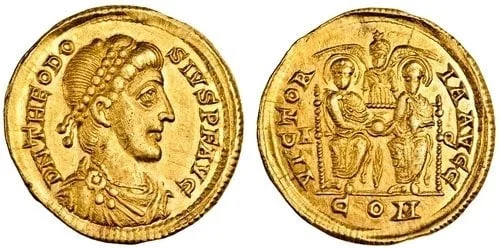
Are you curious about the rarest Roman Coins? On this page, you will discover which Roman Coins are valuable, the most sought after, and the most collected by Rare Coin enthusiasts.
Are you interested in knowing the value of rare Roman coins? On this page, you will find valuable information regarding the birth and history of Roman coins and their current market value.
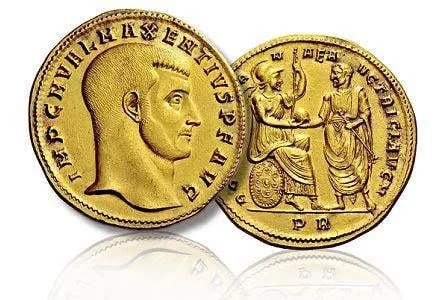
Some coins from ancient Rome are extremely rare as only a limited number of copies are known. An example is the gold medallion of Maxentius, known in only two specimens. Among other extremely rare Roman coins, we can also include the Gold Solidus of Emperor Theodosius I, available in more than splendid condition for €13,500.
Roman Coins: The Pre-Minting
Since the origins of Rome, trade and exchanges with other Mediterranean peoples made a practical innovation necessary to facilitate these transactions.
Initially, at the dawn of Rome's history, the most common method of exchange was barter, where goods were exchanged for other goods of equal value.
Roman Coins: Aes Rude
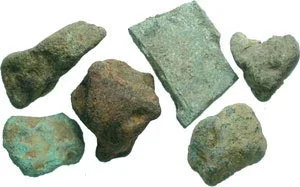
The first form of coinage was actually a sort of “updated barter,” where goods were paid for with fragments and scraps of metal (usually bronze) called Aes rude. They were not classic coins and did not have a defined shape. Their value was determined by the value and weight of the metal itself.
Roman Coins: Aes Signatum
Subsequently, the use of Aes signatum was adopted. These were pieces of bronze with a defined shape, either round or rectangular. They bore the value and some symbols indicating the authenticity and authority of the issuer.
The oldest Aes signatum show a few irregular traits resembling a dry branch or a fish spine. They were probably just grooves to facilitate the escape of gases during the pouring into the mold.
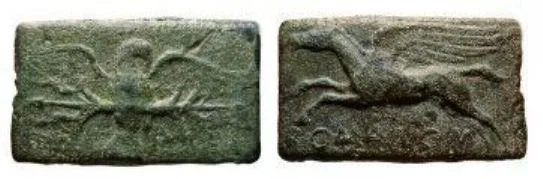
Both Aes rude and Aes signatum had a very variable weight (from 3 Kg to 3-400 grams) and are often found broken into fragments.
The next step for the “birth” of Roman coins was the minting of the so-called Aes Grave. These were heavy round metal coins that began to circulate in the early days of the Republic.
Like the Aes signatum, the Aes grave also displayed on both sides the value of the coin itself and representations of deities and other symbols, and can be considered as the first ancient Roman coins.
Roman Republican Coins
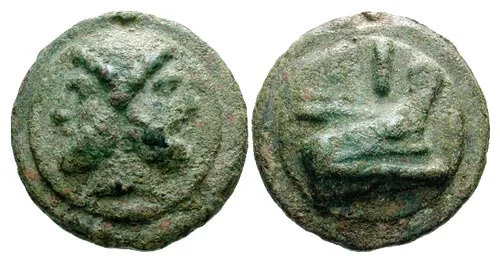
With the advent of these first Roman coins, there was a differentiation between different “denominations”.
Roman Coins: the As
The as was the ancient Roman coin of greater value and weight. Initially, an as weighed 273 grams, a weight that, over time and following various monetary reforms, saw a substantial decrease.
Roman Republican Coins Struck
If at the beginning a Roman as weighed 273 grams (one Latin pound) or 327 g (one Roman pound), it was reduced to half a Roman pound, that is, 163.5 g already in the second half of the 3rd century BC. It subsequently weighed 54.5 g after the reform of 214 BC. In 209 BC, it weighed 27.25 g. The last reform brought the weight of an as to 13.6 grams.
However, the value of the as remained unchanged despite the progressive decrease in weight. The value of coins that were fractions or multiples of the as also remained unchanged.
Roman Coins: Multiples and Fractions of the As
Roman coins of weight and value multiples of the as were: the dupondius (2 asses), the tripondius (3 asses), and the decussae (10 asses).
These are the Roman coins that were fractions of the as: the semis (½ as), the trient (1/3 as), the quadrans (¼ as), the sextans (1/6 as), the uncia (1/12 as), and the semuncia (1/24 as).
In the series of the oldest Roman coins, one side of the coin depicted the bow of a ship. On the other side, there was the profile of a deity. (Janus, Jupiter, Minerva, Hercules, Mercury, etc.).
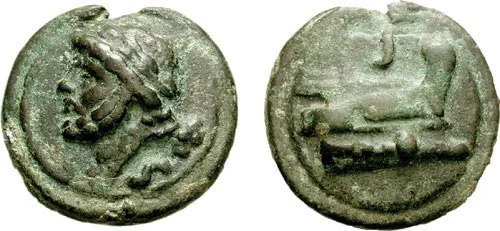
Other themes represented were pastoral and related to the simple life of the time. Republican coins can be found with the shell, the boar, the dolphin, etc.
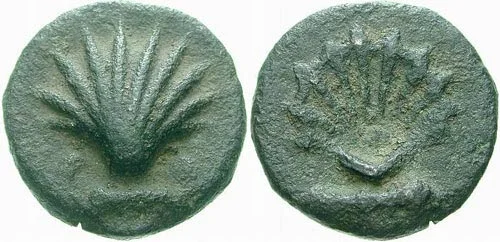
Given their antiquity, these coins, if well preserved, can currently reach a very high value, from 30 to 200 euros.
All these were coins obtained by casting in molds, but with the expansion of trade with Magna Graecia, Rome began minting coins of precious metal struck by hammer.
Struck Roman Republican Coins
The first struck Roman coins are known as Roman-Campanian coins, as they were issued in the name of Rome and most likely minted in Campania by Greek-Campanian artisans.
They were primarily used for trade with Magna Graecia. In fact, the style of these coins from Republican Rome closely resembles that of Greek coins.
Roman Coins: Didrachm
The first Roman Republican silver coin to be minted was the Didrachm, that is, a double Dracma. It depicted Mars with a Corinthian helmet on one side and a horse protome with the inscription “ROMANO” on the other, indicating that it was minted outside the city but on behalf of the Romans.
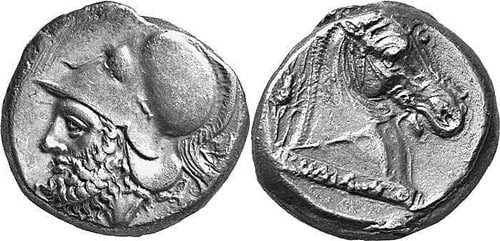
Subsequently, many other figures were added to that of Mars, such as Apollo, Hercules, Minerva, personified Rome, and the ever-present Janus.
The current value of a didrachm in good condition can be very high and exceed 500 euros.
Roman Coins: the Denarius
Around 211 BC (although this dating is still controversial), the denarius appeared, which would become the main Roman coin until the time of Constantine, when it ceased to be minted.
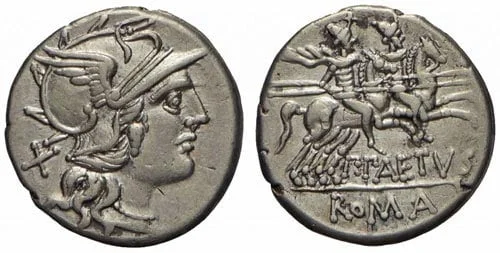
The weight of the first denarii was approximately 4.55 g. This Roman coin displayed the head of Rome with a helmet on the obverse and the Dioscuri on horseback with the inscription “ROMA” on the reverse.
These coins of old Rome can currently have a value starting from 50 euros and exceeding 200 euros.
Roman Coins: Fractions of the Denarius
Roman coins were then introduced as fractions of the Denarius such as the quinarius (½ denarius) and the sestertius (¼ denarius). Both were made of silver and were minted sporadically during the Roman Republic.
Some gold coins were also minted sporadically during the Republic under the names of stater and half stater. But it is with the birth of the Roman Empire that they began to be issued regularly.
Imperial Roman Coins
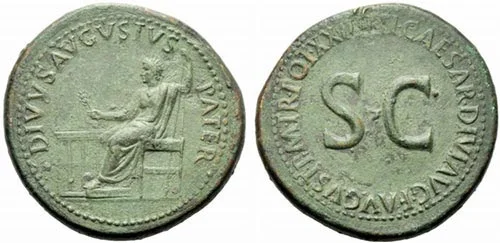
During the imperial period, the first coin was issued by Augustus. In 15 BC, he entrusted the emperor with control over the minting of Roman coins in gold and silver. The minting of lesser denominations was delegated to the Senate.
Roman Coins: the Aureus
The aureus (1/42 of a Roman pound, approximately 7.78 g) was the gold coin on which the series of coins of imperial Rome was based. It had as a multiple the quaternary (4 aurei) and as a submultiple the quinarius (½ aureus).
The denarius and the quinarius also remained in use. For lesser denominations, the as, the dupondius, and the sestertius were preserved, minted in less noble metals such as bronze, copper, and orichalcum.
On the lesser value imperial Roman coins, from the First Empire until the mid-3rd century AD, the abbreviation “S C” appeared. It meant “Senatus Consultum” indicating the Senate's control and approval of the issuance of these Roman coins.
The current value of an aureus, depending on its condition and rarity, can reach very high figures, from €2,000-3,000 up to €7,000.
For example, an aureus “pietas augusti” in splendid condition of Emperor Gordian III is valued at €7,000.
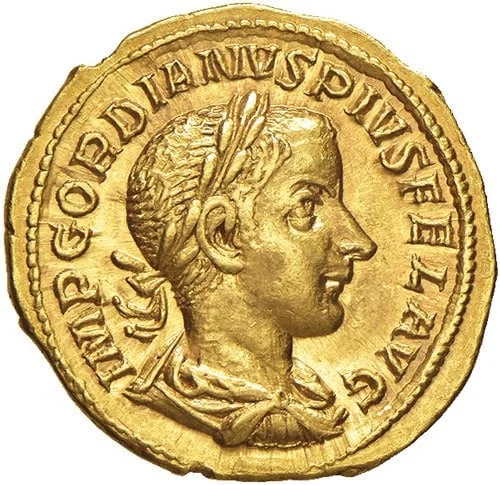
During the Empire, the aureus and the denarius experienced a progressive devaluation. The actual amount of precious metal contained in Roman coins decreased. Eventually, a monetary crisis ensued following the reform of the Roman Emperor Caracalla in 215.
Rare Coins of Imperial Rome
The rarest known imperial Roman coin is perhaps the gold medallion of Maxentius, known in only two specimens. One specimen of this extremely rare Roman coin was sold at auction on April 5, 2011. The price? It was sold for the astronomical sum of $1,407,550.
The Legislation for Rare Roman Coins
Currently, Italian legislation allows the collecting and trading of ancient and rare Roman coins. This requires many precautions, including the issuance of certificates of authenticity and the certification of lawful and non-illegal provenance of the coins themselves.
Archaeological research and therefore the on-site search for ancient and rare Roman coins in Italy is prohibited for private individuals and allowed only for archaeologists engaged in authorized research and excavations.
In the event that you happen to accidentally discover, during fieldwork or while using a metal detector (the use of which is permitted but strictly regulated and not allowed in archaeological sites or sites of archaeological significance), how should you behave?
Italian law requires you to immediately report the discovery to the competent authorities (Superintendency of Cultural Heritage, Municipality of discovery, Carabinieri, etc…) and also prohibits removing them from the site of discovery, so that archaeologists can carry out all necessary surveys.
We have discussed the current regulations on rare coins on this page.
Roman Coins Where to Find Them?
If you are looking for ancient and rare Roman coins and are wondering, “where to find them?” The best solution is to turn to numismatic dealers or numismatic auction sites that guarantee authenticity and legal provenance. We recommend reading this page where we explain exactly how to sell or buy rare coins. Or you can click here and register directly (it's free) on the largest numismatic auction site in Europe.
Didn't find what you were looking for? Check these topics:
- To learn everything about the Gold Pound, click here.
- If you are looking for Rare Euro Coins then click here.
- If you want info on the Ancient Greek Coin and its value, you can find it here.
- The Rare Lire and their great value have been discussed here.
- We talked about the Value of Phone Tokens on this page.
- To Sell or Buy Rare Coins online, read these tips.
- All information about 500 silver lire can be found here.
Where to sell or buy coins
Do you own coins like these, a lot, or a rare piece? Register on Catawiki and place your first bid, or submit a lot for sale — signing up is free. For years we have used this auction site, our partner. Browsing auctions is not enough: start with registration and a first action (a bid or a listing). Register and start.