
How to Recognize Fake Coins and Fake Euros.
Updated:
Have you ever wondered how to recognize fake coins? We will discuss it right here because if you are lucky enough to find yourself with a rare euro coin, such as one of the commemorative €2 coins from the Vatican or Monaco, you need to ensure that it is not a fake coin.
We will not talk about old coins like fake Greek coins (there are plenty of them) or Roman coins or those of the lira. We will talk about Euro coins.
In fact, whether we are starting to collect euro coins or if we already have a large Euro collection of coins and are searching for the rarest and most expensive pieces, we need to know how to recognize fake euro coins.
The reason is simple and obvious. A fake coin is a piece that we cannot use, collect, or sell. So practically, if we have purchased one or more fake coins, we have fallen for what is called in Rome a “sola,” a scam.
It's not a big deal if the coin in question is a euro that we found in our pocket after getting change at the supermarket. It's more serious if it is a piece that we have searched for and bought at a high price.
In this regard, we always like to remind you that if you want to buy or even sell coins online, the safest way is what we have explained on this page: where to buy and sell rare coins. You can read in detail the guides we have provided on how to buy rare coins or also on how to sell rare coins online.
Looking for this guide in German? See the German edition on MoneteRare Deutschland.
Counterfeit Coins among Euros and Fake €2 Coins
Even though Euros, both coins and banknotes, are equipped with sophisticated security systems to make copying and counterfeiting impossible or at least difficult, we must keep our eyes open and never let our guard down.
Counterfeiters who learn how to make fake coins must be able to replicate the coins as closely as possible, circumventing these systems that we will describe.
This is because, as enthusiasts and numismatists, we cannot afford to work with fake pieces that have no value.
It should be noted that Euros are one of the most secure coins in the world from a counterfeiting perspective. In practice, it is very difficult to counterfeit them, as you can also read on the official website of the European Central Bank.
This does not mean that there are no fake pieces in circulation. In fact, there are, especially the €1 and €2 denominations are the most subject to counterfeiting.
For this reason, it is truly important to know how to recognize fake Euros when someone gives us one, whether it is a banknote or a coin, otherwise we receive something that has no value.
Finding counterfeit coins with the comparison coin.
This article specifically discusses counterfeit euro coins and not banknotes, which have different anti-counterfeiting security systems.
A good practice to recognize a genuine coin from a counterfeit is to compare the two coins, the one you are sure is genuine with the one you suspect is counterfeit.
To do this, we use the so-called “comparison coin,” which is simply a coin of the same value and type that we are certain is genuine.
So we ask ourselves, how can we be sure that a coin is genuine?
The next chapter will clearly explain how to recognize a counterfeit coin from a genuine one and how to carry out an accurate check of counterfeit coins.
Checking Security Features
Okay, you've come across a Euro coin and have a doubt; you suspect that the coin might be fake. What to do?
Perform a systematic check of all the security features of the coin. There are 3, and you must check all three, not just one.
These procedures for checking fake coins have been made really easy and applicable by anyone, without the need for special tools, and in order they are: TOUCH, OBSERVE, CHECK.
There is a similar procedure for Euro banknotes, which you can find on this page: banknote security check.
Touch the Coin
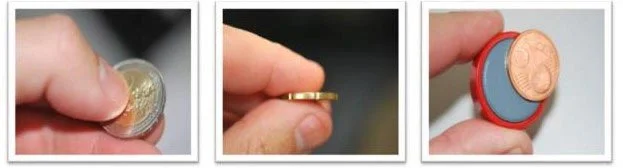
Hold any Euro coin in your hand and, with your eyes closed, try to feel its faces with your fingers.
You will notice that the reliefs of the coin can be felt well to the touch, and these reliefs are clearly different from the rest of the surface.
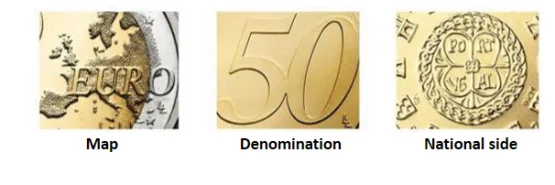
In particular, on Euro coins, the map (map) and the denomination (denomination) are always raised on the common side. On the national side, the design is always raised.
Observe the Coin
First, observe the edge of the coin, perhaps using a magnifying glass for a better view. The edges have different characteristics in size, thickness, and shape for each denomination of coins.
In general, the outer edge is always raised, uniform, and well-defined.

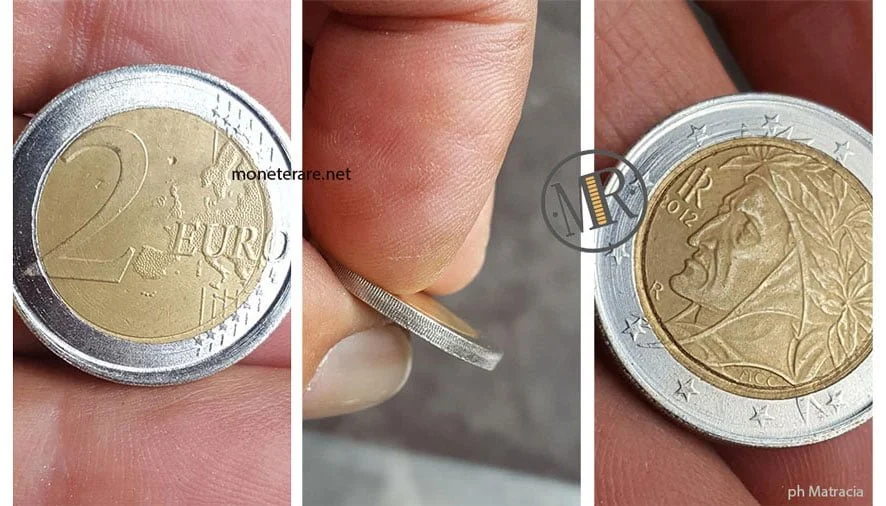
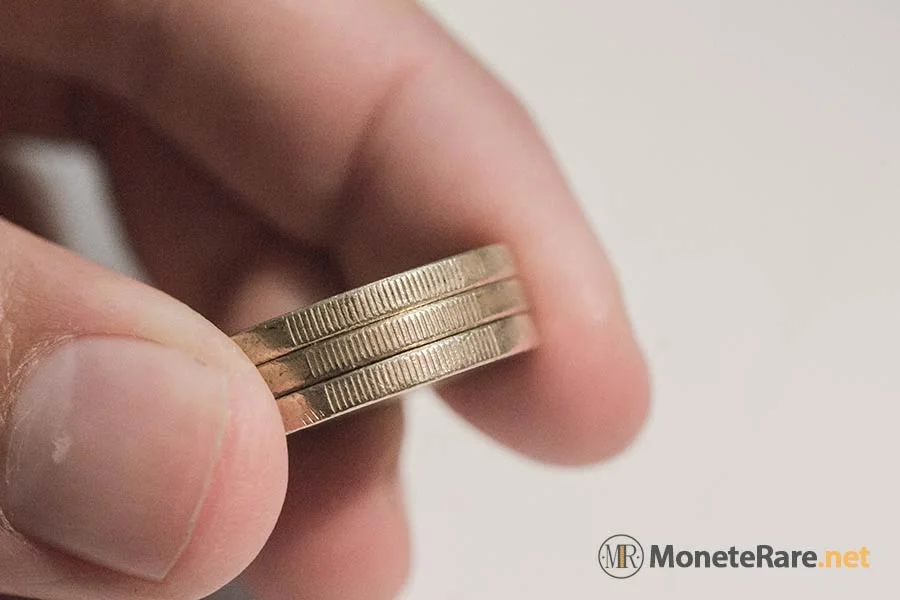
Inscription on the edge: still using a magnifying glass, you can proceed to check the inscription on the edges of the two-euro coins. You will notice a raised, well-defined, and uniform edge milling. The inscription on the edge features characters or symbols that vary based on the country that issued the coin.
It goes without saying that if you find a coin with an edge different from that in the photo above, it is fake. This often happens with fake 2 euro coins, which often do not reproduce the original edge with the value (which is indeed on the edge interspersed with stars).
Edge alignment: if you try to align two or more 2 € coins or even with 1 euro coins with the same national side, you will notice that the letters and symbols on the edges align perfectly.
Align the coins and observe both edges. The raised spaces and the smooth spaces will also be perfectly aligned.
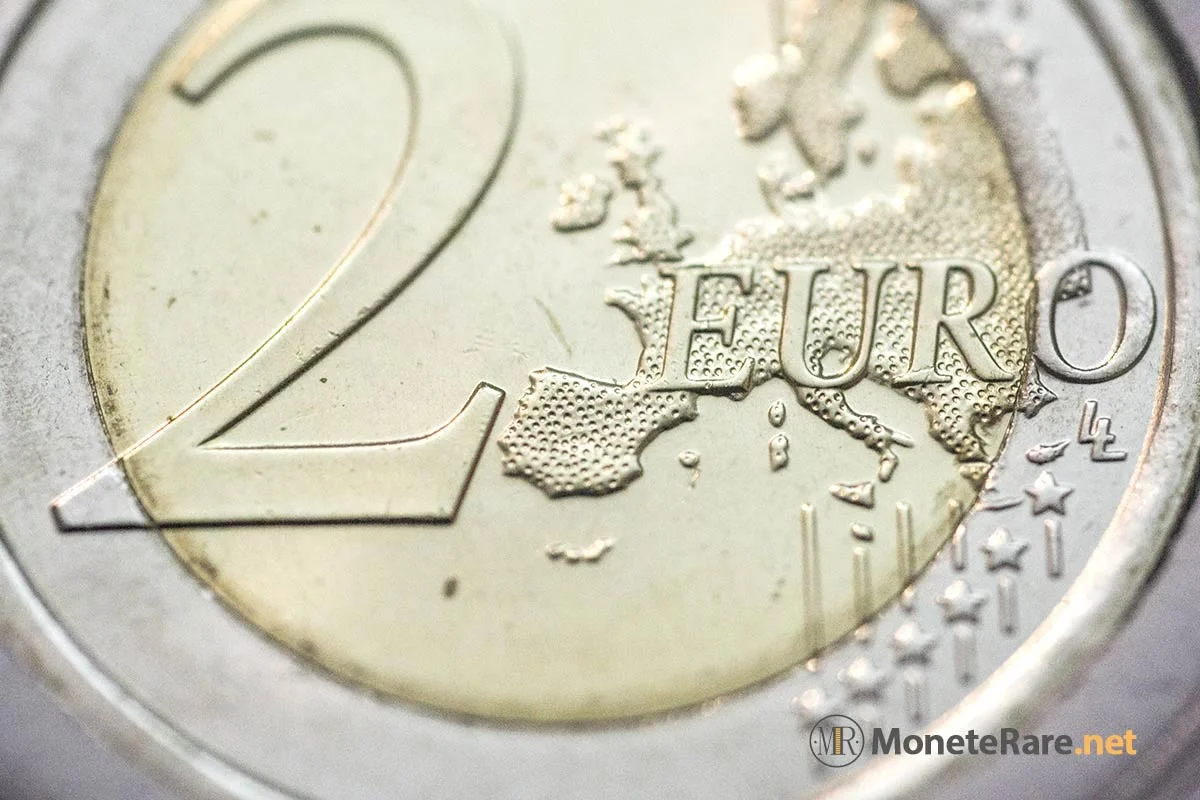
Micro dots: the maps of the European Union on the common side of the one and two euro coins are depicted in negative relief. Always using a magnifying glass, you can easily notice that they are also composed of tiny dots that are difficult to replicate.
The dots are easily noticeable on lightly circulated coins. On others, those that have entered circulation, the dots wear down significantly and are much harder to notice. A good magnifying glass is needed to see them.
Check the Coin
Checking for fake coins is a simple procedure that you can do at home by yourself with the simple aid of a magnet because it all relies on magnetism.
Magnetism is one of the characteristics and physical properties of the materials that make up the coins and helps us determine their authenticity. If you use a simple magnet, you can easily check and verify the magnetic properties of each coin, which differ from one another.
The 1 and 2 Euro coins that are bimetallic have a slightly magnetic inner part and a non-magnetic outer part. Therefore, if the coin is authentic, the magnet will only stick to the inner part.
The 10, 20, and 50 cent Euro coins have no magnetic properties. It goes without saying that if you find one of these coins that is attracted to the magnet, then it is fake. The 1, 2, and 5 cent Euro coins are made of very magnetic material, so the magnet easily attracts them.
How to recognize fake 2 euro coins.
If you have read above, you will certainly understand how to recognize fake 2 euro coins. Fake 2 euro coins can be immediately identified through the magnet test, to see if the inner part attracts the magnet and the outer part does not. An additional test to perform on fake two euro coins is the edge alignment test.
Frequently asked questions
How to recognize a fake €2 coin?
Check the weight and diameter, perform the magnet test, verify the minting marks (edge lettering), and compare with an authentic coin. Fakes often have imprecise details and unusual colors.
How to tell if a euro coin is fake?
Use touch tests (relief), light tests (halo on the cents), and compare with genuine coins. For €2 coins, also check the reeded edge and the crown of stars.
Where to sell or buy coins
Do you own coins like these, a lot, or a rare piece? Register on Catawiki and place your first bid, or submit a lot for sale — signing up is free. For years we have used this auction site, our partner. Browsing auctions is not enough: start with registration and a first action (a bid or a listing). Register and start.