
500 Italian Bimetallic Lire
Updated:
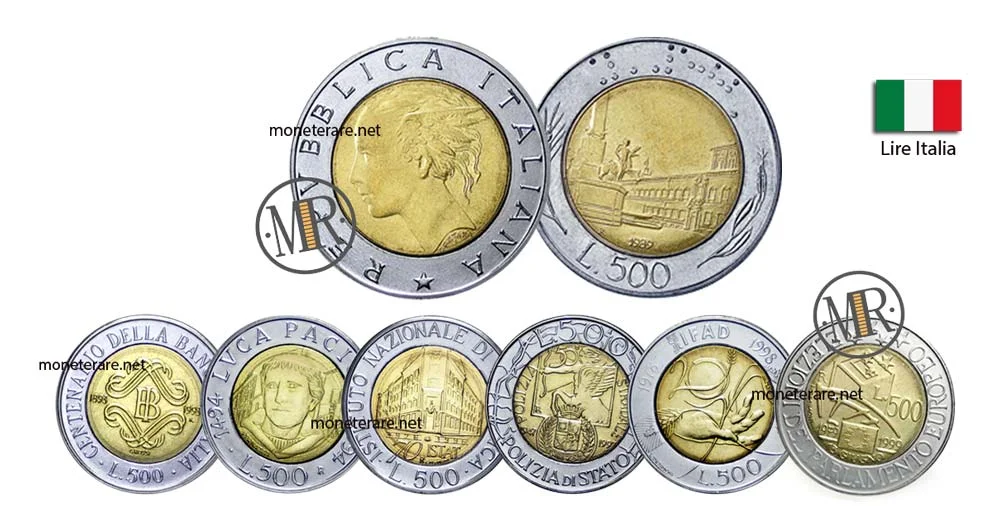
Are you curious to know everything about the 500 bimetallic lire coins? Then you are in the right place! In this article, we will try to describe everything there is to know about these 500 lire coins from the Italian Republic that many of us remember with nostalgia. We will also discuss the value of the 500 lire coins and, of course, if there are any rare 500 lire coins.
We will also look at the various commemorative 500 lire that have been minted over the years, up to 2001 when the 500 bimetallic lire, like the other lire, were replaced by the euro.
History of the 500 Lira Bimetallic Italy
We all remember having held the 500 bimetallic lira in our hands, but few know that this coin, so common to us, brought several innovations in the way coins are minted.
First of all, when it was issued in 1982, the 500 lira coin was the first bimetallic coin ever minted, thanks to a technology developed by the Italian Mint that later spread to other countries. We can therefore boast a WORLD LEAD that revolutionized the coin production process, making it harder to imitate. This new method, devised by Nicola Ielpo, was studied to combat counterfeiting of coins, at least those with the highest face value.
Moreover, the 500 bimetallic lira coin was also the first coin to feature, on the outer ring, the value of L.500 in Braille to facilitate its use for visually impaired individuals. Another important milestone is the female signature, as for the first time in the history of Italian Numismatics, a woman is the author of the engravings. The signature belongs to Laura Cretara, born in 1939.
Composition of the 500 Lira Bimetallic Coins
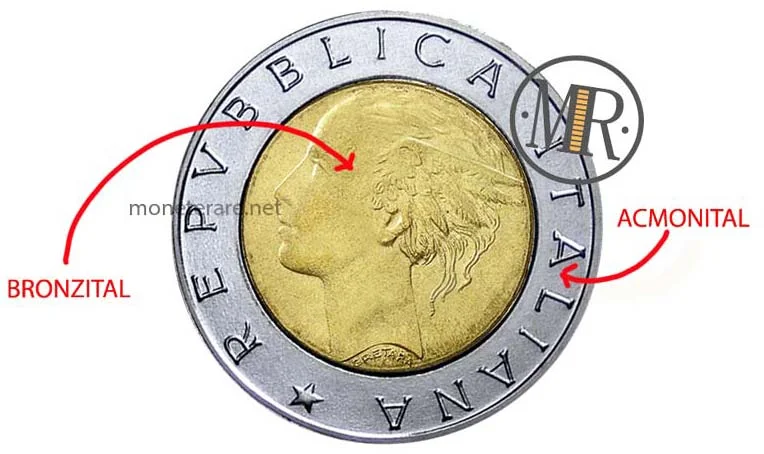
Perhaps those of you who, like me, were born in the 1980s have wondered as children: “But are they made of gold and silver?”
I'm sorry to disappoint our childhood dreams, but no. The two metals that make up the outer ring and the central disc of the 500 Lira bimetallic coins are not actually pure metals but alloys of different metals used to mint coins in Italy since 1939. So let's see what these alloys are:
The outer ring of the 500 Lira bimetallic coins is an alloy made of iron, chrome, and nickel, with small percentages of molybdenum and vanadium, known as Acmonital.
Acmonital is actually the abbreviation for “Italian monetary steel” and has been used to mint a wide variety of coins. In addition to the 500 Lira bimetallic coins, it was also used for the 50 Lira and 100 Lira of the Italian Republic, some 20 centesimi and 50 centesimi coins, and 1 and 2 Lira coins of the Kingdom of Italy, as well as for the 0.2 and 0.5 and 1 and 2 Lek of Italian Albania.
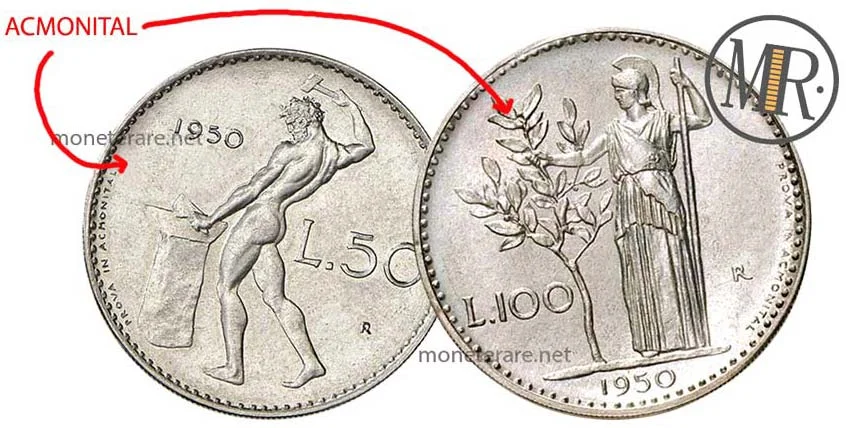
There are different types of Acmonital and initially, the coins were minted with amagnetic acmonital, but starting from 1940, ferromagnetic acmonital was used, with a lower percentage of nickel.
The outer ring of the 500 Lira bimetallic coins is therefore made of ferromagnetic acmonital. As for the central part of the 500 Lira bimetallic coin, it is also an alloy similar to bronze, called Bronzital. In particular, Bronzital is an alloy of copper and aluminum to which, since 1968, a small percentage of nickel has also been added.
In Italy, in addition to the central part of the 500 Lira bimetallic coins, it has also been used for the 20 and 200 Lira coins and for the outer part of the 1000 Lira coins of the Italian Republic.
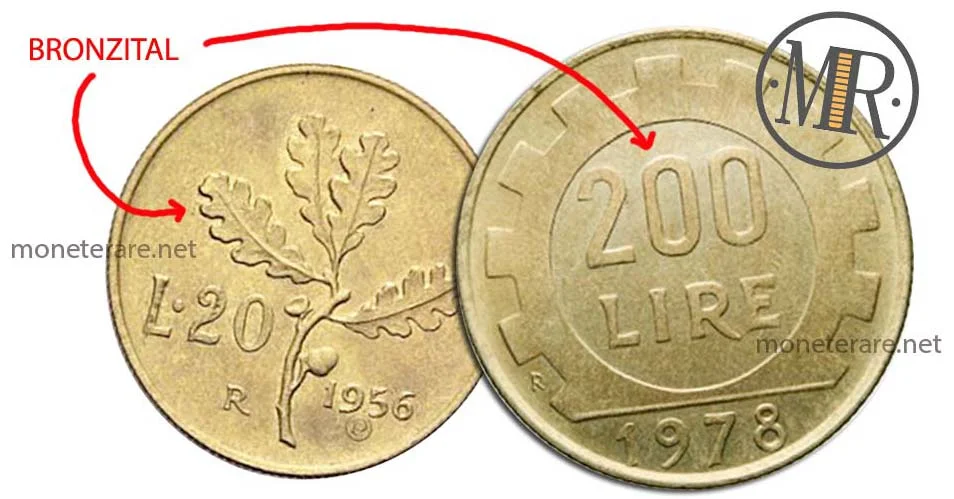
Even the 5 and 10 centesimi of Lira minted during the Fascist period were made of Bronzital.
In general, the 500 Lira bimetallic coins have the following characteristics:
- they weigh 6.8 grams
- they have a diameter of 25.8 millimeters
- they have a grooved edge with discontinuous sections
- the type of coin is Bimetallic
- they were made of Bronzital (core) and Acmonital (ring)
- they were minted from 1982 to 2001
500 Italian Bimetallic Lire – Quirinale
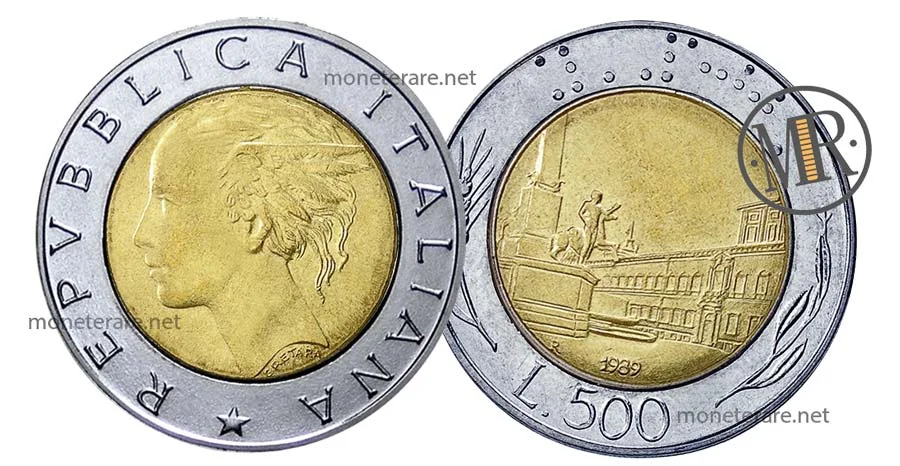
The first 500 Bimetallic Lire coin of Italy was minted in 1982 and subsequently every year until 1992, then again in 1995 and finally in 2000 and 2001 when they were withdrawn from circulation due to the arrival of the euro. From 1985 until 2001, it was also minted in proof in a special packaging for collectors.
On the obverse of the 500 bimetallic lire coin, there is a winged female head facing left, representing the Italian Republic. Below, under the neck of the figure, is the signature of the author, and on the outer part, there is a five-pointed star and the inscription Repubblica Italiana.
On the reverse, there is a depiction of the Quirinale Square with the year of minting at the bottom and to the left of it the mint mark R (Rome). On the outer ring, the value of the coin is shown, as we have also seen in Braille characters, between a ear of wheat and an olive branch.
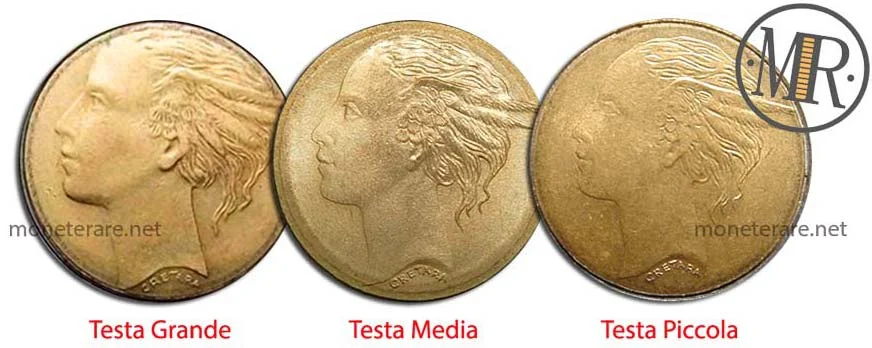
Over time, the female profile on the obverse of the 500 bimetallic lire coin has undergone slight dimensional variations, resulting, depending on the year of minting, in being a bit larger or a bit smaller, thus giving rise to the three variants of 500 bimetallic lire: “large head”, “medium head” and “small head”.
There are also variants of the 500 bimetallic lire called “small signature” and “large signature” depending on the size of the author's signature, Laura Cretara.
Value of the 500 bimetallic lire
Are you curious to know the value of the 500 bimetallic lire coins you found at home?
Well, generally speaking, being a very common coin (the mintage is 1,816,300,000 pieces), the value of a 500 bimetallic lire FDC is around €3 or €4 for those from 1995.
As we have seen, however, there are some variants that reach slightly higher prices.
- For example, the 500 bimetallic lire minted in 2000 and 2001, being fewer in number (classified NC), can reach €10.
- Classified as NC are also the 500 bimetallic lire of 1991 in the “small head” variant, which can be worth €15, while the “large head” variant from the same year is worth only €3.
- In 1987, two variants were minted, one classified C with “medium head and large signature” which can be worth €3, another classified NC with “medium head and small signature” which in FDC can reach €40.
- Also in 1985, two variants were minted: “medium head and large signature” classified C which reaches €3 and “medium head and small signature”, NC, which can reach €25 (these are the rarest 500 lire coins).
Table with Prices and Mintages
Below is the table with the rarity, mintage, and value of each Italian 500 lire bimetallic coin. All coins were minted at the Rome mint.
| Year | Rarity | Price (BU) | Mintage |
|---|---|---|---|
| 1982 Medium head | CC | 3€ | 162,026,000 + 120,000 BU |
| 1983 Medium head | CC | 3€ | 138,000,000 + 76,000 BU |
| 1984 Medium head | CC | 3€ | 162,000,000 + 77,000 BU |
| 1985 Medium head – Large signature | CC | 3€ | 162,000,000 + 75,000 BU + 15,000 Fs |
| 1985 Medium head – Small signature | NC | 25€ | – |
| 1986 Medium head | CC | 3€ | 165,000,000 + 73,200 BU + 17,500 Fs |
| 1987 Medium head – Large signature | CC | 3€ | 200,000,000 + 57,500 BU + 10,000 Fs |
| 1987 Medium head – Small signature | NC | 25€ | – |
| 1988 Large head | CC | 3€ | 142,000,000 + 51,000 BU + 9,000 Fs |
| 1989 Large head | CC | 3€ | 155,000,000 + 51,200 BU + 9,260 Fs |
| 1990 Large head | CC | 3€ | 130,000,000 + 52,300 BU + 9,400 Fs |
| 1991 Large head | CC | 3€ | 140,000,000 + 54,000 BU + 11,000 Fs |
| 1991 Small head | NC | 15€ | – |
| 1992 Small head | CC | 3€ | 130,000,000 + 52,000 BU + 9,500 Fs |
| 1995 Medium head | CC | 4€ | 110,000,000 + 44,558 BU + 7,960 Fs |
| 2000 | NC | 10€ | 61,400 BU + 8,960 Fs |
| 2001 | NC | 10€ | 115,250 BU + 10,000 Fs |
The 500 Lire Commemorative Italian Republic
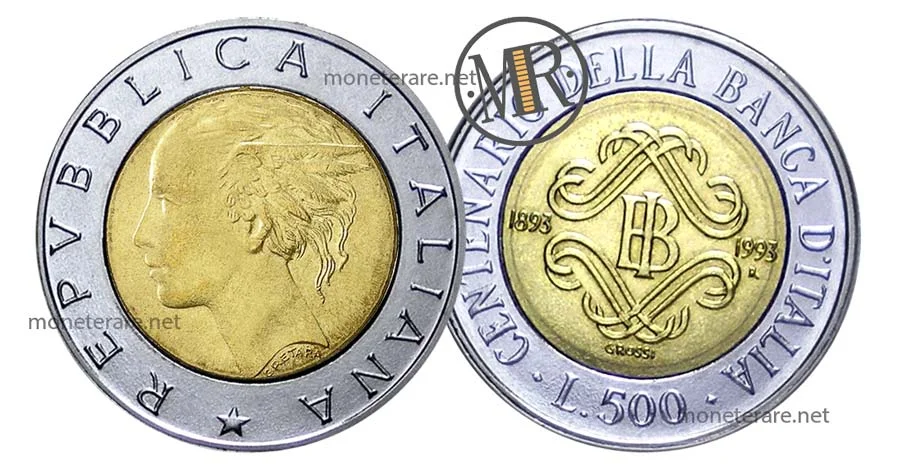
In addition to the coin from the Quirinale, 6 different Commemorative coins were minted in the years: 1993, 1994, 1996, 1997, 1998, 1999. Now let's take a closer look at all the 500 lire Commemorative Bimetallic coins from Italy.
500 Lire 1993 – Banca d’Italia
The first of the 500 lire bimetallic commemorative coins was minted in 1993 to celebrate the centenary of the Banca d’Italia.
Description 500 Lire Italian 100° Banca d’Italia
Like the other 500 lire bimetallic coins, these are also made of Acmonital and Bronzital.
On the obverse, the female profile of the Italian Republic appears, with the signature of Laura Cretara under the neck.
On the reverse, the inscription reads, on the outer ring, CENTENARY OF THE BANK OF ITALY and the value L.500. In the central part of the reverse of these 500 lire bimetallic coins, there is the monogram of the Banca d’Italia, the dates 1893 and 1993, the mint mark R of the Rome mint, and the signature of the designer Sergio Grossi.
There are two known variants of this 500 lire bimetallic coin commemorating the 100th anniversary of the Banca d’Italia.
- The 500 lire of the first type has a slightly larger design of the monogram and the signature “Grossi” is smaller.
- While the 500 lire 100° Banca d’Italia of the second type has a small monogram design and a large signature.
Some specimens of these 500 lire bimetallic coins are known to have a minting defect due to wear, showing the dates 893 – 1993.
Value 500 Lire 100° Banca d’Italia
Both types of 500 lire bimetallic commemorative coins of the 100° Banca d’Italia are classified as CC and therefore do not reach very high prices.
- 500 Lire Banca d'Italia 1993 of the 1st type in BU condition can be worth 3 €
- The 500 Lire Banca d'Italia 1993 of the 2nd type only 2 €.
500 Lire 1994 – Luca Pacioli
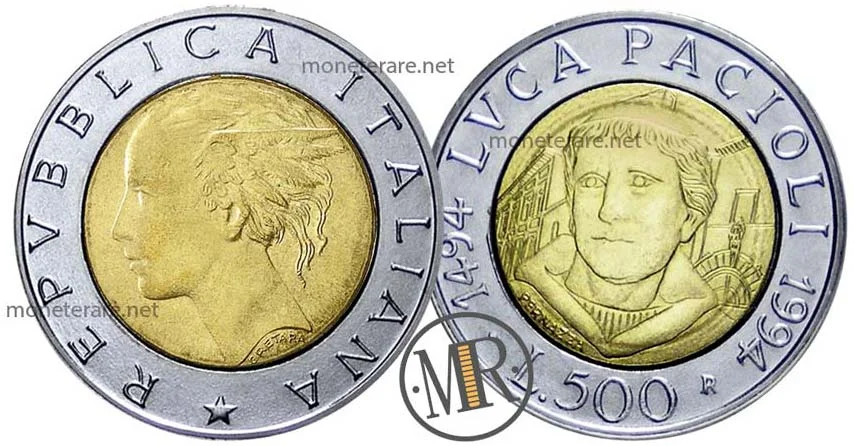
In 1994, a new version of 500 lire bimetallic Italian was minted to commemorate the 500th anniversary of the publication of “Summa de arithmetica, geometria, proportioni et proportionalità” by Luca Pacioli.
Fra Luca Bartolomeo de Pacioli is recognized as the founder of accounting; he was an Italian mathematician, economist, and religious figure, famous for developing the accounting method known as “double-entry bookkeeping.”
Description 500 Lire Italian 500° Luca Pacioli
On the obverse, the usual female profile appears.
On the reverse of these 500 lire bimetallic commemorative coins, there is a bust of Fra’ Paccioli with architectural elements from Sansepolcro, his hometown, and the signature of Uliana Pernazza, the designer of the reverse, at the bottom left.
On the outer circular crown of these 500 lire bimetallic coins, still on the reverse, we find the inscription 1494 LVCA PACIOLI 1994 and the value L.500.
Authors: Laura Cretara (Obverse), Uliana Pernazza (Reverse)
Value 500 Lire 500° Pacioli
- These 500 lire bimetallic commemorative coins Italy Luca Pacioli are classified as common, therefore their value, even in BU condition, reaches about 5 €.
500 Lire 1996 – ISTAT
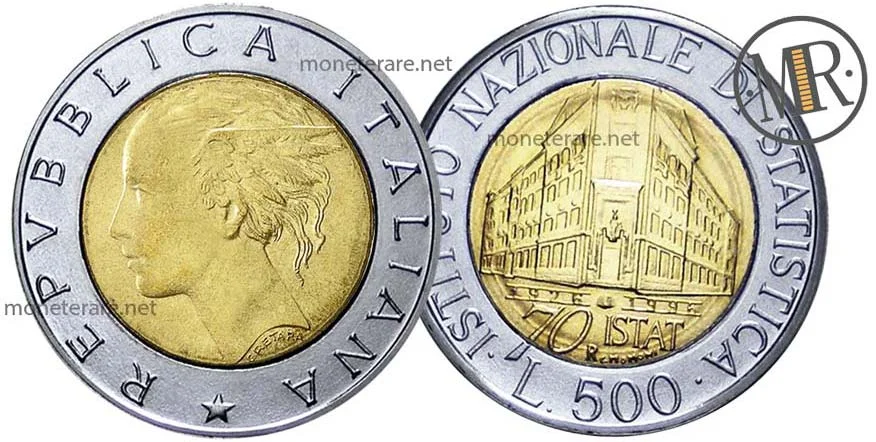
We then had to wait until 1996 for a new minting of 500 lire bimetallic commemorative coins. The occasion for this emission was the 70th anniversary of the founding of the Istituto Nazionale di Statistica.
Description 500 Lire Italian 70° ISTAT
As with the other 500 lire bimetallic coins, the figure on the obverse remains unchanged. On the reverse, in the central portion of the coin, there is a perspective representation of the building housing the Istituto Nazionale di Statistica.
Below the building, the dates 1926 and 1996 are inscribed, and even lower “70 ISTAT”, the mint mark, and the signature of the author Claudia Momoni. On the outer rim, it is written ISTITUTO NAZIONALE DI STATISTICA and L.500.
Authors: Laura Cretara (Obverse), Claudia Momoni (Reverse)
Value 500 Lire ISTAT
- These 500 lire bimetallic commemorative coins Italy, ISTAT, are also classified as common, so their value is around 3€.
500 Lire 1997 – 50° Polizia Stradale
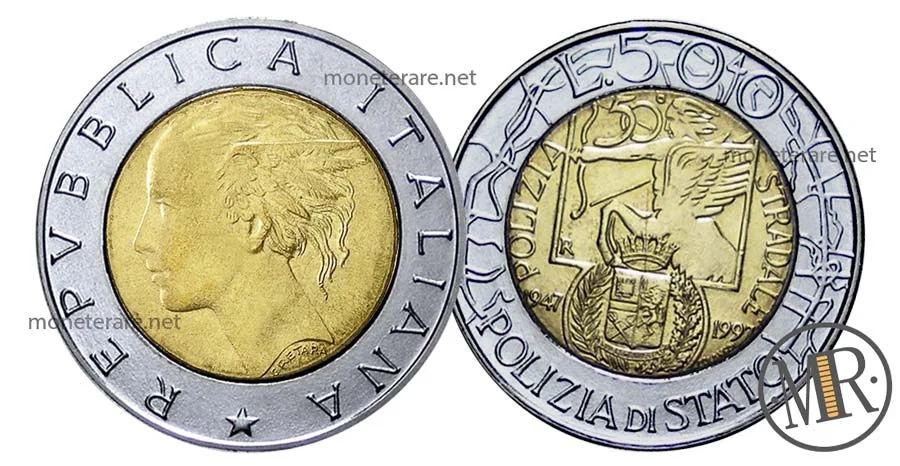
In 1997, on the occasion of the fiftieth anniversary of the creation of the Polizia stradale, a commemorative 500 lire bimetallic coin was minted.
Description 500 Lire Italian Polizia stradale
As with the other 500 lire bimetallic coins, the obverse remains unchanged, while the reverse is much more intricate.
In the inner circle made of Bronzital on the reverse, we find at the top a panel with the centaur (symbol of the Polizia stradale), the mint mark R in the bottom left corner, and “50°” in the top left. Below the panel is the coat of arms of the Polizia stradale between the two dates 1947 and 1997, while at the edges of the inner circle is the inscription “POLIZIA STRADALE”. Finally, in the bottom right is the signature of the reverse designer Maria Carmela Colaneri.
On the Acmonital crown, we find at the top the value L.500 superimposed on a road grid, and at the bottom “POLIZIA DI STATO”.
Authors: Laura Cretara (Obverse), Maria Carmela Colaneri (Reverse)
Value 500 Lire Polizia Stradale (50° Anniversary)
- The 500 lire Polizia stradale of the Italian Republic, minted in 1997 to celebrate the 50th anniversary of the foundation of the Polizia stradale, are classified as common and are worth a maximum of 3€.
500 Lire Bimetallic Italy 1998 – IFAD
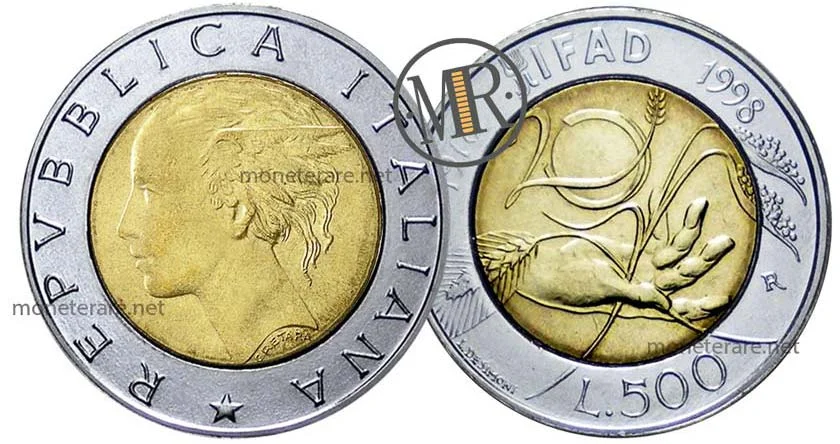
We only had to wait until 1998 for a new commemorative 500 lire bimetallic coin to be minted in Italy to celebrate the twentieth anniversary of the International Fund for Agricultural Development, namely IFAD (International Fund for Agricultural Development).
Description 500 Lire Italian 20° IFAD
On the obverse, as always, the female profile of the personification of the Italian Republic. On the reverse of this 500 lire coin, a hand holding a spike of wheat and one of sorghum is depicted, topped by the logo of the 20th anniversary of IFAD.
On the outer circle, we find the signature of the author Luciana De Simoni at the bottom left, followed by the value L.500 and the mint mark. At the top, the mark and the inscription IFAD are contained between the dates 1978 and 1998.
Authors: Laura Cretara (Obverse), Luciana De Simoni (Reverse)
Value 500 Lire IFAD (20° Anniversary)
- With a mintage of 100,000,000 specimens, the 500 lire bimetallic 20° IFAD coin is classified as C and can be worth, if in BU condition, 3€.
500 Lire 1999 – European Elections
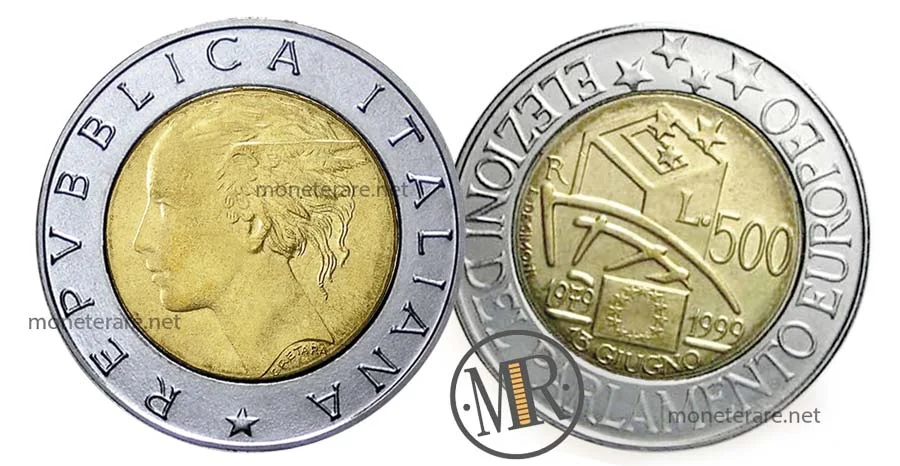
The last of the 500 lire bimetallic commemorative coins to be minted by the Italian Republic is the one issued on the occasion of the European Elections of 1999, marking the twentieth anniversary of the first elections (79, 84, 89, 94, 99). Since 1979, European Parliament elections have been held every five years.
Description 500 Lire Italian 20° European Elections
On the obverse, the usual female profile designed by Cretara. In the circular crown made of Acmonital, on the reverse of the 500 lire bimetallic 20° European Elections, the inscription “EUROPEAN PARLIAMENT ELECTIONS” is found, along with some stars at the top that, moving downwards, enter the inner Bronzital circle.
Inside this circle, there is a ballot box from which stars (7 stars) emerge, with the mint mark on the left and the value L.500 on the right. Below the ballot box, there is a stylized representation of the hemicycle of the European Parliament and the flag of the European Union between the dates 1979 and 1999.
Below the flag is the inscription “June 13” and on the left is the signature of the reverse designer Luciana De Simoni.
Authors: Laura Cretara (Obverse), Luciana De Simoni (Reverse)
Value 500 Lire – European Elections (20° Anniversary)
- The value of these 500 lire bimetallic commemorative European Elections coins, since the mintage is lower than the others (50,000,000), can reach 4€, even though the coin is still classified as common.
The value of the 500 Lire Bimetallic Commemoratives
Here is the table with the values related to each Commemorative, divided by year.
| Year | Rarity | Price | Mintage |
|---|---|---|---|
| 1993 Banca d'Italia Large design – Small signature | CC | 3€ | 89,949,800 + 50,200 BU + 8,500 Proof |
| 1993 Banca d'Italia Small design – Large signature | CC | 2€ | – |
| 1994 Luca Pacioli | CC | 5€ | 49,955,500 + 44,500 BU + 8,500 Proof |
| 1996 ISTAT | CC | 3€ | 96,710,000 + 45,000 BU + 8,000 Proof |
| 1997 Polizia Stradale | CC | 3€ | 39,956,400 + 43,600 BU + 8,440 Proof |
| 1998 IFAD | CC | 3€ | 99,944,800 + 55,200 BU + 9,000 Proof |
| 1999 European Elections | CC | 4€ | 49,948,200 + 51,800 BU + 8,500 Proof |
Other Types of 500 Lire Coins
500 Lire Republic of San Marino
The bimetallic 500 lire coins were not only minted in Italy but also by the Republic of San Marino, from 1982 to 2001.
Unlike the bimetallic 500 lire coins of the Italian Republic, the designs on the obverse and reverse of the San Marino coins were changed each year.
We have discussed these bimetallic coins extensively in a dedicated article that you can find here: 500 Lire Coins San Marino.
The 500 Lire Vatican City
The Vatican City also minted bimetallic 500 lire coins from 1982 to 2001. We will discuss this in more detail in an upcoming article along with the silver ones.
Italian 500 Lire Silver Coins
From 1958 to 1967, Italy minted 500 lire coins in silver. There are three types, called “Caravelle”, “Centenary of Italian Unification”, and “Dante Alighieri”.
In particular, the 500 lire silver coins with the Caravelle featuring the flags against the wind are among the rarest and most valuable coins of the Italian Republic.
Didn’t find what you were looking for? Check out these topics on the lire:
- Here you can learn everything about the 1 lira, 2 lire, 5 lire, rare 10 lire, 20 lire, and 50 lire.
- The 10 centesimi of lira are here, the 20 centesimi are here, and here are the rare 50 centesimi of lira.
- If you are looking for the 1 centesimo of lira, look here and here for the rare 2 centesimi of lira and the 5 centesimi of lira.
- If you want info on the 100 lire and their value, you can find it here as well as that of the 1000 Lire of the Italian Republic.
- We have covered the 200 lire and their value here.
- We discussed the Telephone Tokens that were worth 200 lire on this page.
- We also talked about the 500 lire silver coins, the 500 lire bimetallic coins, and the 500 lire paper notes
- For German-speaking collectors, we have created a dedicated version of the catalog of rare coins that you can find here “MoneteRare Deutschland”.
Where to sell or buy coins
Do you own coins like these, a lot, or a rare piece? Register on Catawiki and place your first bid, or submit a lot for sale — signing up is free. For years we have used this auction site, our partner. Browsing auctions is not enough: start with registration and a first action (a bid or a listing). Register and start.