
20 Cents
Updated:
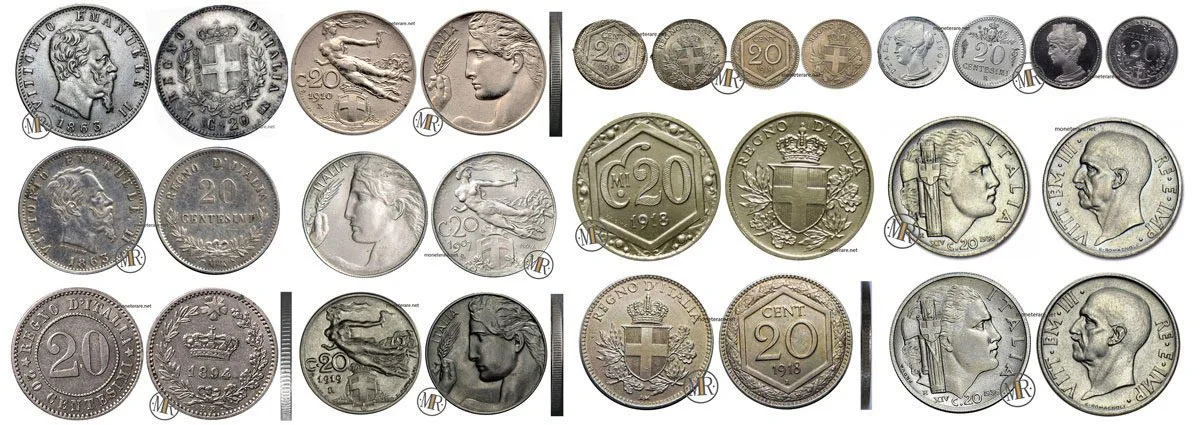
The history of the Italian 20 Cents coins is fascinating and reflects the historical and political events of the Classical and Modern periods between the late 1800s and the mid-1900s. Each coin has a story that makes it unique and interesting, not only from a numismatic perspective but also from an artistic one. In fact, some of these coins are considered among the most beautiful coins in world numismatics of the first half of the 20th century.
Through trials, designs, withdrawals, re-strikes, and experiments with new alloys, this historical period has left us with a large number of rare 20 cents coins!
Classic Period 1861 – 1911
From a monetary perspective, this period was rich in changes that highlighted the differences between the two periods of the reign of Vittorio Emanuele II, King of Sardinia and later King of Italy.
The differences between the coins of the Kingdom of Sardinia and those of the new Kingdom of Italy were various; one of these is the truncation of the neck on the figure of the King on the reverse of the coins.
In fact, the coins minted during the period of Vittorio Emanuele II King of Sardinia depict him with a “Long Neck,” while those minted during the reign of Vittorio Emanuele King of Italy show the King with a “Short Neck.”
Another difference is the use of the Latin language for the coins of the first period and Italian in the second period.
Interestingly, in 1863, the 20-cent coins of the “Coat of Arms” and “Value” series were minted in parallel.
Let’s take a look at both!
20 cents 1863 “Coat of Arms” Vittorio Emanuele II
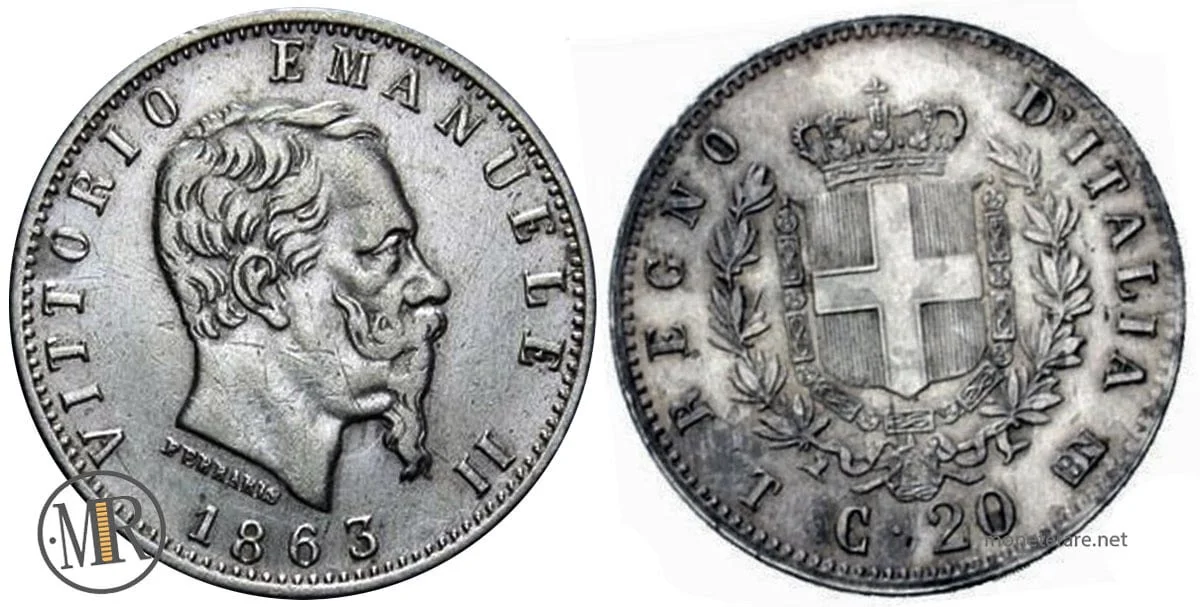
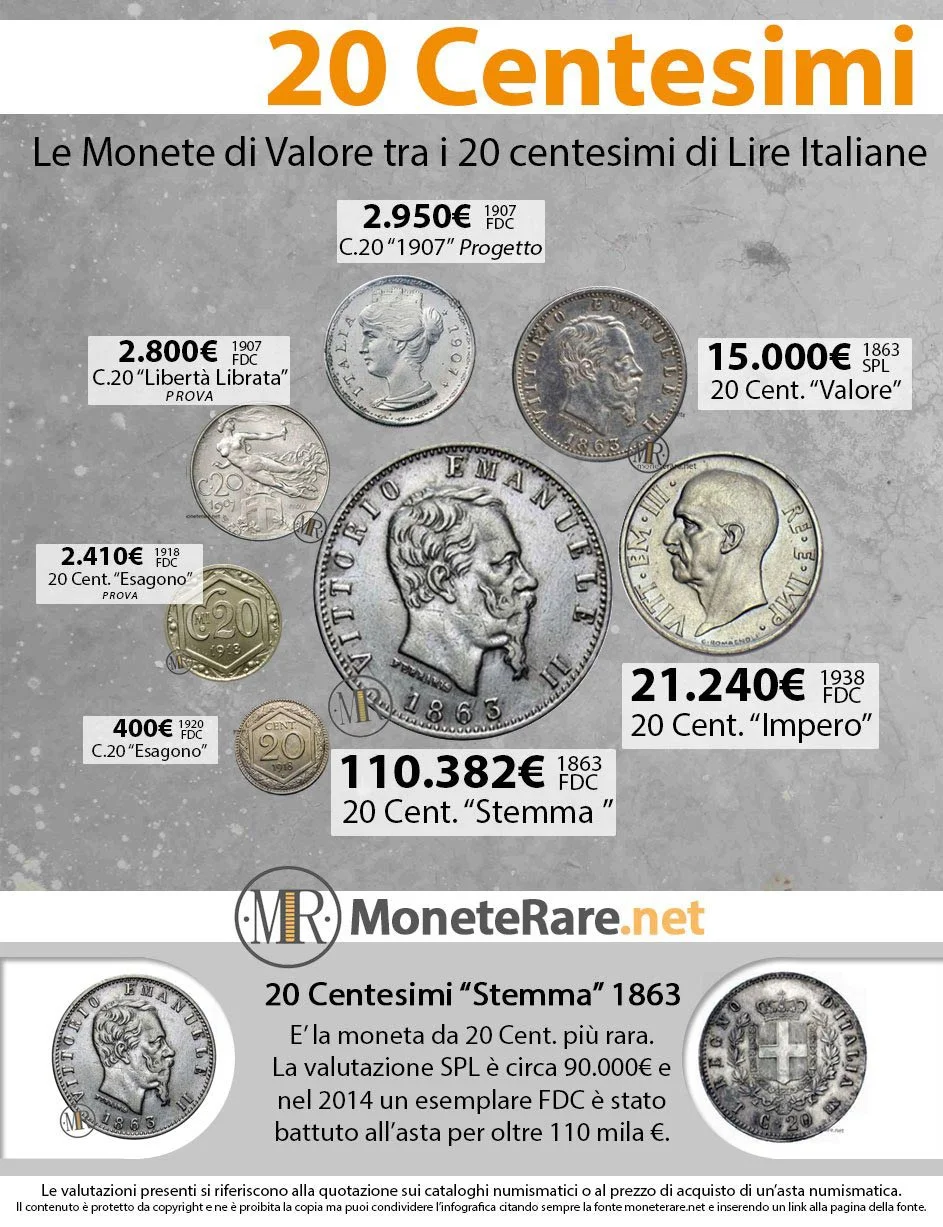
In 1862, due to a new Monetary Law, a new type of coin was established to replace the 25 Centesimi of Lira in circulation in the Kingdom of Sardinia. Thus, the 20 cents of Lira in Silver known as “Coat of Arms” was born. Minted in 1863 by the Mint of Turin with a small mintage of only 461 pieces.
It quickly made headlines due to its resemblance to the 5 Lira gold coin. Very similar in both size and the image engraved on the reverse, the new silver coin could easily be gold-plated and passed off as a 5 Lira.
For this reason, they were promptly withdrawn from circulation to be melted down; however, about a dozen specimens went missing, becoming highly sought-after specimens classified as R4.
The coin was designed by Giuseppe Ferraris, made with a diameter of 16 mm and a weight of 1 g.
On the Obverse, the head of King Vitt. Emanuele II is depicted facing right, with the engraver's signature below the neck line and the mint year 1963 along the beaded edge at the bottom. Surrounding the coin is the inscription VITTORIO EMANUELE II.
On the Reverse, within the beaded edge, is the inscription REGNO D'ITALIA, with the coin's value at the bottom between the symbols of the National Bank and the Mint of Turin.
The Edge is smooth.
Table | 20 Centesimi COAT OF ARMS 1863
Value | 20 Centesimi COAT OF ARMS 1863 – Auctions
Auctions of the rare 20 cents COAT OF ARMS:
- A 20-cent coin from 1863 R5 in FDC was sold at auction on May 7, 2014, for 90,000 GBP, equivalent to 110,382€.
- On November 10, 2017, there was an auction where an R5 specimen in SPL+ was sold for 102,660€.
20 cents 1863 “Value” Vittorio Emanuele II
An interesting fact about this coin is that the die dated 1963 was also used in the years 64', 65', and 66'. They were then withdrawn from 1883 to 1886.
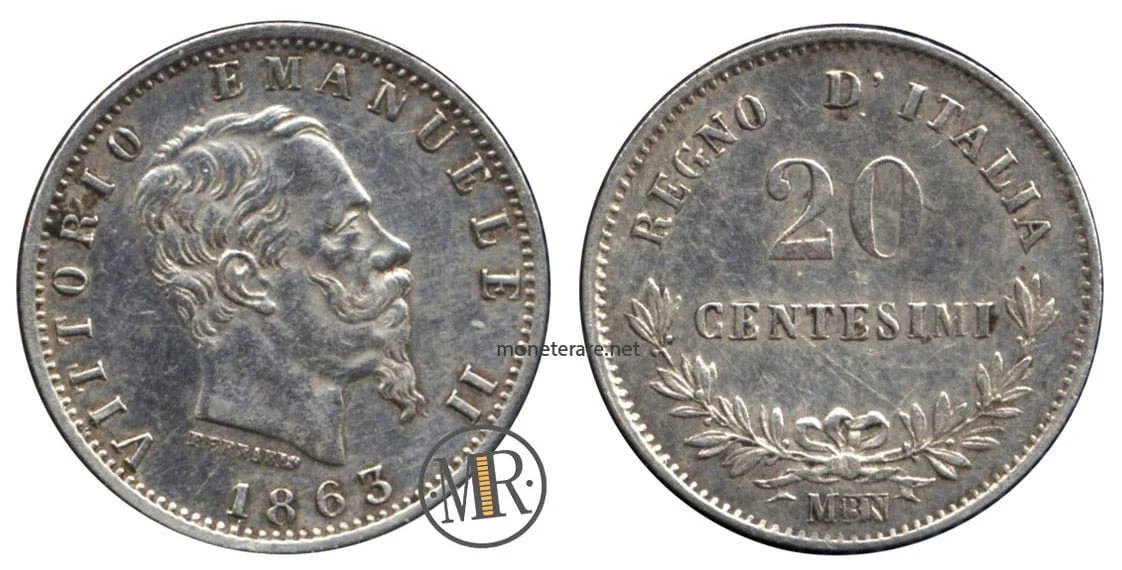
Minted in 885 Silver with a total mintage of 34,999,539 between 1863 and 1867, it weighs around 1g and has a diameter of 16 millimeters.
The Obverse depicts the head of the King with a short neck facing right, with the engraver Ferraris' signature below. Surrounding it is the inscription VITTORIO EMANUELE II and below, 1963. All around is a beaded circle.
On the Reverse, the inscription 20 CENTESIMI is displayed in two lines with the inscription REGNO D'ITALIA above and two laurel branches tied with a ribbon below, along with the symbols of the Mint M BN.
The Edge of the coin is smooth.
These are common coins; however, a version from 1863 with the BN symbol inverted is considered R4. And those from 1867 are R.
The value of the twenty cents. Value differs between the Turin and Milan mints.
Table | 20 Centesimi VALUE 1863
Value | 20 Centesimi VALUE 1863 – Auctions
The Auctions of the rare 20 cents VALUE:
- 18,560€ for an R4 20 cent. Value with inverted BN dated 1863 Turin in BB+ quality during the auction on October 26, 2012.
- An SPL specimen of 1863 Turin R4 with inverted BN was sold at auction on October 26, 2013, for 12,305€.
- For a coin from 1867 Turin R in FDC, 863€ was spent at the auction on January 18, 2013.
- The 20 cents Value 1867 Turin R SPL were auctioned for 826€ on October 20, 2015.
20 cents 1894 Umberto I – Nichelino
The coins under the reign of King Umberto I are quite similar to those of the previous reign, with the exception of the engraver. In fact, Ferraris was replaced by Filippo Speranza, who maintained the stylistic characteristics of the coins minted previously. The most striking difference is the space occupied by the King's name, which, being shorter, was significantly reduced.
In the case of the twenty cents, the King's name was removed.
The minor coins were made with less precious metals; for example, the 20 cent coin was minted in Nickel alloy, a new alloy, very ductile, widely used during this period for the production of everyday coins. The use of the new alloy gave rise to the nickname of the 20 Centesimi Umberto I, now known as Nichelino.
However, the same alloy that gave rise to the name also caused its withdrawal, as being a copper-rich alloy, it tended to tarnish the coins. In fact, they were withdrawn in 1909. However, they were later reused for the minting of the 20 cents Hexagon in 1918; we will see why later.
The coins may feature two Mint symbols, that of Rome R and the initials K.B. This refers to the German Mint of Berlin and the metal industry Arthur Krupp of Berndorf, which collaborated for the minting of these 20 cent coins of Umberto I. However, the acronym K.B. may also refer to the Mint of Kremnitz in Bohemia.
Description
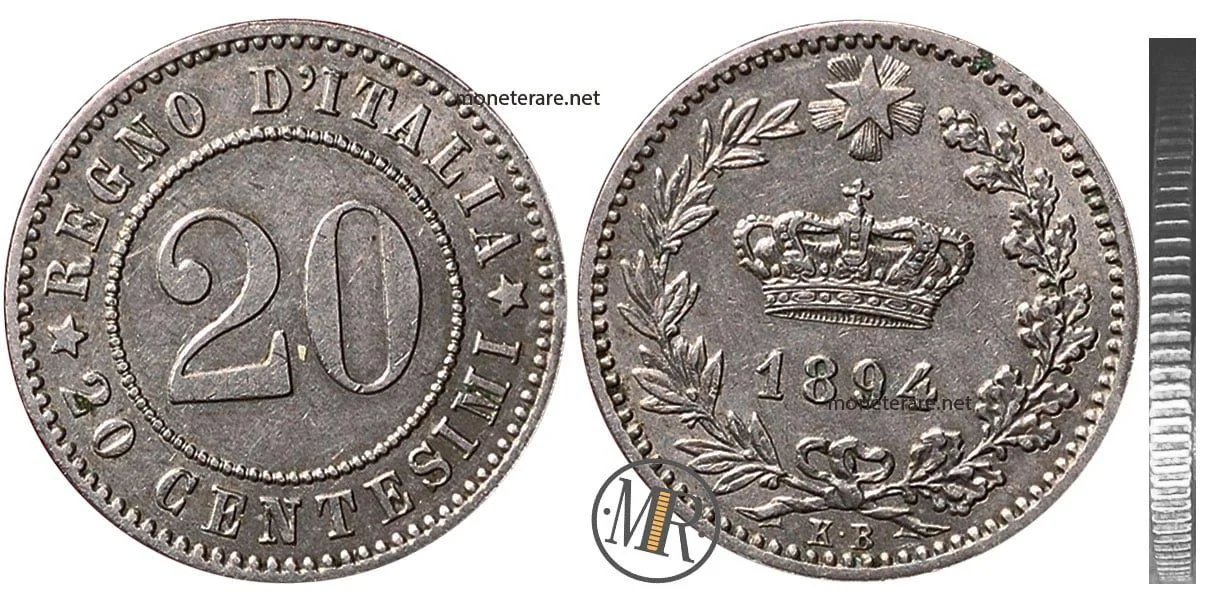
Made of Nickel alloy, weighing 4g and a diameter of 21.1mm.
The Obverse features the Royal Crown above the mint year 1894, with the star of Italy at the top. On the right and left are laurel and oak branches tied with a ribbon, and below is the Mint symbol K.B.
On the Reverse, inscribed in a beaded circle, is the value 20 engraved very large. Around it, between the beaded edges that frame it, is the inscription: REGNO D'ITALIA 20 CENTESIMI with two five-pointed stars.
The Edge is lined.
These coins were counterfeited in large quantities, which was also one of the reasons that led to their withdrawal from circulation.
Table | 20 Centesimi NICHELINO 1894
Value | 20 cents 1894 Umberto I – Nichelino – Auctions
- On March 26, 2008, an C specimen from 1894 with the K.B. mint in FDC was sold for 253€.
- On November 22, 2008, a C coin in FDC from 1894 from the Mint of Rome was purchased for 288€.
- An NC specimen in FDC from 1895 was sold at auction for 322€ on May 7, 2011.
20 cents 1908 “Libertà Librata” Vittorio Emanuele III
King Vittorio Emanuele III has always been very connected to numismatics; he was also President of the Italian Numismatic Society. Even when he became King, he wanted to maintain a decision-making role in monetary matters, even at an aesthetic level. Hence his reputation as the Numismatic King.
The 20 Centesimi of 1908 represents an aesthetic innovation compared to previous coins; those of this period were indeed conceived and designed by Artists, carefully selected, who drew inspiration from ancient Roman coins with clear references to floral style. The result was that the coins of this period (1908/1918) were among the most beautiful in monetary art of the first half of the 20th century, worldwide.
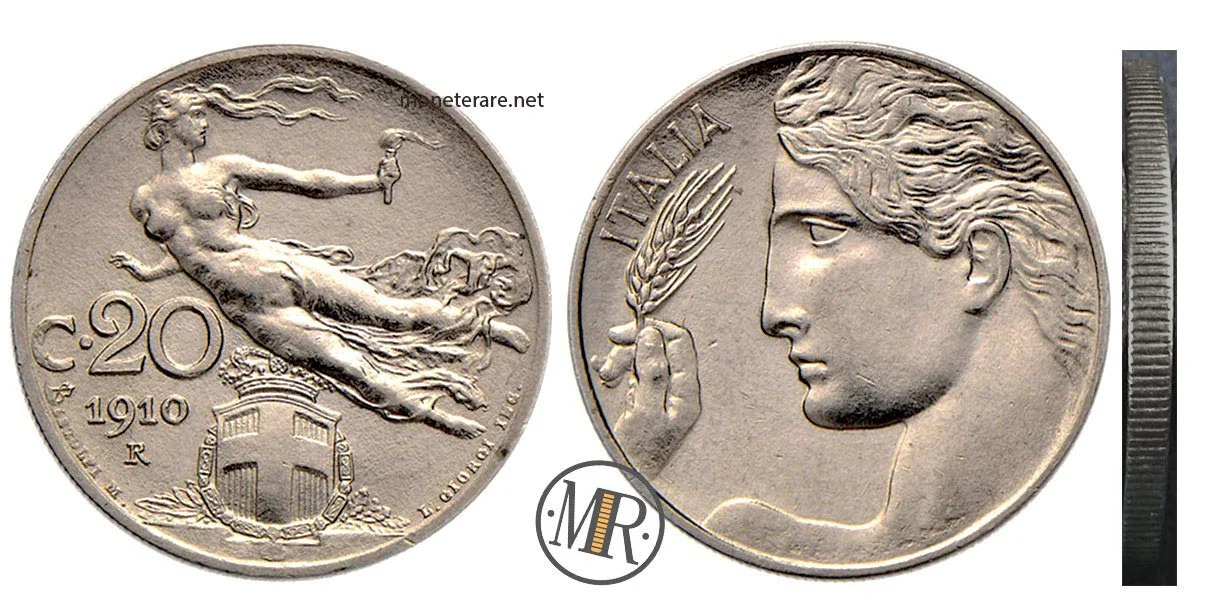
The first thing that stands out is that the King is not depicted. Recognized as the most beautiful Italian coin made of nickel!
So beautiful that between 1926 and 1935, they were minted only for numismatists. (See the table with values below)
Designed by the artist Leonardo Bistolfi, with clear inspiration from Ancient Greece and the typical floral taste that characterizes the artistic period of the time, the Liberty style.
Description
On the Obverse, the Greek profile of a woman looking to the left is depicted, with a bare shoulder visible, holding a wheat ear in her right hand and the inscription ITALIA above between the ear and her hair.
On the Reverse, it hosts the female figure with long hair representing Liberty soaring to the left and looking to the right. The woman holds a torch in her left hand, and her garments wrap around her, creating light drapes shaped by the wind. Below is the Savoy shield with embellishments and the king's crown, and on the sides are the names of the engraver Giorgi INC and the designer L. Bistolfi, followed by the monogram LB.
The Edge is lined, weighing 4 g and with a circumference of 21.5 mm. Made of Nickel 975.
Table | 20 Centesimi LIBERTY LIBRATA 1908
Table | 20 Centesimi LIBERTY LIBRATA – RARE
20 Centesimi 1907 Libertà Librata PROOF
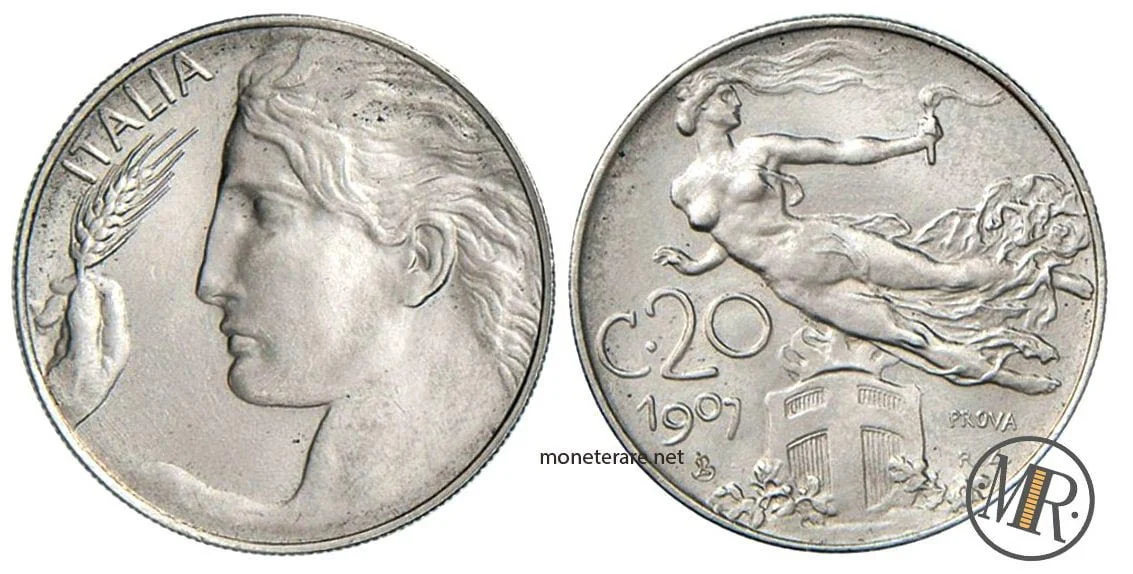
The 20 Centesimi 1907 PROOF coin bears the inscription proof followed by R.Z in the line below. The font used on the reverse is italic capital letters of Liberty imprint, typical of the period but perhaps too bold for a coin that was later minted using a typeface, still Liberty but more compact. The rest of the coin is very similar to the one that was minted the following year, in 1908.
Table | 20 Centesimi 1907 Libertà Librata PROOF
Value | 20 Centesimi 1907 Libertà Librata PROOF – Auctions
Some Auctions on the rare “Libertà Librata PROOF” 20 cents:
- For an R2 specimen of 20 Centesimi 1907 Libertà Librata PROOF, 2,300€ was spent in FDC at a Nomisma auction on April 13, 2013.
- On May 7, 2011 (Nomisma Auction 43), for a 20 Centesimi 1907 Libertà Librata PROOF R4 in qFDC, but without a date, the auction price was 2,185€.
Rare 20 Centesimi 1907 PROJECT
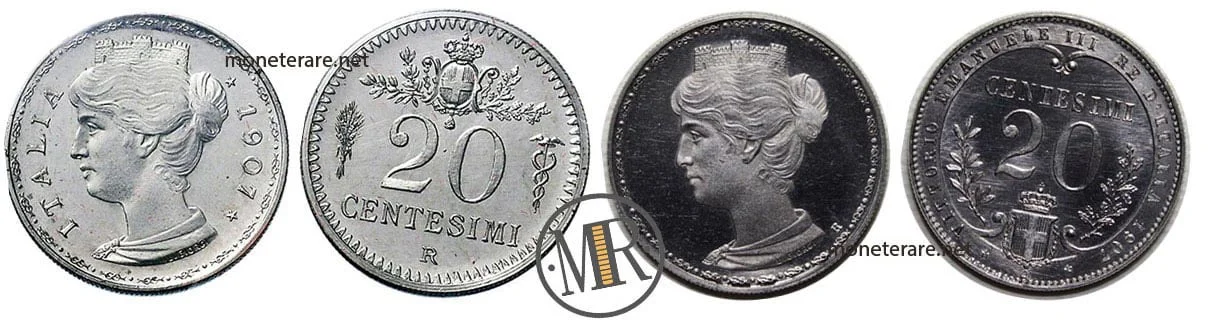
In addition to the proof coin, there are also the 20 Centesimi 1907 PROJECT. This project depicted on the obverse of the 20-cent coin the profile of Italy Turrita under the guise of a woman looking to the left. Along the edge of the coin is a succession of Savoy knots and beads. The inscription on the sides reads, separated by five-pointed stars, ITALIA and the date 1907. However, there is a version of the coin that looks to the right.
On the reverse, there are two versions, both bearing the value of 20 CENTESIMI in two lines and the Savoy Coat of Arms with a Crown and laurel branches.
In one of the two versions, the inscription reads: VITTORIO EMANVELE III RE D'ITALIA, while in the other, the caduceus and the ear of wheat are engraved.
All coins minted for the project are classified as R4.
Value | Rare 20 Centesimi 1907 PROJECT
Some auctions on the most interesting rare 20 cents 1907 PROJECT:
- On May 13, 2014, a coin in FDC of 20 cents 1907 project was auctioned for 2,950€.
- 1,725€ for an FDC at the auction on May 9, 2010, for a project with the inscription VITTORIO EMANVELE III RE D'ITALIA.
- On May 7, 2011, a Project specimen in FDC was purchased for 2,530€.
Modern Period 1911 – 1945
1911 is the year that sees the issuance of the first series of commemorative coins for the 50th Anniversary of the Unification of the State. The coins are those of Vittorio Emanuele III.
We are talking about a period of war that sees the near disappearance of 1 cent and 2 cents of lire or anyway the small coins in nickel. This is because this element was almost entirely destined for the manufacturing of weapons. To solve the problem, the nickel coins of Umberto I, previously withdrawn, were resurrected, they were treated and used as a base for a recoinage.
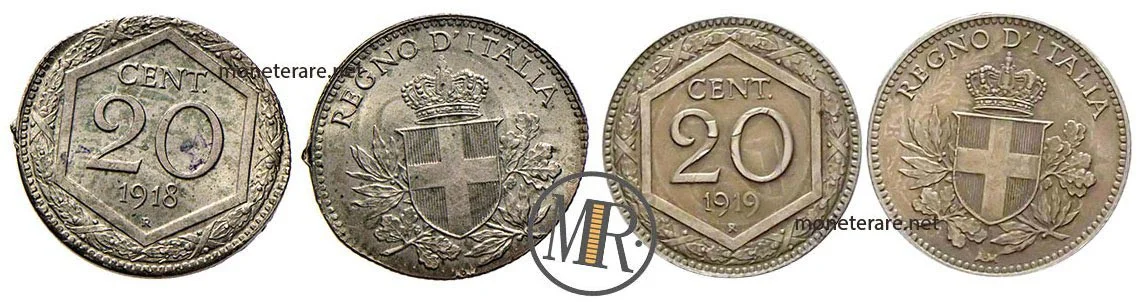
In fact, it is not difficult to find traces of this transition in the coins “Hexagon” of 20 cents. As can be seen from the coins below, where the use of the Nickel of 1894 is clear as a base for minting the new ones.
20 Centesimi Esagono 1918 PROVA
Here is an example of a PROOF of the 20 cent coin from 1918
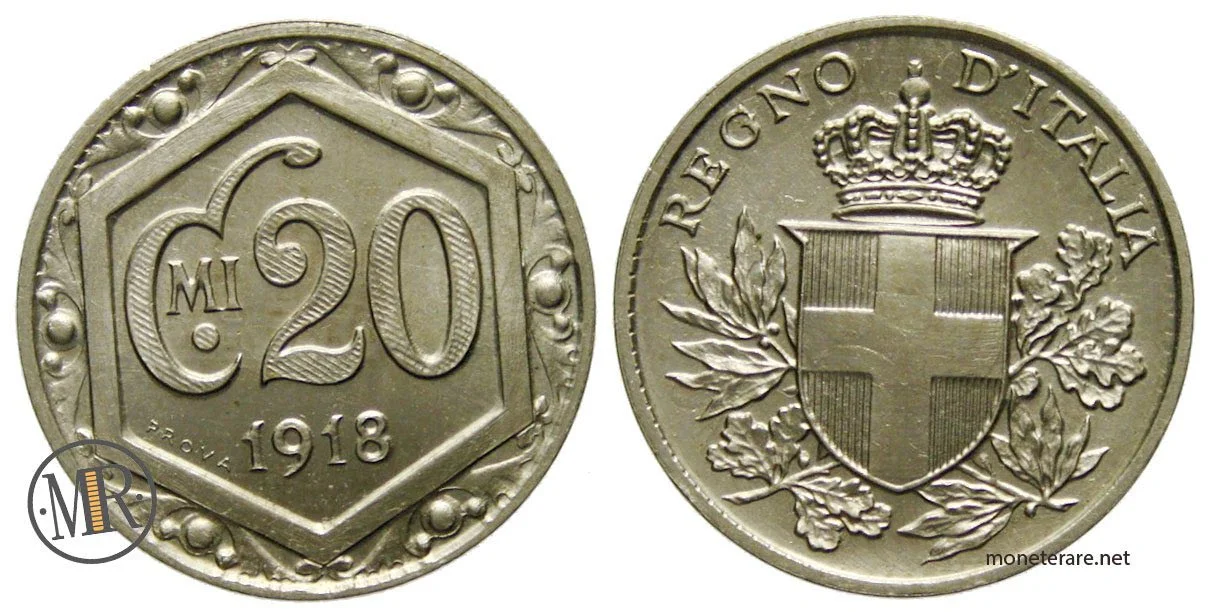
On the Obverse is depicted the Savoy Coat of Arms surmounted by the Royal Crown, flanked by crossed branches of laurel and oak. At the top, the inscription REGNO D'ITALIA.
On the Reverse, inscribed within a hexagon is the value of 20 C.mi in a detailed Liberty-style font, with the C worked with an appendix, below the date 1918. On the left side of the hexagon, the inscription P R O V A. The background has the ornamental decorations typical of the coins of these years.
The Edge is smooth.
The one depicted is classified as R4, has a smooth edge and shows slight traces of the underlying coinage. In fact, despite the inscription PROVA, it is considered more reliable to think that it is a reprint project over an old coin of the Nickel 1894/95. The mintage of these coinage projects is unknown.
Table | 20 Centesimi 1918 Esagono PROVA
Value | 20 Centesimi Esagono 1918 PROVA – Auctions
Here are some Auctions of Projects and PROOFS of the rare 20 cents “Hexagon PROVA”:
- November 26, 1996, a Series of 19 Commemorative coins Royal Mint R5, in a case and in FDC were sold for the equivalent of 51,375€ (99,475,000 Lire)
- A PROOF from 1918 in FDC R4 with the Radiant Star inscribed below the tip of the hexagon, was purchased for 2,415€ on October 29, 2011.
- On October 23, 2010, a proof specimen R4, which has the C with appendix like the one in the photo in FDC, was sold at Auction for 978€
- Another coin of 20 Cents 1918 P R O V A, also R4 and FDC, was hammered at an Auction for 923€
20 Centesimi 1918 “Esagono” Vittorio Emanuele III
This is the coin approved for the 20 Centesimi of King Vittorio Emanuele III in 1918.
Which we know to be minted over the old nickels.
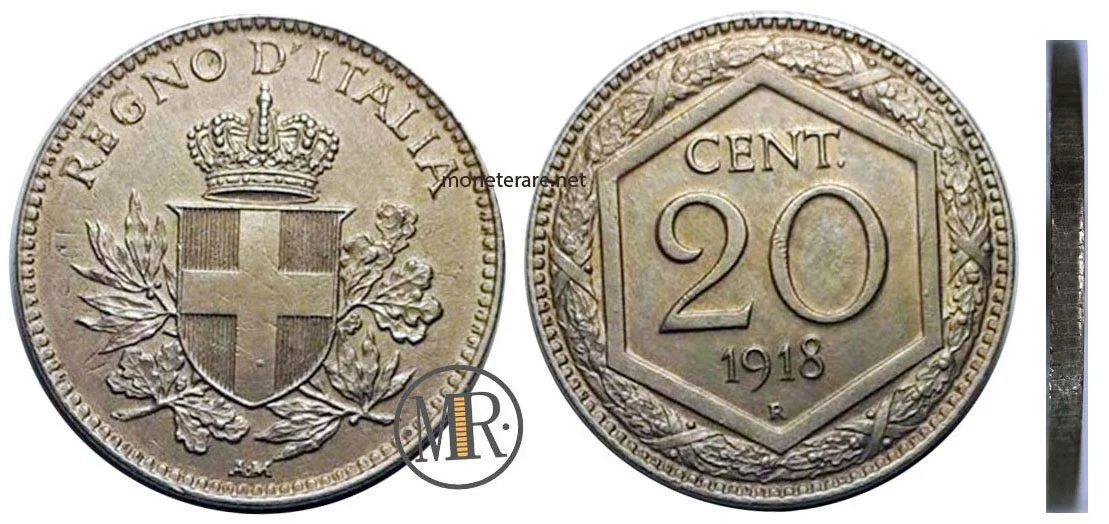
On the Obverse is depicted a hexagon with the value of the coin inside, CENT. 20 and the year of minting, 1918. Below the date is the R of the Rome mint. Around the hexagon inscribed within a serrated edge, there is a floral crown ribboned and adorned.
On the Reverse is engraved the coat of arms of the royal house with intertwined oak and laurel branches below. Above the central inscription REGNO D'ITALIA and between the inscription and the shield is the King's crown. At the bottom are the initials of Attilio Motti, the designer.
The Edge presents:
- grooved for the coins of 1918 and 1919 that used the nickel as a base
- smooth for the new blanks used for the coins minted in 1920
Diameter of 21.3 mm, weight of 3.9 g and axes at French.
Table | 20 Centesimi 1918 Esagono
20 Centesimi 1936 “Impero” Vittorio Emanuele III
They were made with various more or less metallic alloys, in fact, it is not rare that a magnetic test must be done before an estimate, below the table with the different values between antimagnetic and magnetic coins.
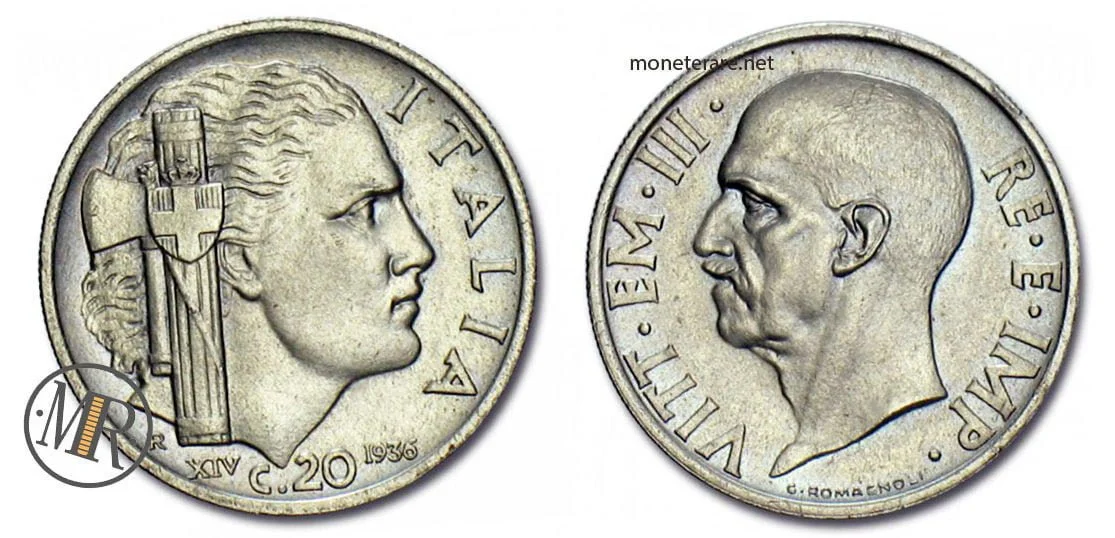
On the Obverse the bare head of King Vittorio Emanuele III looking to the left, with around the inscription VITT – EM – III – RE – E – IMP – . The signature of G. Romagnoli is at the bottom along the edge of the coin.
On the Reverse the female profile facing right is that of Italy behind the fascio with the Savoy Shield. The inscription ITALIA is on the right side of the coin, below the neck is the nominal value of C. 20, the year of minting and on the left the fascist era in Roman numerals with the R symbol of the Rome mint.
The Edge of the coin is grooved.
Made of acmonital, with a diameter of 21.7 mm, a weight of 4 grams and a grooved edge.
Table: 20 Centesimi IMPERO 1936
Value | 20 Centesimi 1936 “Impero” Vittorio Emanuele III – Auctions
- A 20 cent coin Impero from 1936 R2 in FDC was sold at an Auction on July 2, 2011 for 460€
- On April 13, 2014, a specimen R2 of 20 cents 1936 in FDC was purchased at Auction for 460€
- A C antimagnetic coin from 1939 in FDC, reached an auction value of 76.70€ on May 13, 2014.
- For a C magnetic coin from 1939 in FDC also on May 13, 2014, 153€ was spent instead
- A specimen of twenty cents CC from 1943 C in FDC was hammered for 27.60€ on September 19, 2012
20 Centesimi 1936 “Impero” PROVA
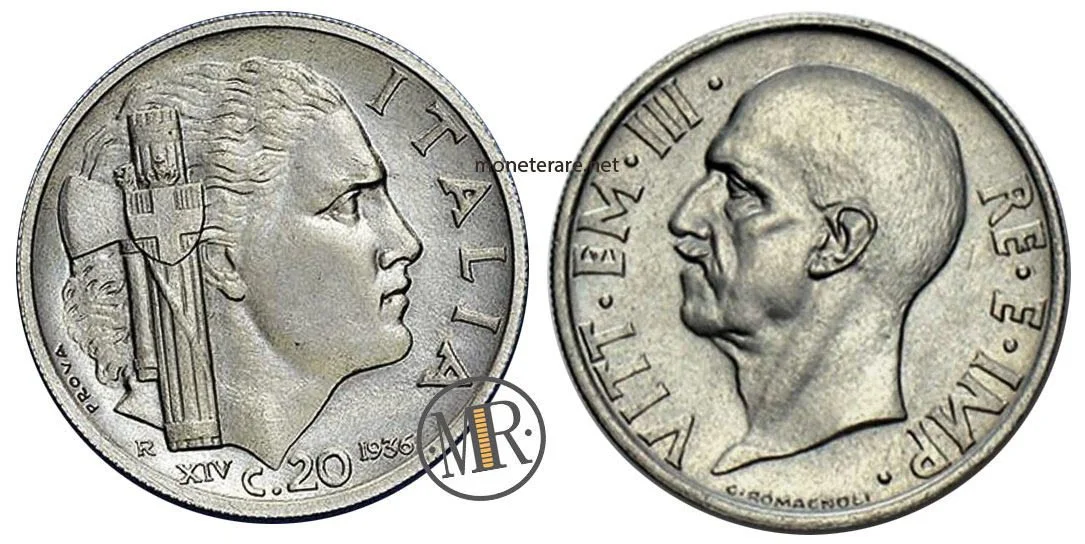
On the Obverse the head of the King with mustache and without crown looking to the left. On the left VITT – EM -III – while on the right the inscription RE – E – IMP – . At the bottom center is the signature of the author G. Romagnoli.
On the Reverse instead the female profile of Italy with the fascio looking to the right. On the right the inscription ITALIA, at the bottom the nominal value C. 20 and the year of minting 1936. On the left the fascist era XIV and the symbol of the Rome mint R.
The Edge of the coin is grooved.
Diameter of 21.5 mm, weight of 4 grams and made of nickel.
Table | 20 Centesimi IMPERO for Numismatists
Value | 20 Centesimi 1936 “Impero” for Numismatists – Auctions
The most sought-after rare 20 cents of 1936 “Impero for Numismatists”:
- For a coin Impero from 1938 R5 well 21,240€ was spent on October 15, 2014, the coin was in FDC and came from a mintage for numismatists.
- A specimen of 20 cents Impero from 1938 R4 in FDC was hammered at the Auction on November 10, 2017 for 16,520€
- 3,658€ is instead the amount spent at the Auction on April 4, 2017 for a 20 cent Impero R3 1938 in FDC.
- The coin of 20 cents Vittorio Emanuele III Impero from 1938 R2 in FDC reached 460€ at Auction on May 13, 2014
Table | 20 Centesimi 1938 PROVA
Value | 20 Centesimi 1936 “Impero” PROVA – Auctions
- A 20 Centesimi Impero PROVA 1936 R3 in FDC was hammered for 1,840€ on May 7, 2011
- On the same day at the same Auction, another PROVA from 1936 R3 in FDC was purchased for 1,495€.
- Also during the same Auction, on May 7, 2011, for a FDC R5 coin of 20 cents Impero 1938 the amount of 6,670€ was reached
- For a PROVA R4 from 1939, on April 13, 2013, the amount of 2,530€ was spent
Do you want to share your experience with this type of coins? If you know other curiosities about the 20 cent coins or want to ask a question, leave a comment below and don't forget to vote for the article if you liked it.
Didn't find what you were looking for? Check out these topics on the lire:
- Here you can learn all about the 1 lira, 2 lire, 5 lire, rare 10 lire, 20 lire and 50 lire.
- The 10 cents of lire are here, the 20 cents here and here instead the rare 50 cents of lire
- If you are looking for the 1 cent of lire look here and here on the rare 2 cents of lire and on the 5 cents of lire.
- If you want info on the 100 lire and their value, you can find it here and also that of the 1000 Lire of the Italian Republic.
- On the 200 lire and their value we have discussed here.
- We have talked about the Telephone Tokens that were worth 200 lire on this page.
- We have also talked about the 500 silver lire, the 500 bimetallic lire and the 500 paper lire
- For German-speaking collectors, we have created a dedicated version of the catalog of rare coins that you can find here “MoneteRare Deutschland”.
Where to sell or buy coins
Do you own coins like these, a lot, or a rare piece? Register on Catawiki and place your first bid, or submit a lot for sale — signing up is free. For years we have used this auction site, our partner. Browsing auctions is not enough: start with registration and a first action (a bid or a listing). Register and start.