
Gold Coins
Updated:
Gold coins have always been the most precious coins ever made by man. The rare metal allowed the coin to be recognized over the millennia due to its maintained exchange value, thus serving as an excellent currency.
Introduction
Throughout history, many gold coins have been minted since the time of the first gold (and silver) coin invented in the 7th century BC in Lydia, Asia Minor. You can learn more by reading this article: History and Origins of Coinage.
Curiosity: Gold coins are also called “gold coins” because the word gold comes from the Latin aurum and has the symbol au.
Ancient Gold Coins
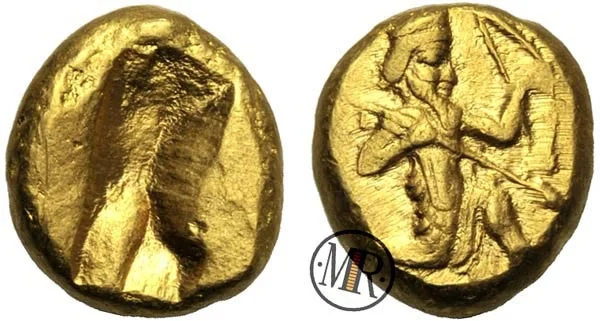
One of the first ancient gold coins to be issued was the Daric, a gold coin minted in Persia for the first time during the reign of Darius I, which lasted from 522 BC to 486 BC.
On the obverse, the King is depicted kneeling in an archer's pose with a crown, bow, and arrow, while on the reverse there is a recessed rectangle.
This gold coin was issued until the conquest of Persia by the Macedonians.
The largest ancient gold coin ever made during that period was minted in Ancient Greece by King Eucratides, which we also discussed in this article: Greek coin.
The gold coin that circulated in Ancient Rome was the aureus (aureus), issued in 49 BC by Julius Caesar, although gold coins called staters and half staters had already been minted since 250 BC.
Julius Caesar established the weight of the aureus at 1/40 of the Roman pound, approximately 8 grams (which is the weight of the modern British sovereign).
The aureus was issued until the beginning of the 4th century AD when Constantine I, in 309 AD, introduced the solidus (solidus) to replace the aureus.
The solidus, mostly widespread in the Eastern Empire, had a larger diameter and was thinner than the aureus.
It wasn't until the end of the 7th century that the Umayyad caliph Abd al-Malik ibn Marwān, following numerous reforms, introduced the minting of a gold coin for the Caliphate, and this coin was named Dīnār.
Initially, it was minted imitating the coin of the Byzantine basileus Heraclius, later the caliph imposed the removal of images and that the coin be entirely epigraphic.
In the 10th century AD, an Arab gold coin worth about ¼ of the Dīnār was introduced in Sicily by the Fatimids, an Ismaili Shia dynasty, which later became known as Tarì.
Other types of Tarì were minted in Amalfi, even after the conquest by Frederick II, and it was minted until 1282.
In the Kingdom of Sicily, it was then reintroduced by Ferdinand II of Aragon, this time as a silver coin.
Barbaric Gold Coins
During the Middle Ages, some of the various so-called “barbaric” peoples who invaded the territories of the fallen Western Roman Empire produced gold coins.
The Lombards and Visigoths continued to mint the types of gold coins present at the end of the Roman Empire.
Starting from the 5th century, the Visigoths minted solidi and tremisses in gold, initially imitating the circulating coins of the Eastern Roman Empire.
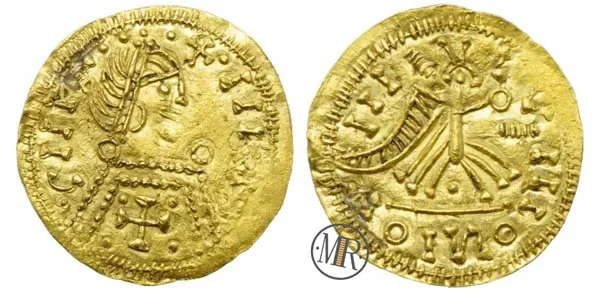
Later, from the 1980s of the 6th century, the kings of the Visigoths, starting with Leovigild, began to mint coins in their own name.
Here below is a tremissis of Leovigild (567-586).
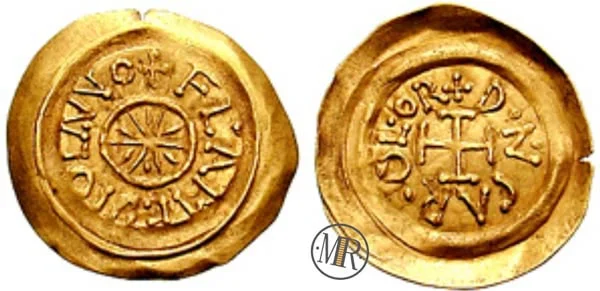
The Lombards also began to issue mainly tremisses, initially imitating the Roman ones.
Then, with King Cunipert, they started to mint gold coins in the name of the King.
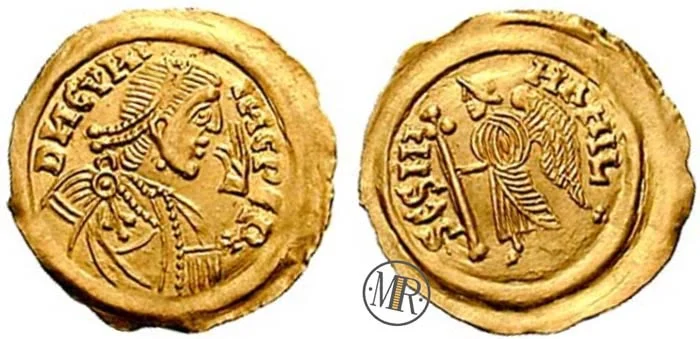
When Charlemagne came to Italy, conquering Pavia and assuming the title of King of the Franks and Lombards, the Franks also began, albeit for a short period (774-781), to mint tremisses in gold in the name of Charlemagne.
The known mints of Charlemagne's tremisses are Milan, Pavia, Bergamo, Coira, Lucca, and Castelseprio.
Italian Gold Coins: the Fiorino, Genovino and Zecchino
In 1252, as we have already seen in this article about the gold fiorino coin, Florence began the minting of the famous gold Fiorino, so named because of the large lily flower on the obverse of the coin.
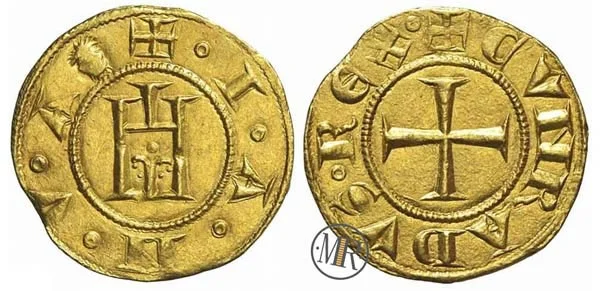
In 1252, Genoa also began minting a gold coin: the Genovino.
On the obverse of the Genoese gold coin appears a stylization of a castle gate and the inscription + IANVA.
On the reverse, the heraldic cross stands out with the inscription CVNRADVS REX, referring to Conrad III, King of the Romans, who in 1139 granted Genoa the right to mint coins.
The “Zecchino” Coin
Also Venice, in 1284 under the government of Doge Giovanni Dandolo, began minting a gold coin with the same weight and title as the Fiorino.
The name Zecchino derives directly from Zecca, the institution responsible for minting coins.
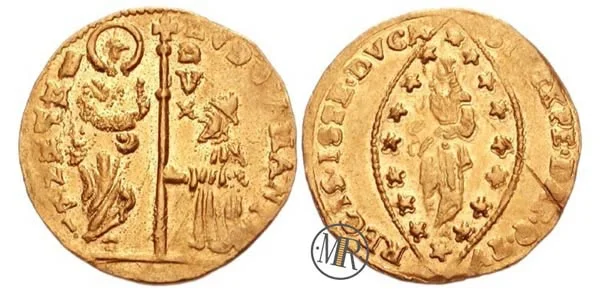
On the obverse of this gold coin appear Saint Mark, the protector of the city, and the kneeling doge. Saint Mark holds the gospel in one hand while with the other he presents the city’s banner to the doge.
The legend on the obverse reads “S M VENET” plus the name of the doge and DVX along the staff of the banner.
On the reverse, the inscription is “SIT T XPE DAT Q TU REGIS ISTE DUCAT” meaning “may this ducat which You govern be entrusted to you, O Christ” and depicts Christ blessing, enclosed within an almond-shaped halo.
The iconography remained practically unchanged until 1797. Below is a gold zecchino of the last doge of Venice, Lodovico Giovanni Manin.
Investment Gold Coins
Among the many gold coins circulated over the centuries, some are still today considered investment gold coins. We have discussed this type of coin extensively in this article: buying gold.
The main ones are: Sovereign, Krugerrand, Marengo, 50 Mexican pesos, 20 dollars, and Chinese Gold Panda.
The English Sovereign, known in Italy as the gold pound, is an English gold coin first minted in 1489, and we have already talked about it in this article: the gold pound.
The South African Krugerrand
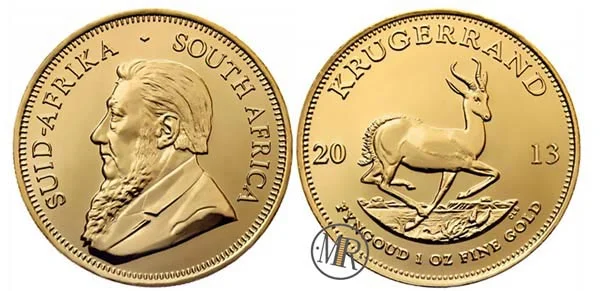
Another investment gold coin is the South African Krugerrand, minted in 1967 to support South African gold in the market.
The name of this gold coin comes from the portrait of Paul Kruger, known as Oom Paul (Uncle Paul), a famous leader of the Boer resistance against the British government in South Africa.
This gold coin contains one troy ounce of pure gold, has a diameter of 32.77 millimeters, and a thickness of 2.84 mm. If you are looking for information on the unit of measure OUNCE, which is important when discussing gold coins, this is the article for you: Ounce and Troy Ounce.
This gold coin contains one ounce of pure gold, has a diameter of 32.77 millimeters, and a thickness of 2.84 mm.
On the obverse, along with the portrait of Kruger, is the inscription “SUID-AFRIKA/SOUTH AFRICA” in Afrikaans and English, while on the reverse is a “springbok,” a typical gazelle of South Africa, and the nominal value of the coin.
In another article, we have already extensively discussed another investment gold coin, the Marengo.
Now, if you have rare coins like these (but also different coins), you can have fun and earn a bit by putting them up for auction online. We buy and sell coins at auction always using this partner site. It is the largest site for online coin auctions and we recommend it. Both selling and buying coins at auction is easy and exciting.
Mexican Gold Coin
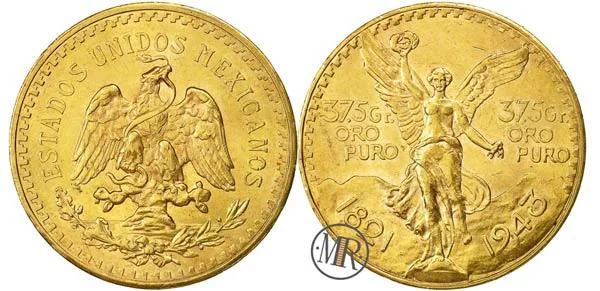
Mexico also minted, in 1921, on the occasion of the centenary of the beginning of the War of Independence against Spain, a gold coin with a value of 50 pesos. This is the largest existing investment coin and contains as much as 37.50 grams of fine gold 900/1000.
20 Dollar “Double Eagle”
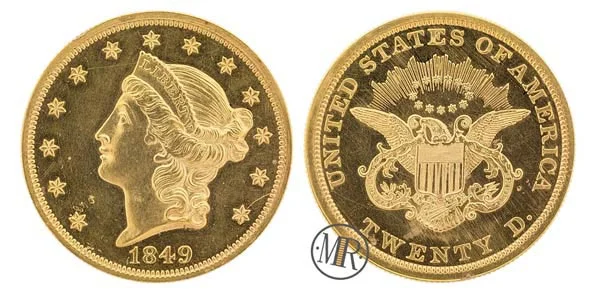
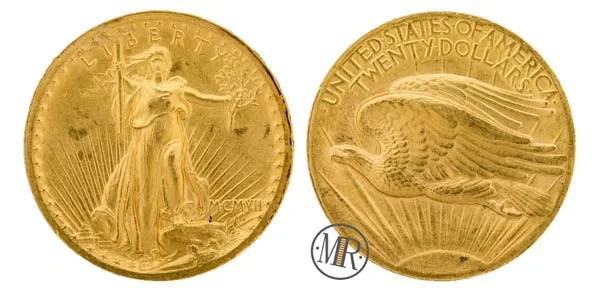
The USA, on the other hand, issued, starting in 1849, a 20 dollar gold coin known as the “Double Eagle.”
It contains 30.0926 grams of fine gold at 21.6 carats, which in 1849 had a value of twenty dollars.
There are two types: a first type called Liberty Head, minted from 1849 to 1907, and a second type called Saint-Gaudens from 1907 onwards.
Frequently asked questions
Which gold coins are worth collecting?
It depends on your budget: marengo/Napoleon, sovereign pounds, and historical florins are among the most traded pieces. Consider the condition, metal premium, and market liquidity.
Where to sell or buy coins
Do you own coins like these, a lot, or a rare piece? Register on Catawiki and place your first bid, or submit a lot for sale — signing up is free. For years we have used this auction site, our partner. Browsing auctions is not enough: start with registration and a first action (a bid or a listing). Register and start.