
Florin Coin | History and Value of the Gold Florin
Updated:
The Florin, a famous gold coin renowned in antiquity, has ancient origins that trace back to the 13th century, during the height of the Middle Ages. It is perhaps the most well-known and celebrated of the ancient Florentine coins.
Origins of the name Fiorino
The name of this gold coin was attributed to it because of the lily flower represented on the obverse of the coin itself.
The Gold Florin of Florence
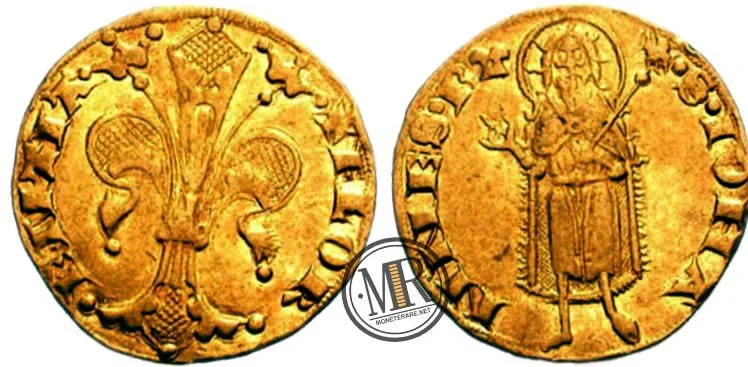
Let’s talk in detail about this celebrity among ancient Florentine coins: the first gold Florin was minted in 13th century Florence, when it was still the “Republic of Florence”.
From 1215, the first disputes began between the Guelphs and Ghibellines, which eventually led to the birth of the “Republic of the First People” in 1250. In this Republic, the milites were removed from the government leadership, which was instead entrusted to merchants, artisans, bankers, notaries, and judges (the “People”).
During that period, the Government of the First People wanted to bet on the enterprise and business spirit of its merchants and bankers, and in 1252 the gold coin that would take the name of Florin was minted for the first time.
No gold coins had been minted since the fall of the Roman Empire, but in 1252 both Florence and Genoa resumed minting gold coins (the Florin and the Genovino, respectively).
Description of the 1252 Gold Florin
The 1252 Gold Florin is made of pure 24-carat gold, has a diameter of 20-21 millimeters, and a weight that ranges from 3.46 to 3.53 grams.
Its very high purchasing power made it necessary to adopt various submultiples such as the silver Florin (“Grosso” or “Popolino”, corresponding to about 1/20 of a gold Florin) and many other coins.
On the obverse of the 1252 Gold Florin, a large lily flower stands out, surrounded by the inscription “ FLOR ENTI “.
On the reverse, Saint John, the patron saint of the city, is depicted.
The Saint is standing, with a smooth halo and wearing a cloth tunic and a fringed fur cloak, fastened at the chest with a button.
With his right hand, he blesses while with his left he holds, resting on his shoulder, a long staff with a cross at the top. The inscription reads “• S IOH NNES • B • “.
It is classified as rarity R3, meaning it is considered a very rare coin. In 2008, at an auction, a gold coin from this first emission was sold for 3304 €.
After 1252, other versions of the original coin known as “I series” were minted.
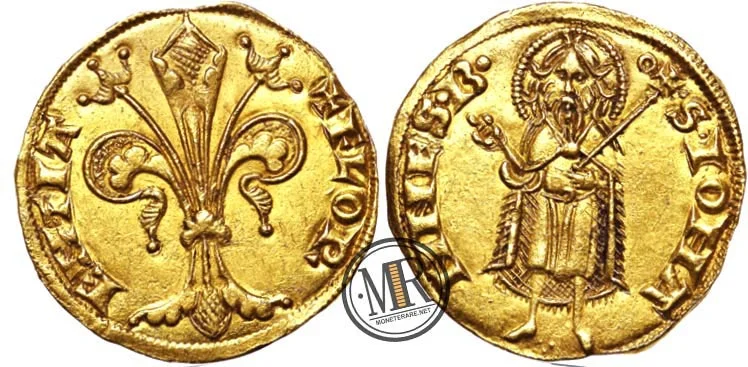
The Gold Florin II series, minted from 1252, differs from the first in the halo (the aureole) of Saint John, which in this coin is beaded and not smooth.
Value of the Gold Florin of Florence
It is classified as R2, very rare coin, and can reach a value of over one thousand euros. At an auction in 2007, a specimen of this Gold Florin “II series” was sold for 1121 euros.
There are numerous “series”, minted over the years until 1533.
Within each series, starting from the third, there are different coins depending on the various symbols, referring to the mintmaster's initials, added between the feet of the Saint or in the legend.
The Hungarian Florin
From 1325, a gold coin weighing about 3.40 grams came into use in Hungary under Charles Robert of Anjou, similar to the Florin of Florence, which quickly became one of the most important coins in that region.
Initially, due to its obvious resemblance to the coin from Florence, it was called florentinus, which later became forint.
In Italy, the Hungarian Florin was called “Ongaro,” and it was imitated by numerous Italian mints.
Generally, it depicted a warrior in wide trousers, which is why they were also called Ongari bragoni.
To this day, the Hungarian currency is the Magyar forint (or Hungarian Florin), despite Hungary's accession process to the European Union, which has been ongoing since 1994, and despite being in the Schengen area since 2007.
The Rhenish Florin
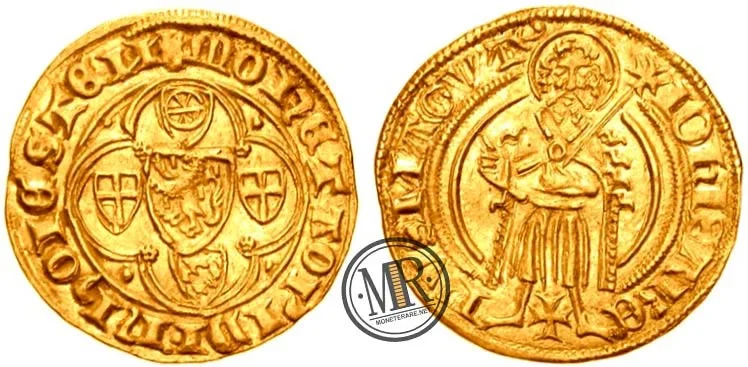
Known as Gulden, the Rhenish florin (or of the Rhine) is the gold coin that circulated in the Holy Roman Empire between the 14th and 15th centuries.
Charles IV of Luxembourg, as a reward for their support in his rise to the throne of the Holy Roman Empire, granted the electoral bishops of Mainz, Trier, and Cologne the privilege to mint gold coins.
Observing this beautiful rare coin up close. On the obverse, in this Rhenish florin of John II of Nassau, Archbishop of Mainz (1397-1419), Saint John is depicted, standing with a halo, cloak, cross of Saint John, and the legend IOH IS AREPVS MAGVT.
On the reverse, within a four-leaf clover, are the coats of arms of the principalities of Mainz, Trier, Cologne, and Bavaria. At the center of the four-leaf clover are the arms of Nassau.
The Double Leopard or English Gold Florin
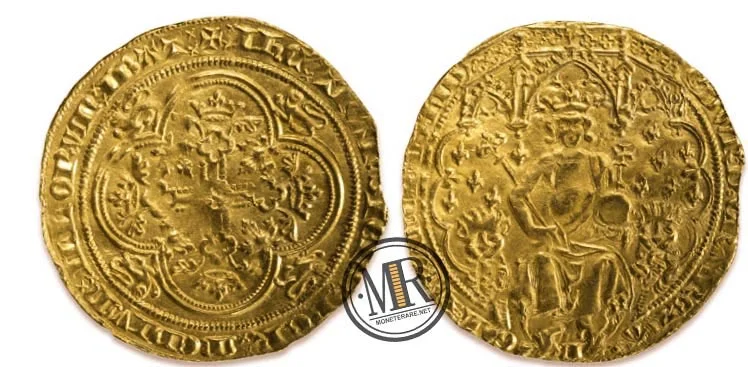
This gold coin was minted in England under King Edward III, based on the Florin of Florence. This rare coin was minted starting in 1344 but remained in circulation for a short time and was soon withdrawn.
For this reason, few specimens have survived of what many consider one of the most beautiful medieval English coins.
On the obverse, the king is depicted seated on a throne under a canopy, with symbols of power and two leopards seated on either side, from which the name “double leopard” derives.
The inscriptions on the obverse read “EDWR D GRA REX ANGL Z FRANC DNS HIB (Edward by the Grace of God King of England and France, Lord of Ireland)”.
On the reverse, there is the royal cross, with a leopard and a shamrock in each quarter and the inscription “IHC TRANSIENS PER MEDIUM ILLORUM IBAT (Christ was passing through the midst of them)”.
The Florin of the Grand Duchy of Tuscany
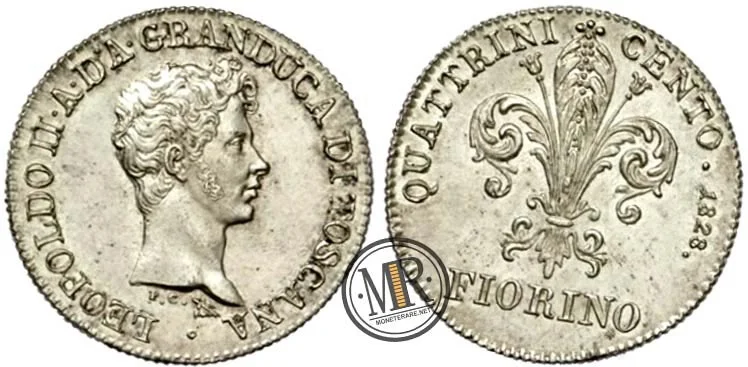
When Leopold II of Habsburg-Lorraine came to power in Tuscany in 1824, he decided to introduce a new coin, the Florin.
This was a silver coin, whose value corresponded to that of 100 Quattrini.
On the obverse, the profile of Leopold II is depicted, while on the reverse, the lily flower of Florence and the value corresponding to one hundred Quattrini are shown.
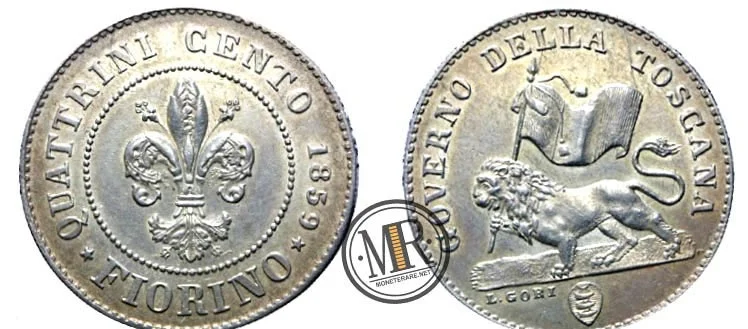
When Leopold II abdicated in 1859 in favor of the Provisional Government of Tuscany, this governing body minted a new version of the florin featuring a lion facing left holding an Italian flag on the obverse.
The Dutch Florin
When Florence began minting Florins in the 13th century, they quickly imposed themselves in commercial exchanges, leading the Netherlands to adopt the Dutch Florin (Nederlandse gulden) as currency in the 15th century.
In the Netherlands, the Florin remained the official currency until it was gradually replaced by the Euro starting in 1999.
However, some former Dutch colonies have retained it as their official currency.
This is the case for the Dutch Antilles, which still maintain the Netherlands Antillean Florin, and the island of Aruba, which separated from the Dutch Antilles but still uses the Aruban Florin as its currency.
We hope you enjoyed this article. If so, we would appreciate it if you could leave a positive rating below (stars) or a comment on the article. If you want to continue reading about other interesting gold coins, we recommend checking out the articles suggested below.
Other gold coins that may interest you:
Where to sell or buy coins
Do you own coins like these, a lot, or a rare piece? Register on Catawiki and place your first bid, or submit a lot for sale — signing up is free. For years we have used this auction site, our partner. Browsing auctions is not enough: start with registration and a first action (a bid or a listing). Register and start.