
Baiocco
Updated:
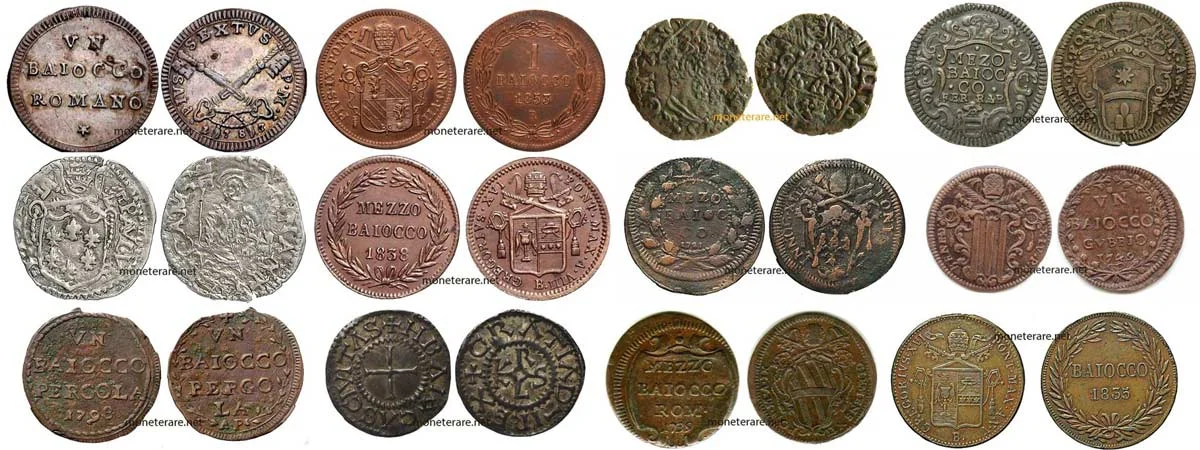
The Baiocco was initially a coin made of silver in the 15th century. Later, the same name was used for numerous other coins. On this page, we will explore many interesting facts about this particular coin, happy reading.
Origin of the Term Baiocco
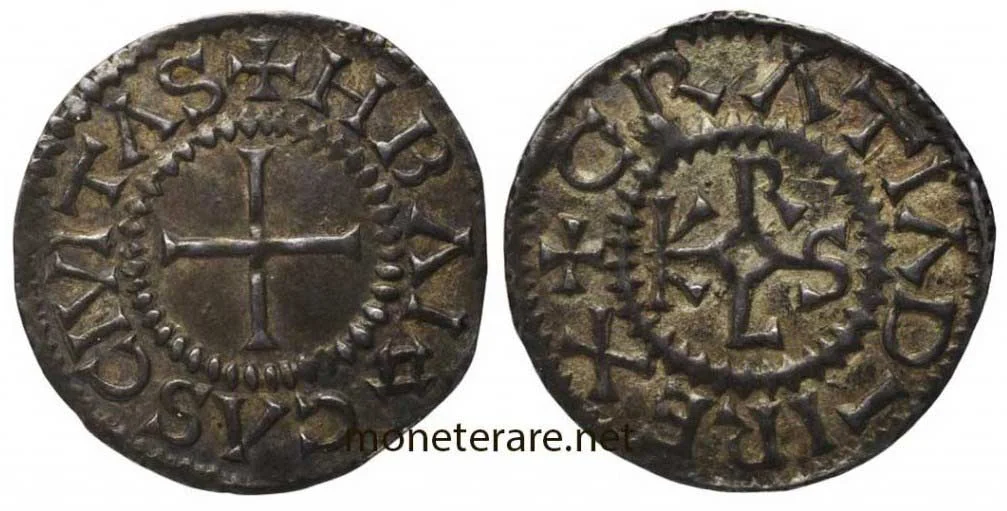
The history of the origin of the term Baiocco is mostly unknown. It is suspected that the name may derive from a silver coin of the Merovingian era with the inscription “BAIOCAS CIVITAS”, meaning City of Baiocas.
Although the origin of the term is not certain, it is known that the word quickly became dear to popular culture, so much so that it was subsequently used for numerous coins of different denominations from the Papal States to the Kingdom of Naples.
History of the Baiocco Coin
The Baiocco, also known as Bajocco, was also referred to as Bolognino because initially its value was equal to the Soldo, that is, 12 denari.
Over time, the size, weight, and value of the coin itself changed.
At one point, around the mid-16th century, it became so thin that it earned the nickname “Baiocchino” or “Baiocchétto” because it actually weighed less than 0.25 g.
It underwent numerous other material variations, losing more and more silver and becoming increasingly of low alloy, to the point of being referred to derogatorily as Baiocchella during the period of Sisto V from 1585 to 1590.
Another version of this rare coin made of copper during the Roman Republic in the 17th century, specifically between 1798 and 1799, was also nicknamed Alberétto (it was withdrawn from circulation in 1801).
“Baiocco dell'Albero” was instead the nickname of the Baiocco in bronze from the Roman Republic of 1849. The nickname referred to the fascio, as it was present on the baiocchi of this period.
Curiosities about the Baiocco.
The term Baiocco also became over time a true synonym for soldo or small change. Even today, it is common to hear the phrase “I’m left without a Baiocco” to indicate the condition of being broke or derogatory phrases like “It’s not worth a Bajocco” to belittle its value.
It seemed that Mazzarò was sprawled out as large as the land itself, and that people walked on his belly. – Instead, he was a little man, the litter-bearer said, that you wouldn’t have given a baiocco for, just by looking at him; and he was only fat in the belly, and it was unclear how he managed to fill it, because he ate nothing but two coins worth of bread; and yet he was as rich as a pig; but he had a head that was a gem, that man.
Giovanni Verga – La Roba – 1883
The Baiocco was also one of the most imitated and counterfeited coins. In fact, it is easy to find numerous imitations of it on the market. But let’s look at some examples of this rare coin.
Silver Baiocco
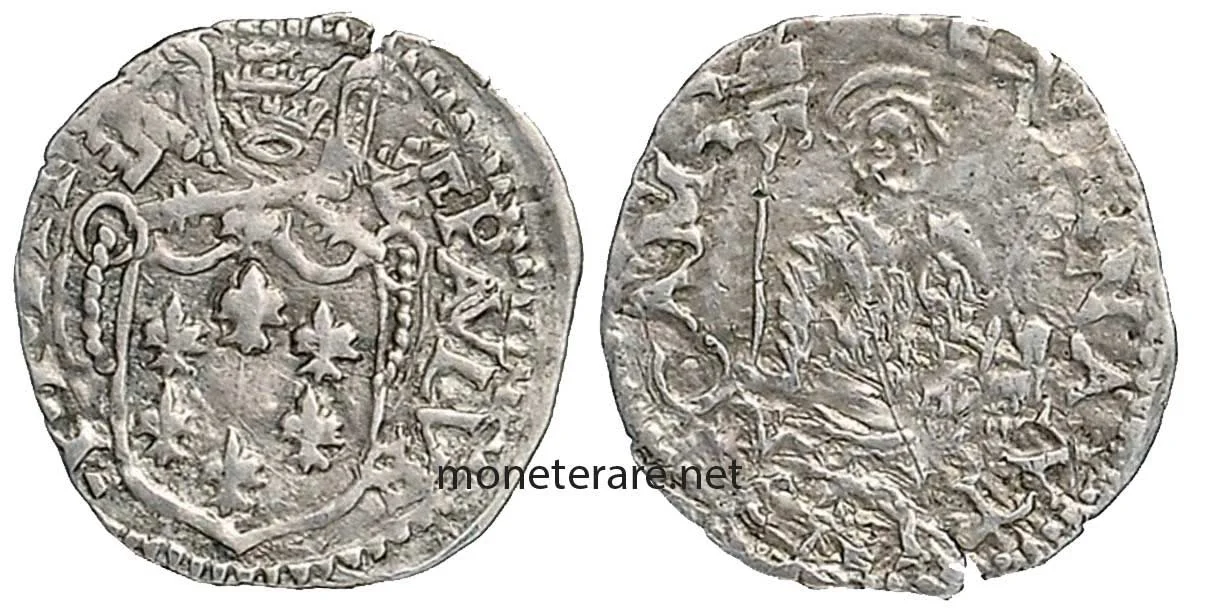
This is a specimen of Silver Baiocco with a heart-shaped coat of arms.
The exact date of this silver coin, which has a diameter of 14 millimeters and an approximate weight of 0.37 grams, is not known.
On the Obverse, the papal coat of arms in the shape of a heart with flowers under the crossed keys. At the top of the coin, the Pope's Tiara and around the perimeter the inscription PAVLVS •P •P •III. On the Reverse, the half-length engraving of Saint Venantius holding a banner with his right hand and the city with his other hand. Around it, the inscription S •VENANTIVS •CAMERI indicates the mint of Camerino.
Value of the Silver Baiocco
A beautiful silver piece classified as qSPL was sold at auction on December 10, 2013, for €767
Roman Baiocco
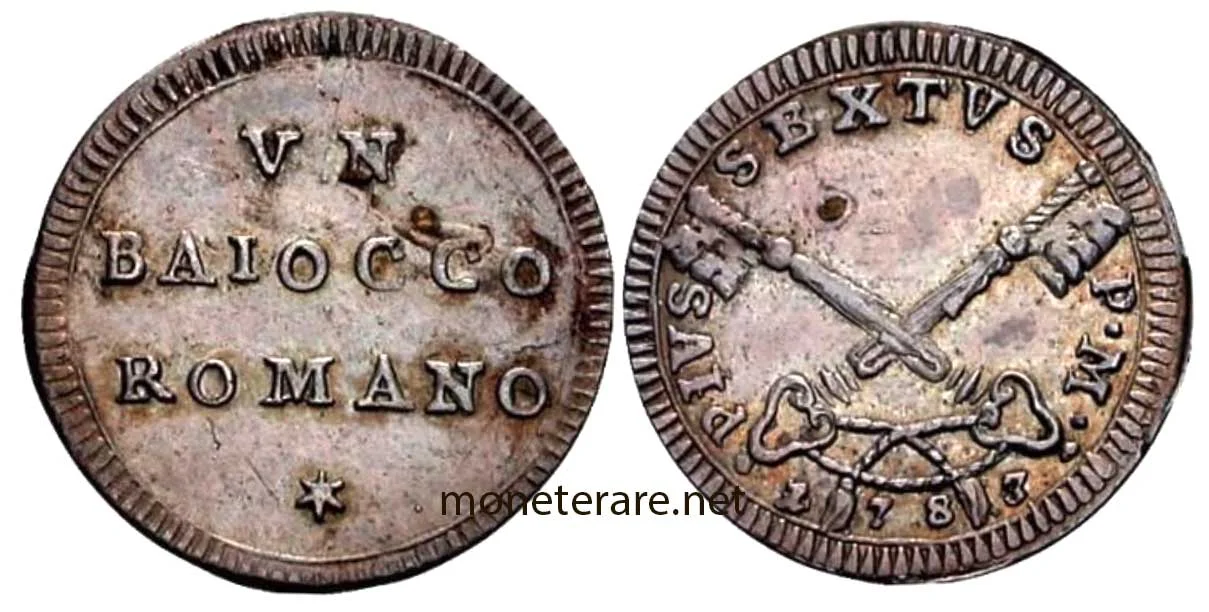
The Roman Baiocco, also known as “Baiocchella,” was minted between 1780 and 1783 by the Rome mint. All are classified as R, with those from 1782 and 1783 being R2.
Made with a mixture of 458, which is an alloy with a low silver content (hence the derogatory term Baiocchella).
The edge is smooth, the diameter is significantly reduced to 17 millimeters, and the weight does not even reach 1 gram. On the Obverse, there is the Cross of Saint Andrew with ribbons on the tied keys and the inscription PIVS – SEXTVS – P • M. The year of minting is located between the ribbons of the keys at the bottom.
The Reverse features the inscription VN / BAIOCCO / ROMANO arranged in three lines and a star at the bottom.
Value of the Roman Baiocco
- At an auction on May 27, 2008, a specimen of Baiocchella R2 from 1783 in FDC was sold for €220.
- On January 18, 2013, a Roman Baiocco from 1782 R2 in SPL+ was auctioned for €138.
A Baiocco Pergola
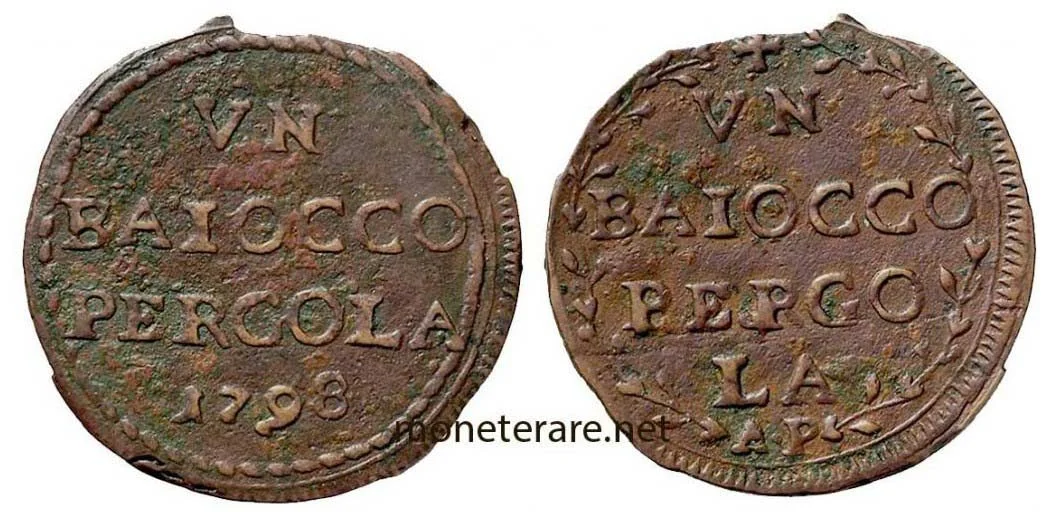
The Baiocco Pergola is a type 1 coin minted in 1798 that falls into the R category of rare coins. Made of copper, it has a variable weight between 7 and 10 grams and an irregular diameter of around 32/33 millimeters.
On the Obverse, the engraver Andronico Perpenti has inscribed in 4 lines the text: UN / BAIOCCO / PERGOLA / 1798. A beaded circular frame surrounds the inscription.
On the Reverse, also in 4 lines, the inscription reads UN / BAIOCCO / PERGO / LA with the initials of the engraver Andronico Perpenti below, surrounded by a wreath of olive leaves and a cross at the top of the coin.
Value of the Baiocco Pergola Coin
- On April 23, 2013, an example of the second type coin R2 in BB+ condition was auctioned for 1,035€
- On June 10, 2010, an example of this rare coin in BB condition was auctioned for 437€
Baiocco Coin
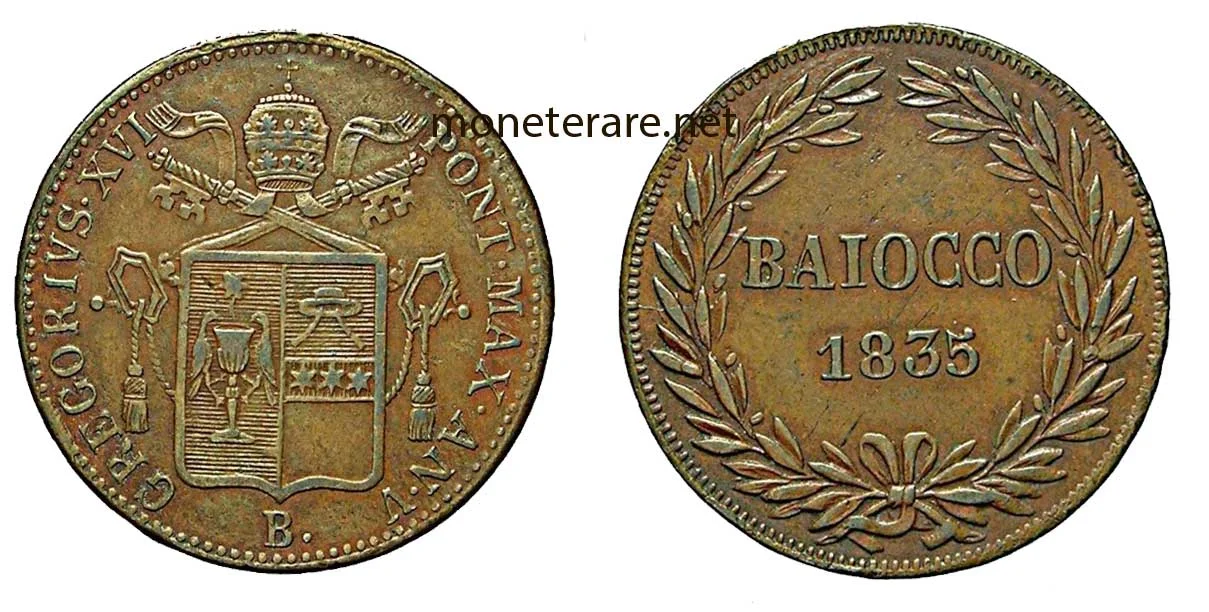
Baiocco coin minted from 1835 to 1845 at the Mint of Bologna and Rome.
On the Obverse, there is a central coat of arms with crossed keys under the papal crown, bows, and tassels. Additionally, around the beaded edge, there is the inscription GREGORIVS • XVI - PONT • MAX • A • year. The mint mark is located below the Vatican coat of arms.
The coin has a smooth edge, a diameter of 3 cm, and weighs over 10 grams. It is made of copper with French axes.
Value of the Baiocco from 1835 to 1845
The rarest are those from 1838 with R3. Also, those from the years 1835 / 1839 / 1841 X / 1841 XI / 1842 XII / 1843 XIII, which are classified as R2, are rare coins. Furthermore, those from 1838 VIII, 1840, and 1844 XIII fall into the classification R.
- On November 28, 2007, an SPL+ specimen from 1842 R2 was sold at auction for €196
- Also on the same day, a coin R from 1835 V, classified as qFDC, was auctioned for €173
1 Baiocco 1850
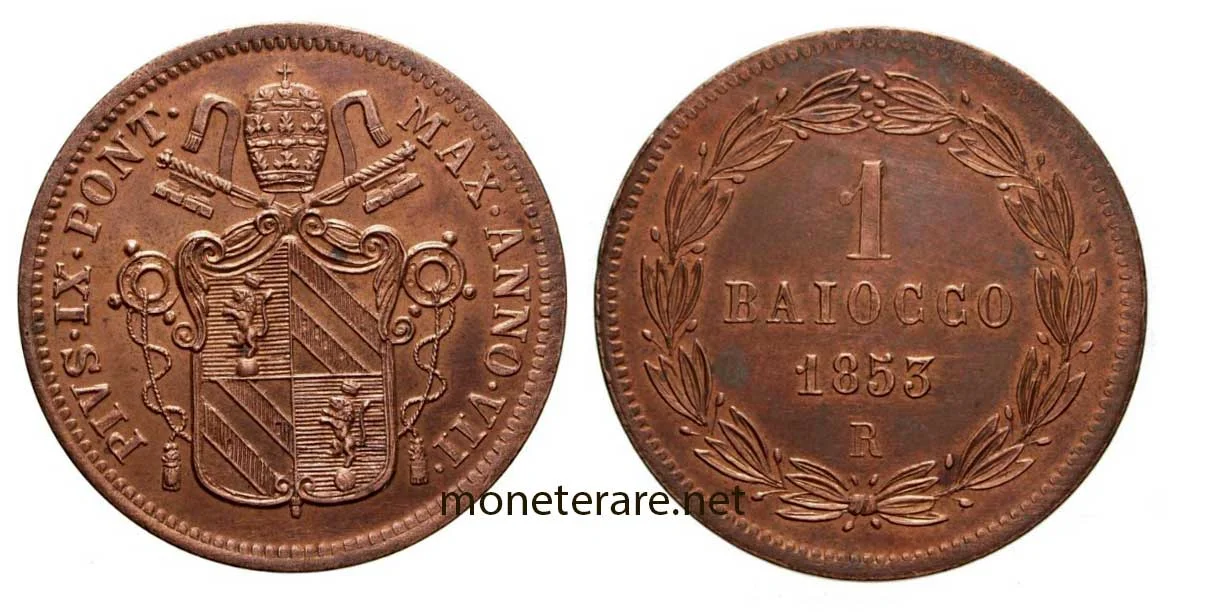
Between 1850 and 1853, between Rome and Bologna, there were issued 13,574,100 coins of 1 Baiocco. They were made of copper, but some, such as those from 1850 V from the Rome mint, seem to have been minted in silver.
With a smooth edge, the weight is 10g and the diameter is between 29 and 30 millimeters.
On the Obverse, the papal coat of arms is engraved with embellishments and hanging cords attached to the crossed keys right above the coat of arms and below the decorated Tiara. The inscription is divided between left and right “PIVS • IX • PON • MAX • ANNO in Roman numerals“. The author is Nicola Cerbara.
The Reverse features a central banner inscription on 4 lines: 1 / Baiocco / year / mint. Surrounding the inscription is a crown of laurel leaves.
1 Baiocco 1850 Value
- At an auction on April 22, 2009, an R2 specimen of 1853 in SPL+ condition was sold for €173
Half Baiocco Coin
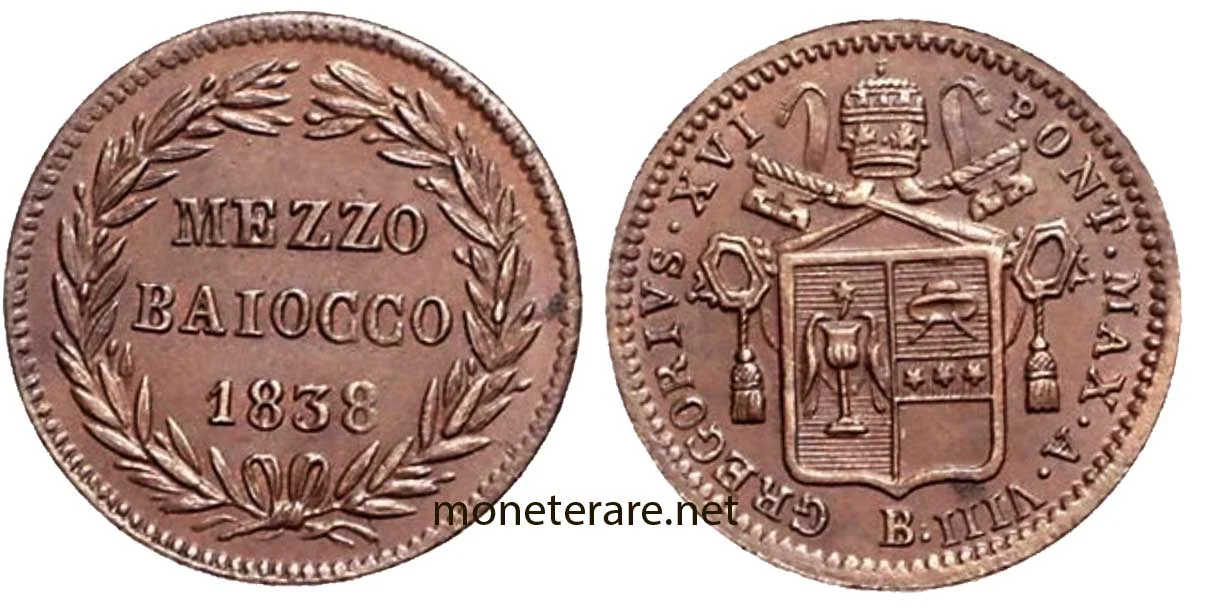
This Half Baiocco coin was minted between 1835 and 1845, made of copper with a smooth edge, weighs just over 5 g and has a diameter of 25.5 mm.
On the Obverse, it features a coat of arms topped with two crossed keys with a cord and bow hanging to the side. Additionally, a Papal crown is at the center of the coin at the top, surrounded by the inscription GREGORIVS • XVI - PONT • MAX • A • followed by the year of the papacy.
The mintmark is located at the bottom of the central axis.
On the Reverse, the inscription MEZZO / BAIOCCO / THE DATE appears prominently, surrounded by an olive wreath with a central bow, arranged in three lines.
From the table published by the Annonaria Congregation of the Legation of Forlì, one can infer what a Half Baiocco could buy in terms of food products between 1835 and 1845. The shopping list costing a Half Baiocco could have been approximately as follows:
- 84 g of Wheat Flour or processed pasta
- 350 g of Oats
- 240 g of Barley
- 200 g of Bean Flour
- 270 g of Semolina
To be considered rare coins and thus classified as R, one must look among those that bear one of these dates:
- 1835 V
- 1837 VII
- 1838 VIII
- 1840 IX
- 1841 X
- 1842 XI
- 1843 XII
- 1844 XIII
Half Baiocco Value
A specimen R of this coin from 1838 VIII was auctioned on April 14, 2007, for €150, and its condition was SPL.
Half Baiocco Ferrara
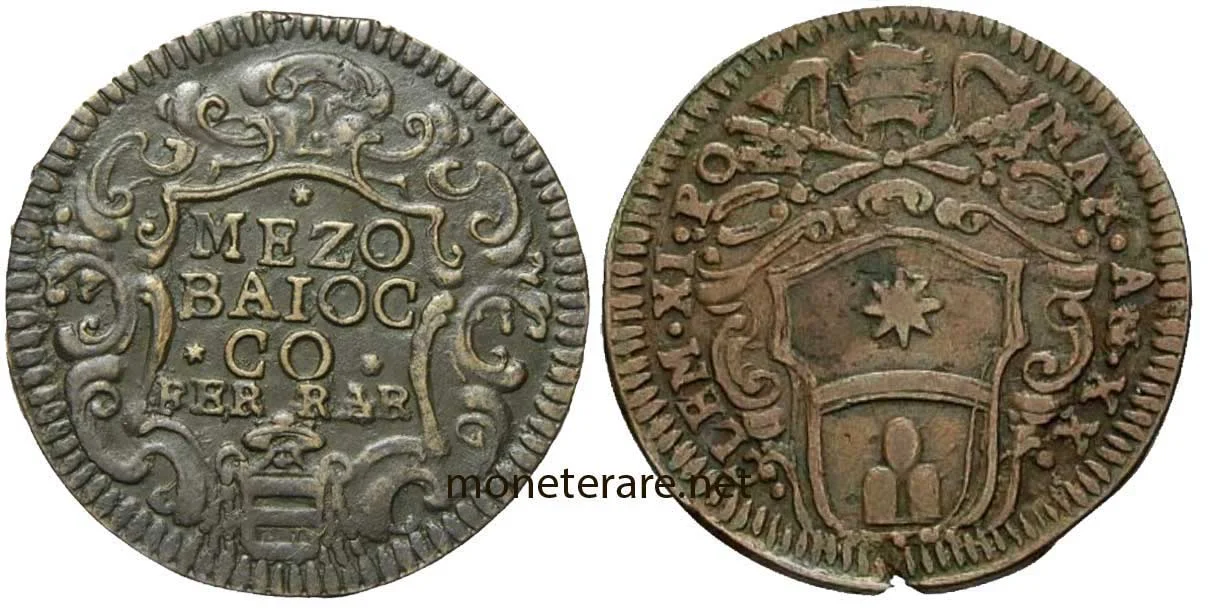
Minted in the 19th and 20th centuries, it is classified as Rare R, but there are also specimens classified as R2 from the year 19 that have variants.
The Half Baiocco Ferrara of Clement XI Pope is a copper coin with an approximate diameter of 27 to 30 millimeters and a weight ranging from 5.27 to 6.85 g.
On the Obverse, it features the papal coat of arms set in an oval with a “cartoccio” frame. Above are the crossed keys under the triregnum. On the sides, the inscription • CLEM • XI • PO – MAX • AN • year of the papacy •
On the Reverse, the inscription is engraved in a central banner on four lines “MEZO / BAIOC / CO / FER RAR” topped by a 5-pointed star. Surrounding the inscription are carved decorations and below, in closure, the arm of Cardinal Legate Giovanni Patrizi.
Value of the Half Baiocco Ferrara
- A specimen R from the 20th century in BB+ condition was auctioned on May 27, 2008 for €159
Half Baiocco Romano
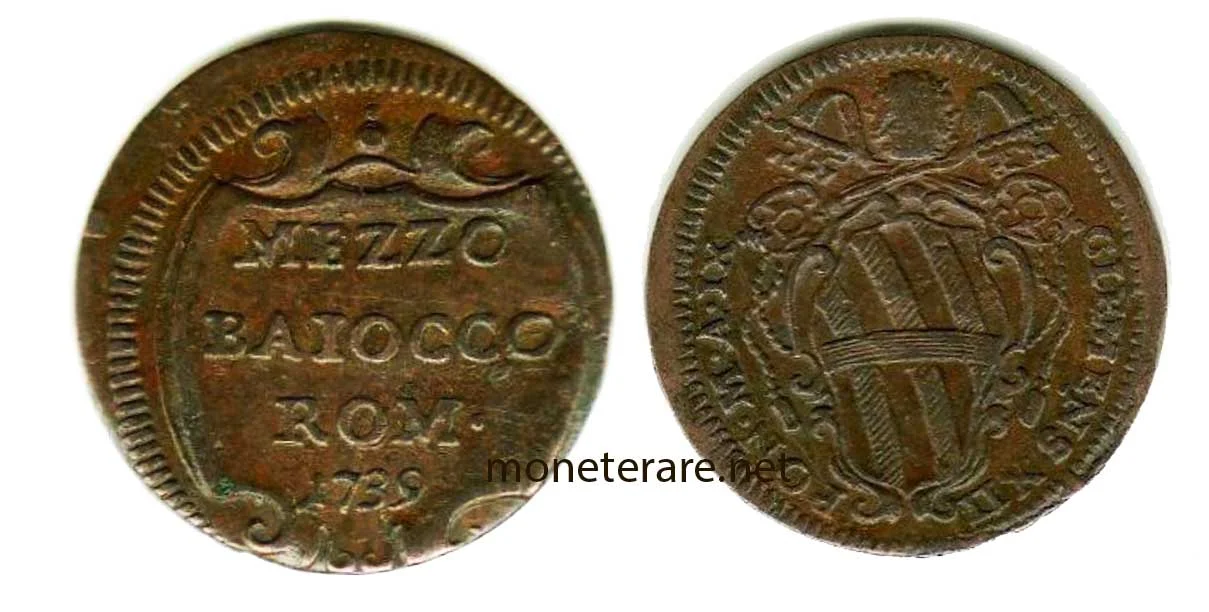
The Half Baiocco Romano of Clement XII was minted from 1738 to 1740 with numerous variants.
It is a rare coin with a smooth edge, a diameter of 25/26 mm, and made of copper.
On the Obverse, there is the classic oval coat of arms with leaf decoration, topped by crossed keys with bows and side cords tied to the key handle. Additionally, all around is a serrated frame and at the bottom the inscription “DX: CLEMENS XII – PON • M • A • year of pontificate”.
The Reverse has a central banner inscription on three lines: MEZZO /BAIOCCO / ROM, below the inscription in a quadrilateral cartouche is the year of minting.
Value of the Half Baiocco Romano
The rarest half baiocco romano coins among these are those of 1739 IX which are classified as R2
- An R2 specimen of 1739 in BB+ condition was sold at auction on October 12, 2003 for the amount of €196
- Another BB coin from 1740 (R) was sold on May 27, 2008 for €85.40
Didn't find what you were looking for? Check these topics:
- If you want to see coins at auction right now, visit this page.
- We talked about Roman Coins on this page and Greek coins.
- Read the history of money on this page.
- If you are looking for Rare Euro Coins then click here.
- If you want info on Ancient Coins and their value, you can find it here.
- We talked about old Italian currency here: rare lire value.
- We discussed the value of Telephone Tokens on this page.
- All information about 500 silver lire can be found here.
Where to sell or buy coins
Do you own coins like these, a lot, or a rare piece? Register on Catawiki and place your first bid, or submit a lot for sale — signing up is free. For years we have used this auction site, our partner. Browsing auctions is not enough: start with registration and a first action (a bid or a listing). Register and start.