
Sestertius
Updated:
The sestertius is perhaps one of the most well-known coins among all types of coins minted in ancient Rome. Few know about the dupondius or the quinarius, but almost everyone has heard of sestertii, if only for the famous Roman saying:
“Caesar, the people demand sestertii!”
“No, no, tell them I'm going straight!”.
In this page, we will talk about the Roman coins “Sestertii” and we will list, as usual, their characteristics, history, curiosities, and of course the value that these rare ancient coins can have. Happy reading.
Introduction to the Roman Sestertius
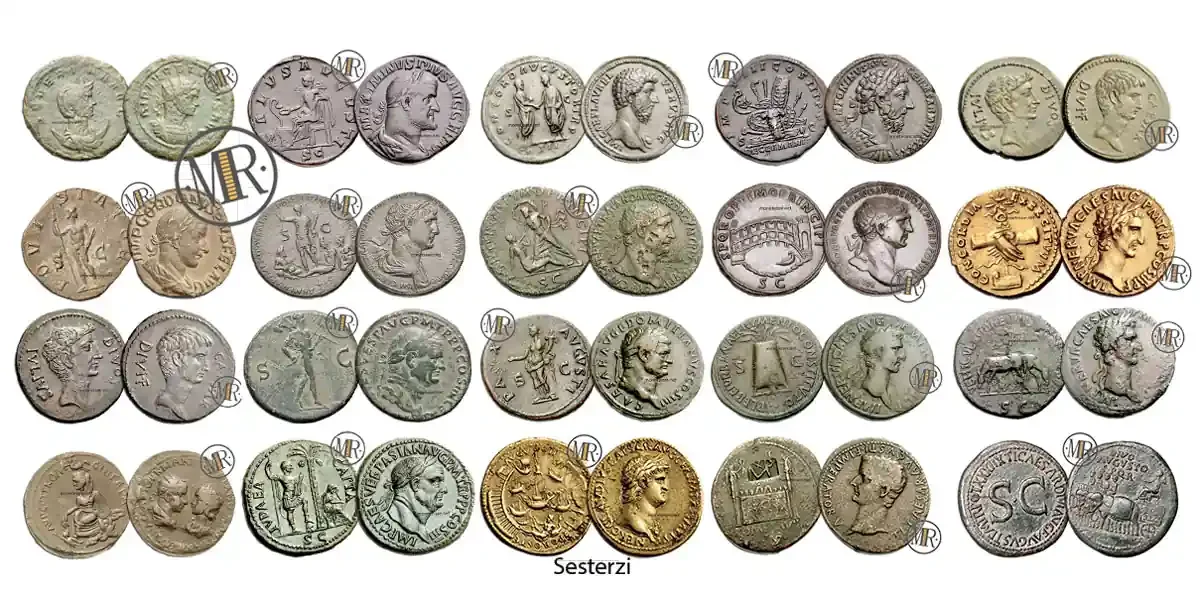
Around 211 BC, as we mentioned in our article on Roman coins, the denarius and its fractions were introduced. These were:
- the quinarius (½ denarius)
- the sestertius (¼ denarius).
Characteristics of the Roman Sestertius
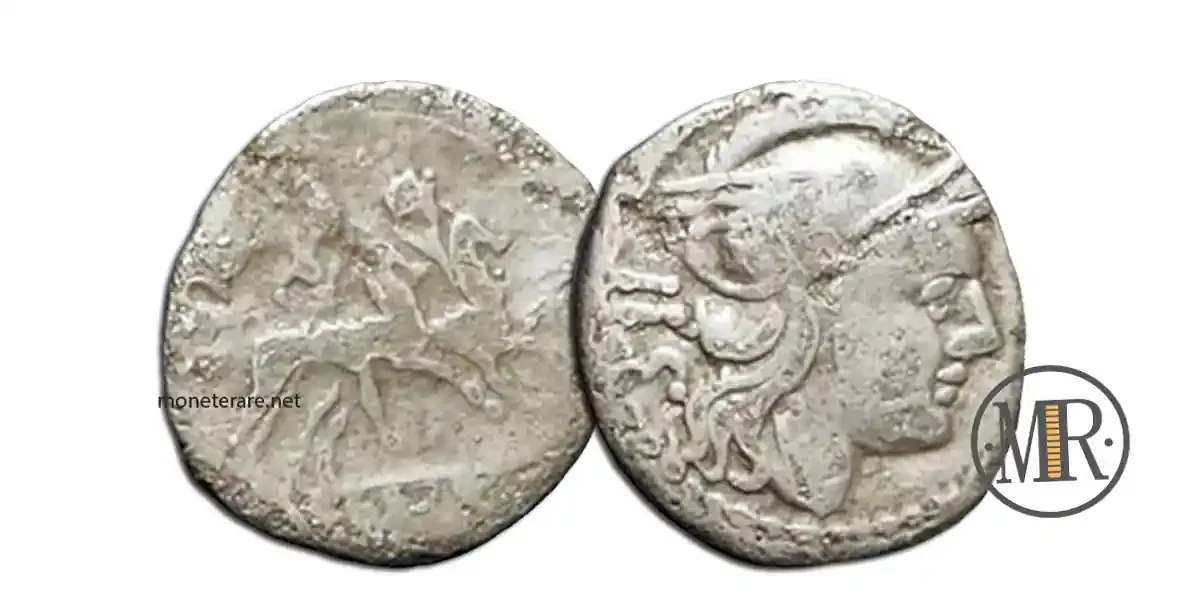
The Sestertius, like the Denarius and the Quinarius, was initially a silver coin and its name derives from its relation to the more well-known Roman coin: the As.
It weighs about one gram and has a diameter ranging from 12 to 17 millimeters.
The Sestertius was worth two and a half asses, in fact, the name Sestertius comes from the Latin “semis-tertius”, which meant “half of the third [as]”. The symbol HS by which it is abbreviated also derives from the way it was represented. Indeed, two “I”s side by side represented two asses, and the “S” meant “semis” which is “half [of the third as]”.
Since a horizontal line was used to indicate numbers in the archaic period, cutting through the letters approximately in half, the original symbol was IIS, which later became HS for simplicity.
History of the Roman Sestertius
Despite its introduction around 211 BC, the Sestertius was minted sporadically during the Roman Republic, and it was only after the monetary reform of Augustus around 23 BC that it became more widespread.
The reform also led to a change in material and design for the Sestertius.
It became a large-format coin and began to be minted no longer in silver but in orichalcum. Do you know what orichalcum is?
The orichalcum is an alloy very similar to brass, composed of a high percentage of copper (90%) and a portion of zinc (10%), used for minting the dupondius (equivalent to 2 asses). As mentioned, the dimensions of the Sestertius also changed, which came to have a diameter of 32-34 millimeters, a thickness of 4 millimeters, and a weight of 25-28 grams!
The last Sestertii were minted almost until the end of the 3rd century AD, but for quite some time, due to rising inflation, the double Sestertius had been introduced, reduced in size and quality.
The Value of the Roman Sestertius
Initially, the Sestertius had a value of 2 and a half asses.
When around 142 BC, due to variations in the weight of the as, the value of the denarius was raised from 10 to 16 asses, the sestertius assumed the value of 4 asses, thus remaining equivalent to ¼ of a denarius.
As we know, the history of Roman coinage is marked by monetary reforms, which over the centuries have led to the variation of the types of coins that circulated.
How and Where to Buy a Roman Sestertius
If you are interested in buying a Sestertius to add to your coin collection, we definitely suggest you check out this portal where every week (in the dedicated section for “ancient Roman coins”) there are hundreds of pieces for sale.
The Price of the Roman Sestertius
The price of Sestertii varies greatly based on the condition of the coin. In fact, Roman coins like the Sestertii are truly rare coins to find, especially in excellent condition, and in that case, they can reach very high prices.
Depending on the condition and rarity, however, you can find Sestertii at lower prices, accessible even to those who want to start a coin collection.
- An anonymous silver Sestertius from the Roman Republic, for example, can be found for sale for €30 on the portal (click here) that we use to purchase coins.
Sestertius Julius Caesar
Description
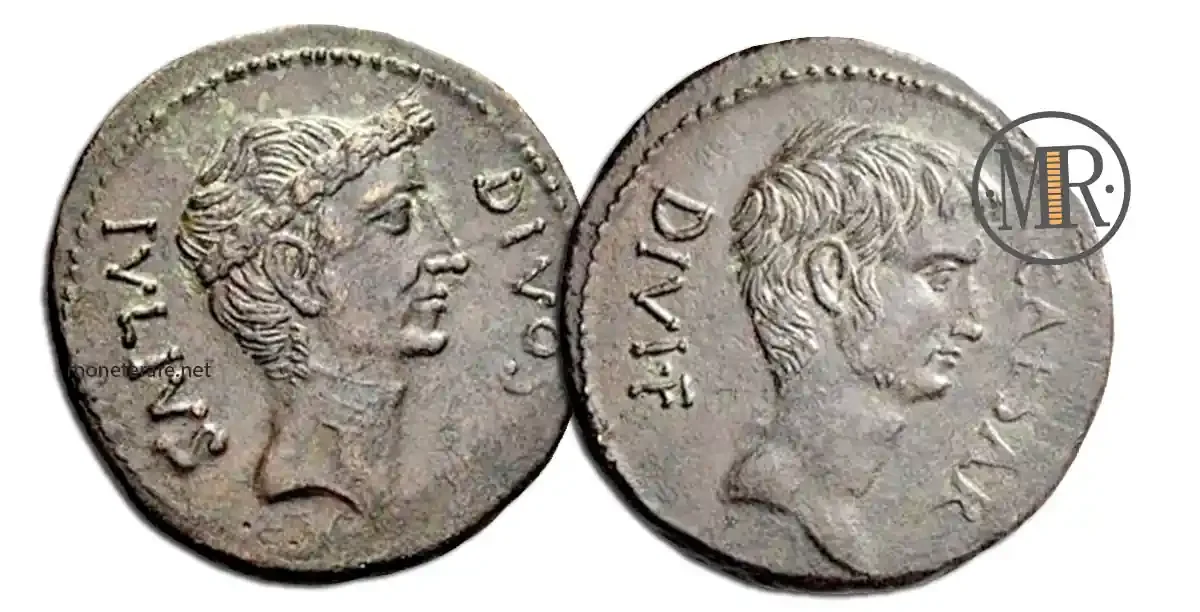
The Sestertius minted during the period when Julius Caesar dominated Roman politics is a small bronze coin weighing about 19-22 grams and with a diameter of approximately 30 millimeters.
On the obverse of this ancient coin, the profile of Octavian stands out, surrounded by the inscriptions “CAESAR” and “DIVI·F”, while on the reverse, the depicted profile is that of Julius Caesar, adorned with a laurel crown and the inscription “DIVOS IVLIVS”.
In another version of the Sestertius of Julius Caesar, on the reverse, the inscription “DIVOS IVLIVS” is at the center, surrounded by a laurel crown.
History and Curiosities
Julius Caesar is considered the first of the 12 “Caesars”.
Although he assumed the role of dictator and was proclaimed imperator by the legions, the Roman Empire was born with Caesar's adopted son, Octavian Augustus, who transformed the title of imperator into one equivalent to that of a prince and made it hereditary.
Value of the Roman Sestertius of Julius Caesar
- In good condition, these coins of Julius Caesar can reach very high prices on specialized auction sites, exceeding €10,000
Augustus Sestertius
Description
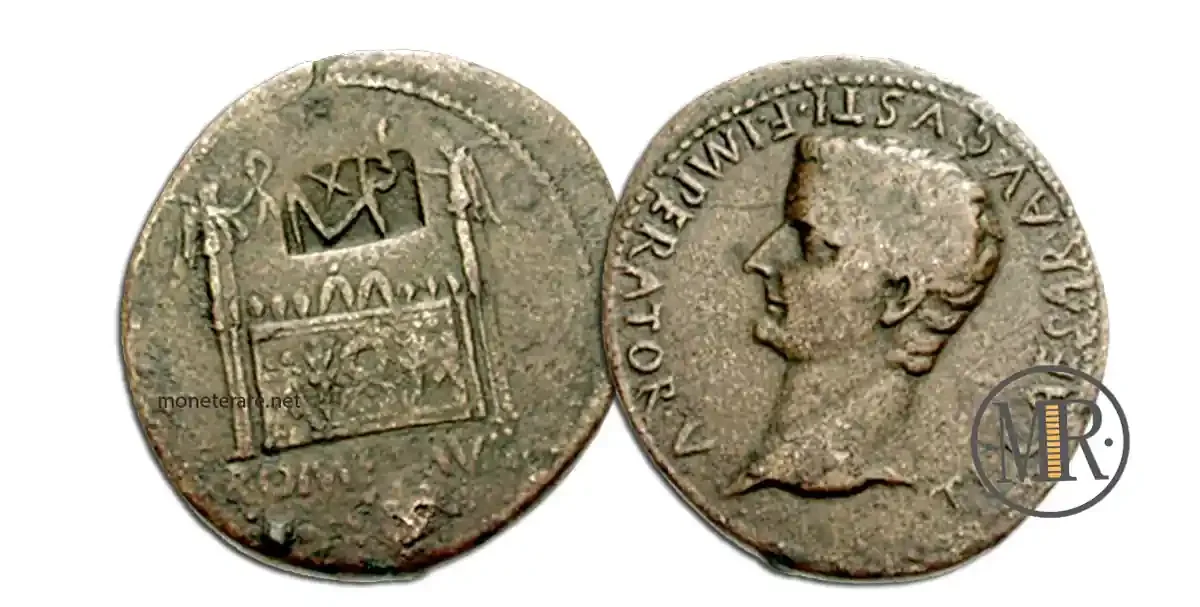
The Sestertii minted by Augustus were, following his monetary reform, minted in orichalcum and had a weight of about 27.28 grams and a diameter between 29 and 36 millimeters.
On two orichalcum Sestertii of Augustus, on the obverse appears the profile of Tiberius (his successor), facing right on the sestertius that celebrates new campaigns in Germany, facing left on the Sestertii for the final victory in Illyricum.
There are many Sestertii that bear the effigy of Octavian Augustus, starting from that of Julius Caesar, as well as many of his successors, who dedicated one side of their coins to him.
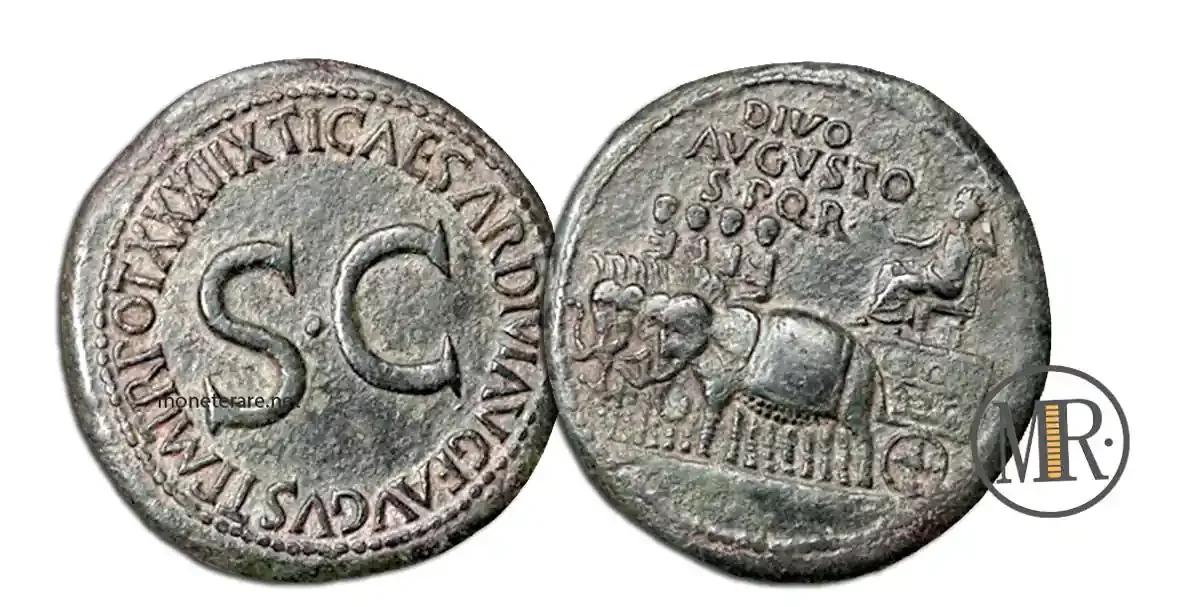
On a beautiful Sestertius of Tiberius, auctioned for 1,900 €, classified as R, stands out on the obverse a quadriga of elephants carrying Augustus in celebration.
History and Curiosities
With his monetary reform, Augustus replaced the Sestertius, which had until then been a small silver coin of about one gram and very easy to lose, starting the minting of Sestertii of orichalcum weighing about 27 grams and around thirty millimeters in diameter, also excellent as a means of propaganda.
Value of the Roman Sestertius of Augustus
- In an auction passage, a specimen of Sestertius of Augustus between MB and BB, depicting Augustus with a laurel branch seated on a chariot drawn by 4 elephants was awarded for 150€
Nero Sestertius
Description
On the obverse of all Nero Sestertii, the bust of the Emperor appears, while the scene depicted on the reverse often changes.
At least 9 main types are known, including, for example, some with Winged Victory, some with Roma in a helmet and armor, with the Temple of Janus, with a Triumphal Arch, with Ceres and Annona, etc…
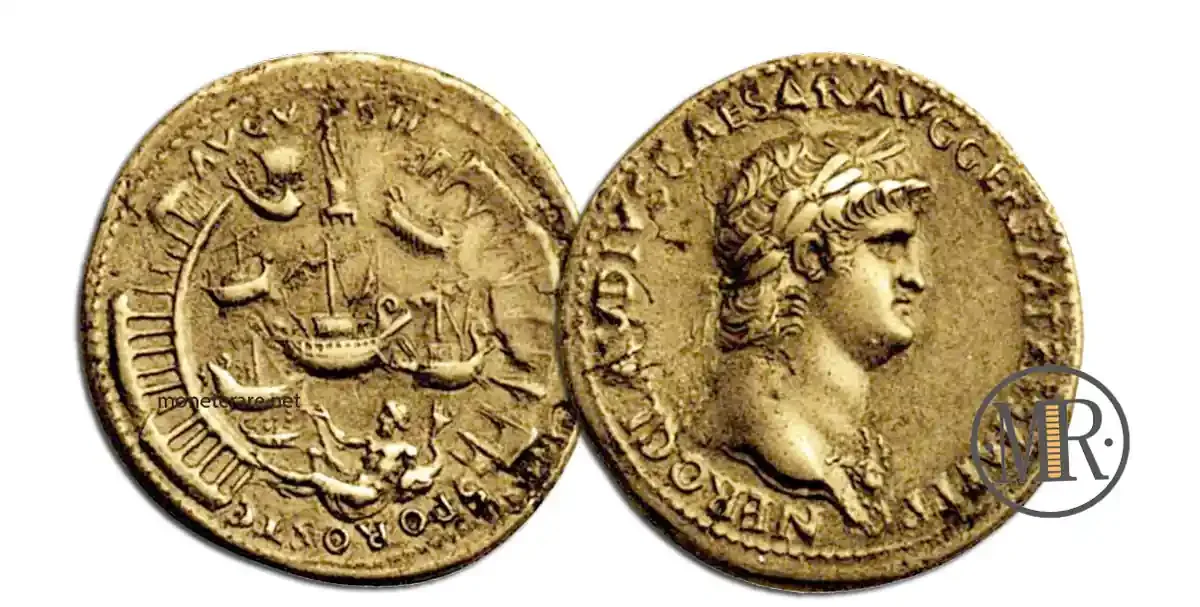
Noteworthy is what is perhaps one of the rarest, most sought-after, and beautiful coins, the Nero Sestertius with the view of the Port of Ostia on the reverse. The number of boats represented in the port can vary from 7 to 11, and the lighthouse with the statue of Neptune and the figure of the Tiber appear below.
History and Curiosities
Porto (Portus) was the name the Romans gave to the urban agglomeration developed at the mouth of the Tiber north of Ostia by Emperor Claudius and completed under Nero. On the occasion of the opening of the Port of Ostia, the most sought-after Sestertius among those of Nero was minted.
Nero was the last Emperor of the Julio-Claudian dynasty. Years of civil war followed, from which Vespasian eventually emerged as Emperor.
Value of the Nero Sestertius
Nero Sestertii can have very variable values, as always depending on condition and rarity.
- The Nero Sestertius with the Port of Ostia can reach very high prices. At an auction, one was sold for more than €7,000.
- However, there are known auctions where the Nero Sestertius with Ceres seated, in BB quality, was sold for €450.
Sestertius of Vespasian
Description
The Sestertii of Vespasian feature on the obverse the profile of the first Emperor of the Flavian dynasty: Titus Flavius Vespasianus.
On the reverse, the representations are numerous. In fact, coins were one of the main means of propaganda, and the reverse often depicted the victories achieved by various Emperors.
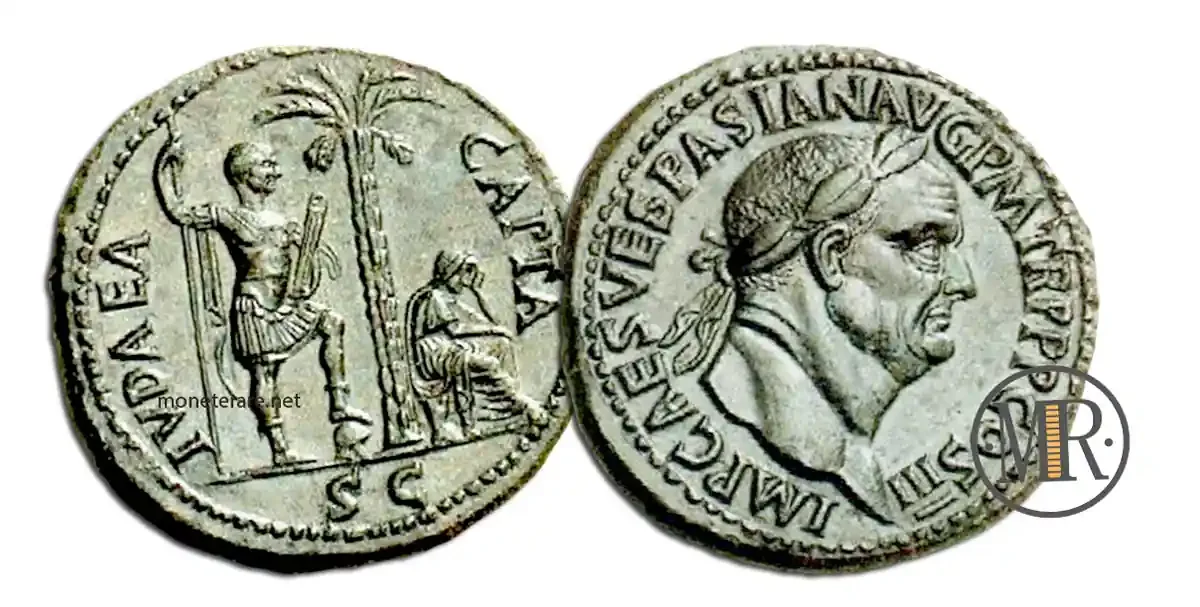
For example, on the occasion of the victory in the campaign against the Jews, Sestertii were minted with a palm on the reverse, flanked by a mourning Judea and a prisoner with bound hands.
The inscription “IVDEA CAPTA” is displayed in a circle.
Another version has on the reverse “PAX AVGVSTI”.
Classified as a rare coin, the Sestertius of Vespasian with Mars with spear and trophy on the reverse is notable.
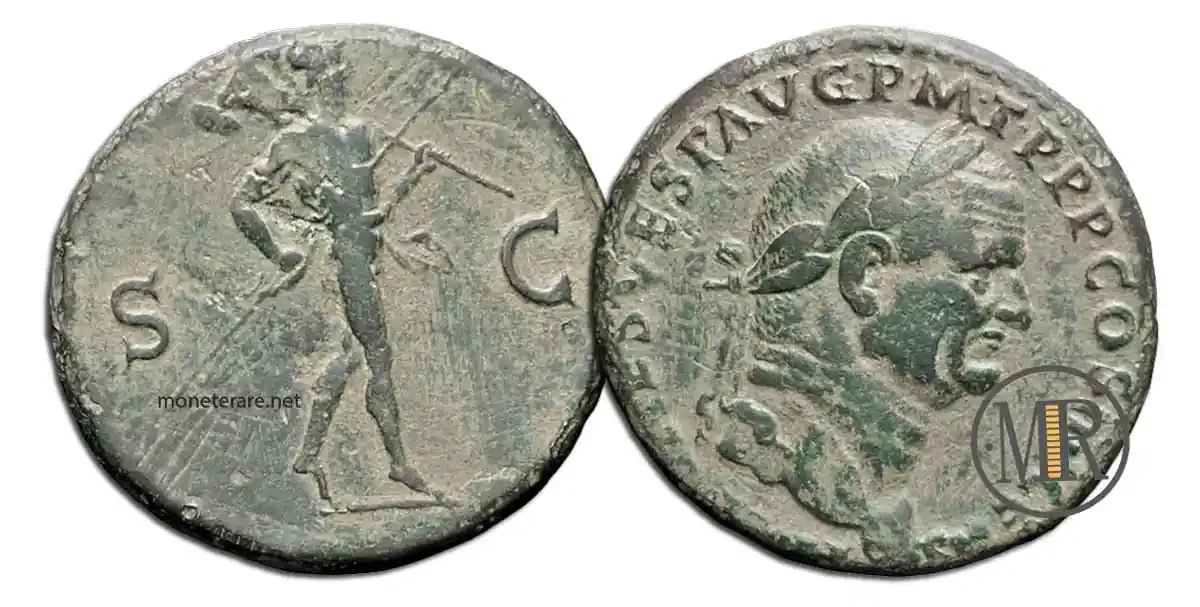
History and Curiosities
Vespasian was the first Emperor of the Flavian dynasty, and rose to power after the civil war, being acclaimed by the legions of Egypt, the Danube, Judea, and Syria.
The Sestertius “IVDAEA CAPTA” celebrates the victory that opened the doors of the Empire for him.
Value of the Sestertius of Vespasian
- A Sestertius ‘IVDAEA CAPTA”, initially valued at 2500 dollars, was sold at auction in 2011 for 100,000 dollars!
- A specimen of Sestertius of Vespasian with seated Peace and olive branch with cornucopia was auctioned on October 21, 2018, for 300€.
Sestertius of Domitian
Description
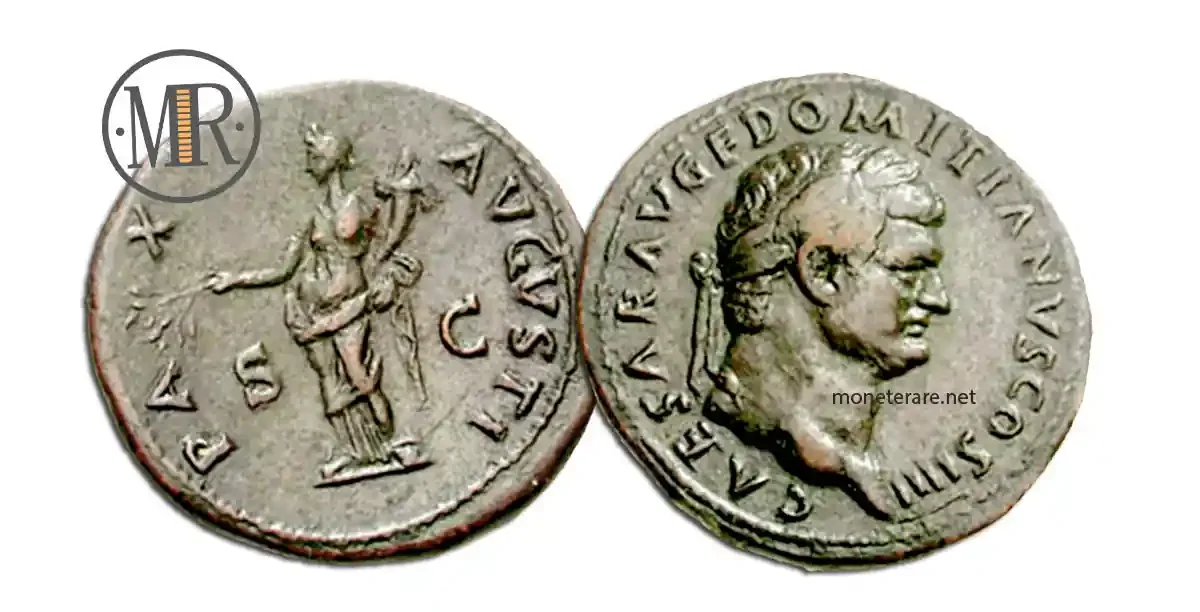
On the obverse of these Sestertii “PAX AVGVSTI” stands the bust of Domitian facing right, while on the reverse Peace stands looking left, holding a cornucopia under her arm and a branch in her hand.
History and Curiosities
Domitian was the last of the Flavians to be Emperor, assassinated in 96 AD following a conspiracy. He was succeeded by Nerva, the first of the “Adoptive Emperors”.
Value of the Sestertius of Domitian
- The Sestertius of Domitian in the photograph is classified as a rare coin R3 and was sold in September 2004, through coin auction sites like this one, for 1,450 dollars!
Sestertius of Nerva
Description
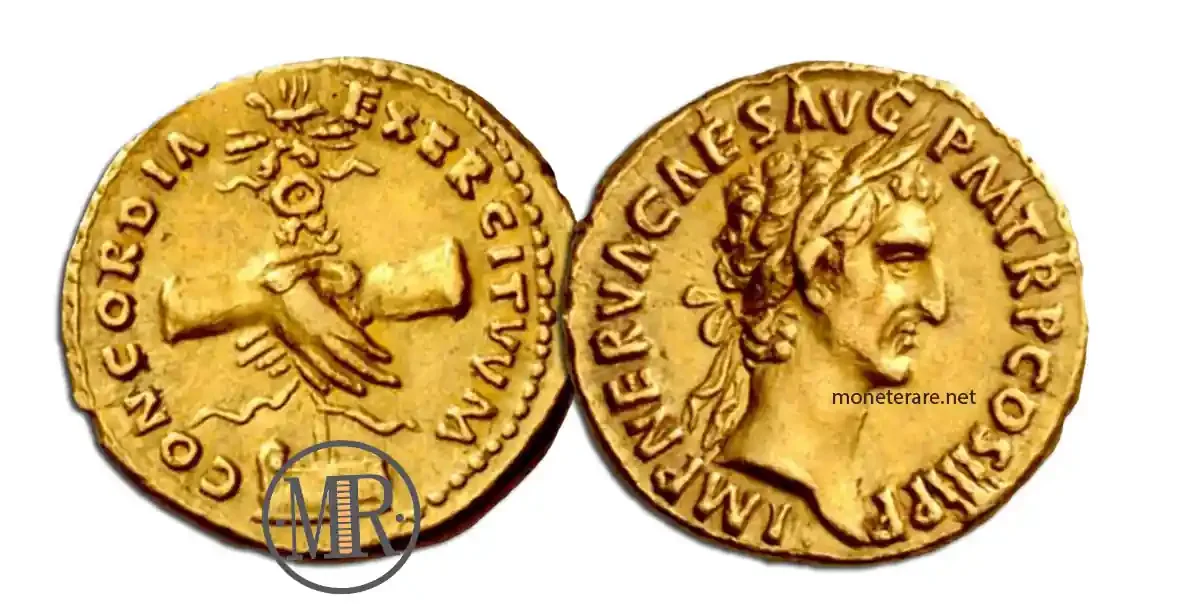
On the obverse of all Sestertii of Nerva, as usual, the bust of the Emperor stands out.
There are different representations on the reverse. One type is known, minted on the occasion of the Jewish tax reform, featuring on the reverse a palm.
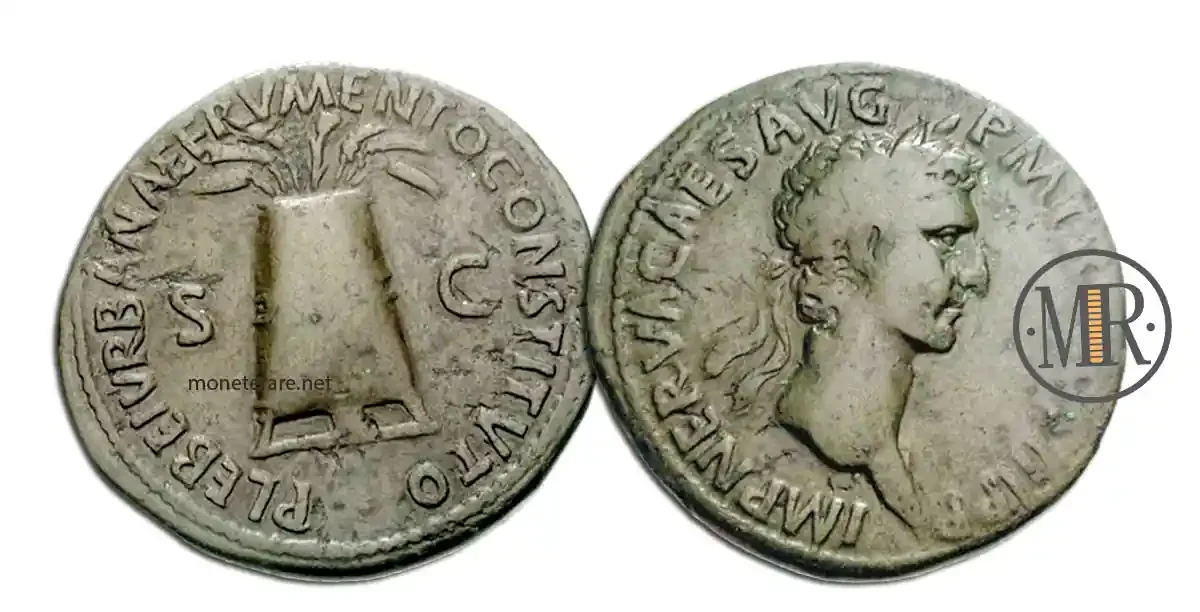
Another Sestertius has on the reverse an ancient container, the modius, filled with six ears of grain and the inscription “PLEBEI VRBANAE FRVMENTO CONSTITVTO”.
Another one on the reverse features two mules grazing, with a cart in the background with a pole and harness.
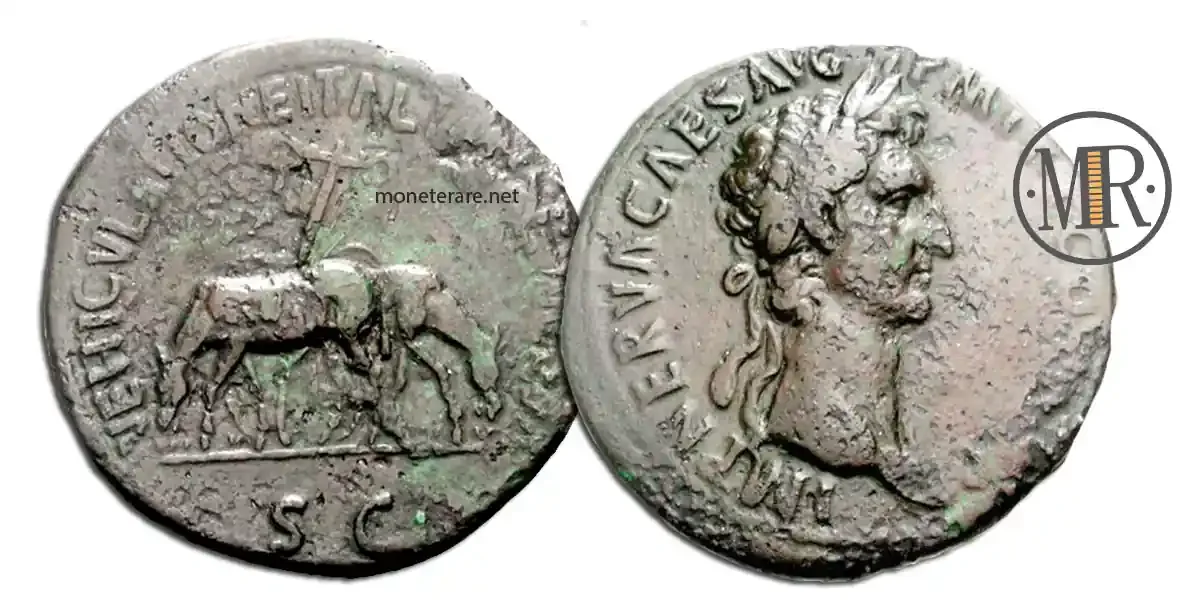
History and Curiosities
Nerva was the first of the so-called “Adoptive Emperors” and introduced the “adoptive principate”, whereby the Emperor had to choose his successor from within the Senate.
Nerva adopted the general Marcus Ulpius Trajan, giving him the title of Caesar Germanicus following an important military victory in Pannonia.
Value of the Roman Sestertius of Nerva
- The Sestertii of Nerva have a variable value like all coins. In an online auction, one was sold classified as BB for 140€.
Trajan Sestertius
Description
A large number of Sestertii are known from Emperor Trajan, at least 16 types minted for various occasions.
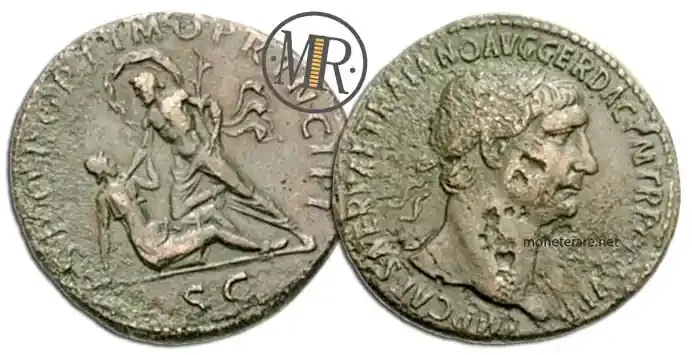
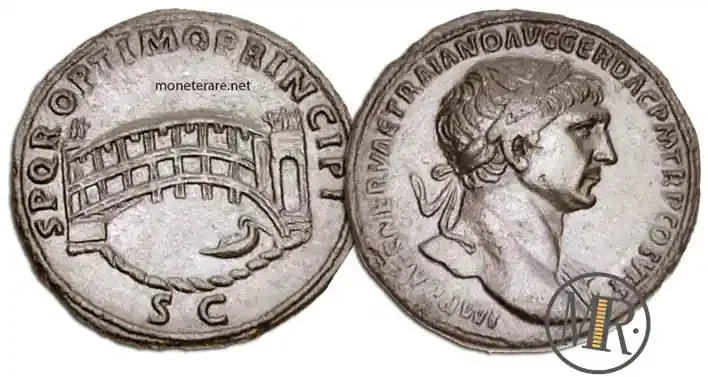
The first are those minted following the conquest of Dacia, a beautiful Sestertius features a Arch Bridge on the reverse, or one where the Tiber subdues and brings down Dacia.
On the occasion of the invasion of the Parthian kingdom, Sestertii were issued to celebrate these eastern campaigns,
On the reverse of one of these, Trajan is depicted standing with sword and spear, with the figures of the Tigris, Euphrates, and Armenia at his feet.
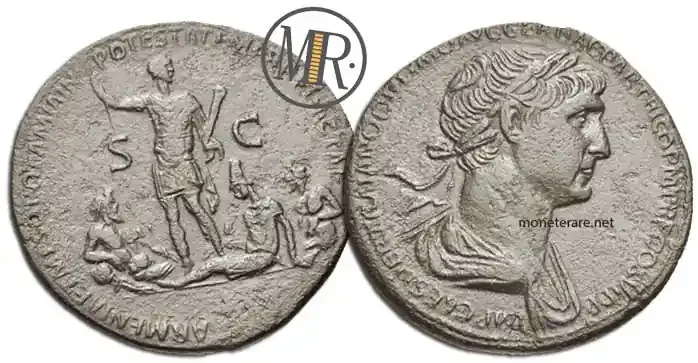
Many Sestertii were minted following the realization of public works.
- A Sestertius minted on the occasion of the construction of the new “Portum Traiani” was auctioned in 2017 for 12,000 €!
History and Curiosities
Under Trajan's leadership, the Roman Empire reached its greatest territorial extent, thanks to the conquests of Armenia, Mesopotamia, Assyria, Dacia, etc.
Trajan is considered one of the best Roman Emperors and was the only one to have a government without any contestation.
Value of the Roman Sestertius of Trajan
- Sestertii of Trajan can be easily found for sale at auctions, where depending on rarity and condition, they can have prices ranging from 70 € and up.
- An interesting auction item is a Sestertius of Trajan in BB+ condition featuring Trajan seated with three men greeting him, sold for 800 € on October 21, 2018.
Sestertius of Marcus Aurelius
Description
On the obverse of many sestertii minted during the co-regency of Marcus Aurelius and Lucius Verus, the profile of either emperor appears, while the reverse is always variable and an excellent means of propaganda.
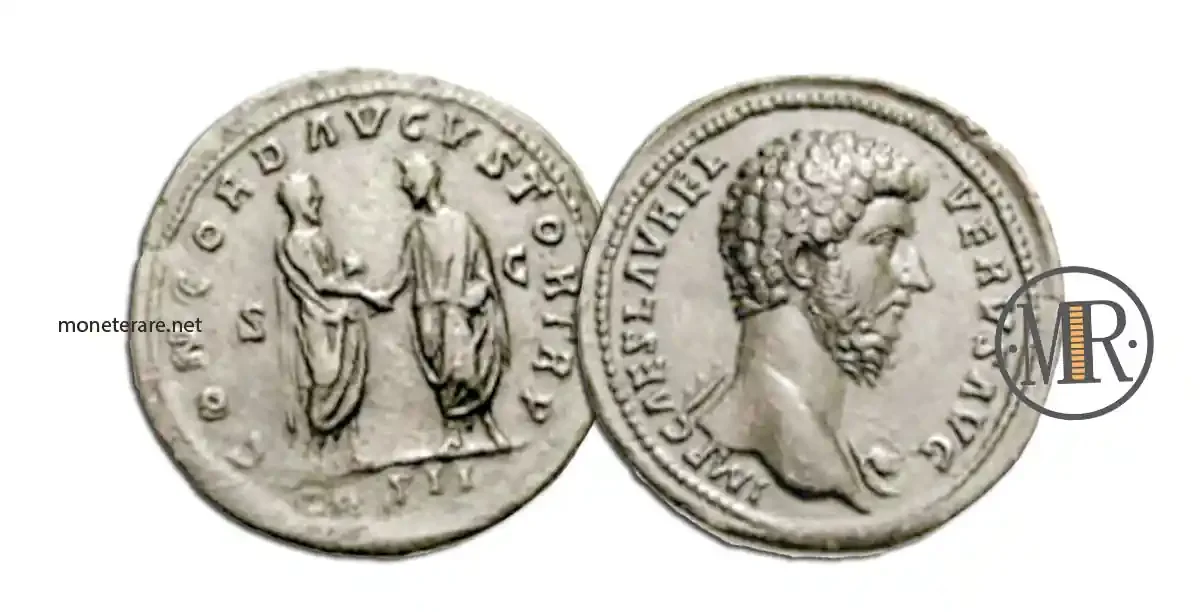
In a sestertius minted in 161 AD to commemorate the ascension to power, the obverse features the bust of Lucius Verus, while on the reverse Lucius and Marcus Aurelius stand facing each other, shaking hands.
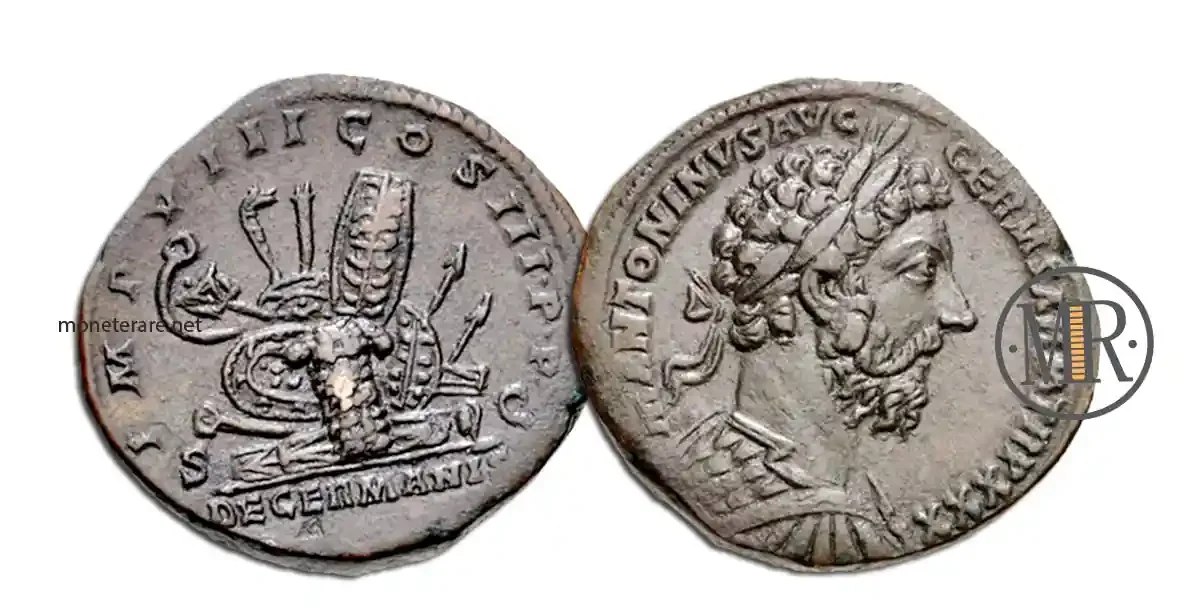
Another example of a sestertius of Marcus Aurelius, with his bust on the obverse, was minted in 177 AD following the victory against the Germans, and on the reverse, there is a pile of weapons of the subdued Germans.
History and Curiosities
Marcus Aurelius was the first Emperor to reign not alone but by sharing power with Lucius Verus, his adoptive brother.
Both were indeed adopted by Emperor Hadrian, and when Marcus Aurelius was chosen by the Senate to take on the role of Emperor, he insisted that Lucius Verus be appointed Emperor alongside him.
However, Marcus Aurelius enjoyed greater authority compared to Lucius Verus.
Value of the Roman Sestertius of Marcus Aurelius
- Sestertii of Marcus Aurelius can be found for sale on sites like this starting from around 50/60€.
Sestertius of Maximinus Thrax
Description
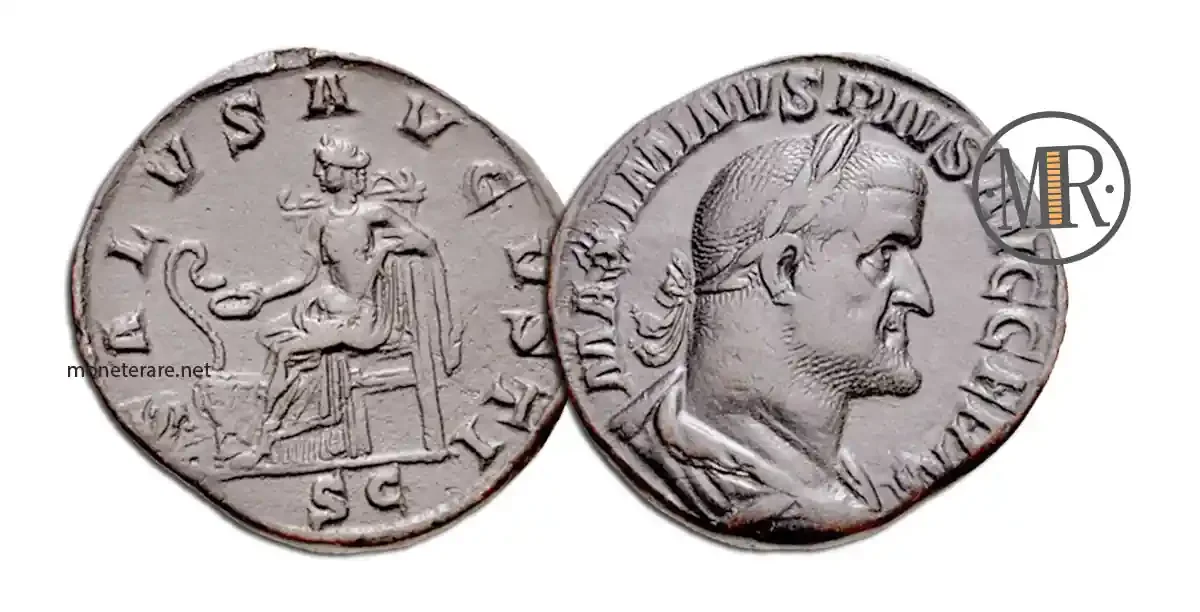
On the obverse of the Sestertii minted during the reign of Maximinus Thrax, his bust appears. The reverse of these Sestertii, minted after AD 236 following victories in Germany, features various scenes.
On one type of Sestertius, “VICTORIA GERMANICA”, there is a Winged Victory with a prisoner at her feet. On another Sestertius, “SALVS AVGVSTI”, the reverse shows the goddess Salus holding a vessel from which a serpent is feeding. In other Sestertii, Maximinus stands between two legionary standards.
History and Curiosities
Maximinus Thrax was the first Emperor of barbarian origin.
Additionally, there is another interesting fact about him. Contrary to what the name “Maximinus” might suggest, he was one of the tallest men in human history, with a recorded height between 239 and 248 centimeters!
Value of the Roman Sestertius of Maximinus Thrax
- Sestertii of Maximinus Thrax can be found online for sale starting from around 50 € and up.
Gordian Sestertius
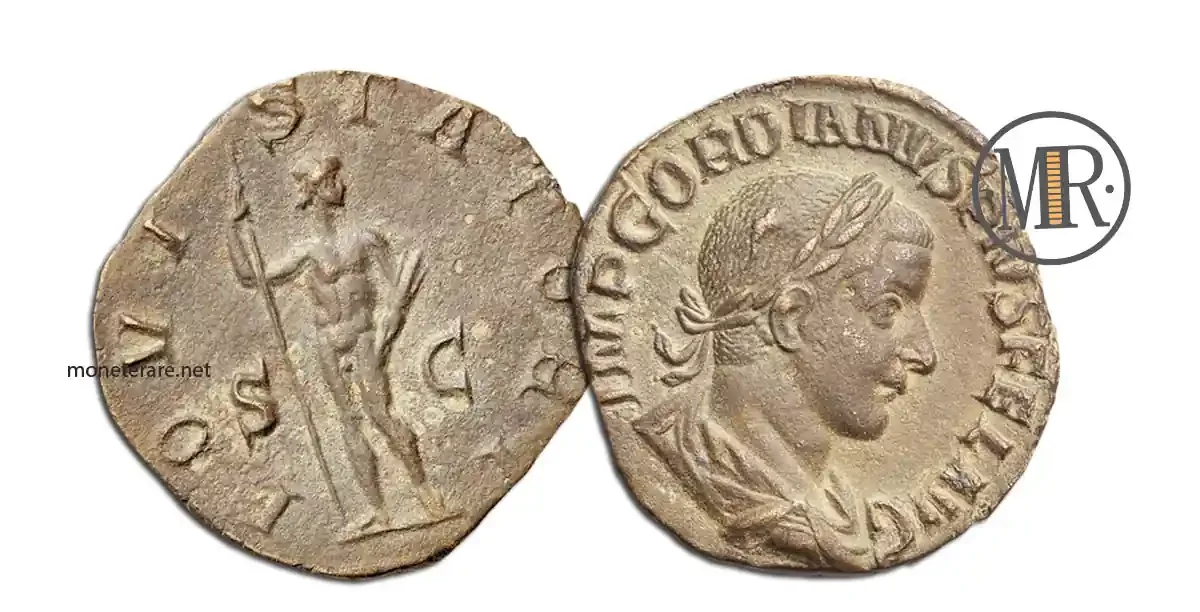
Description
On the Sestertii minted by the first two Gordians, the obverse features the profile of Gordian I, while the reverse shows a Winged Victory or Virtus with shield and spear.
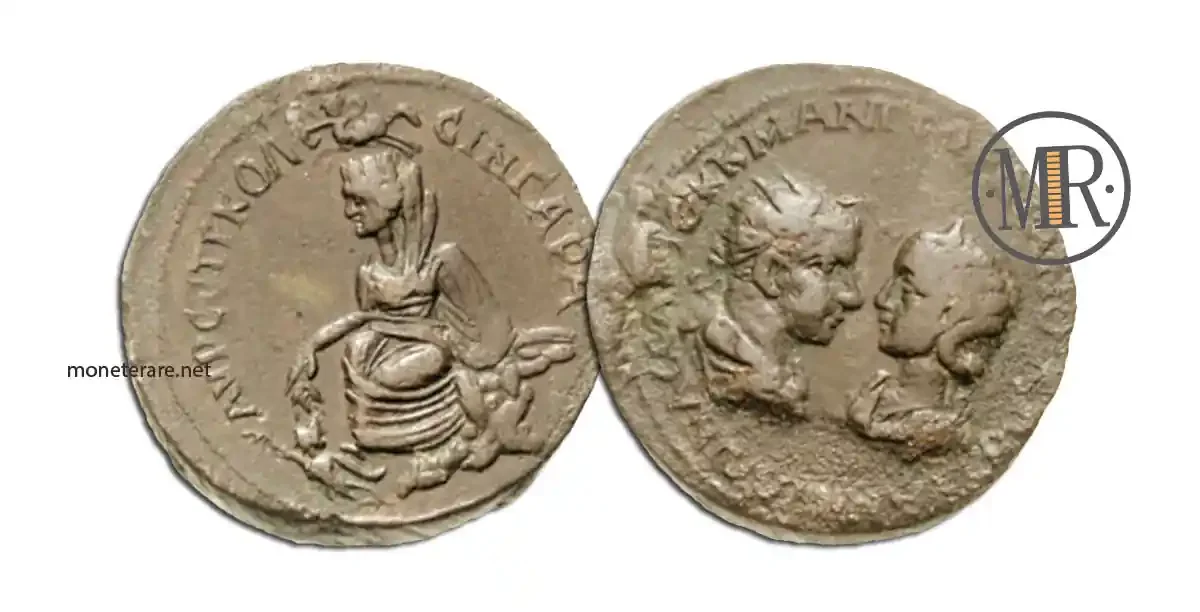
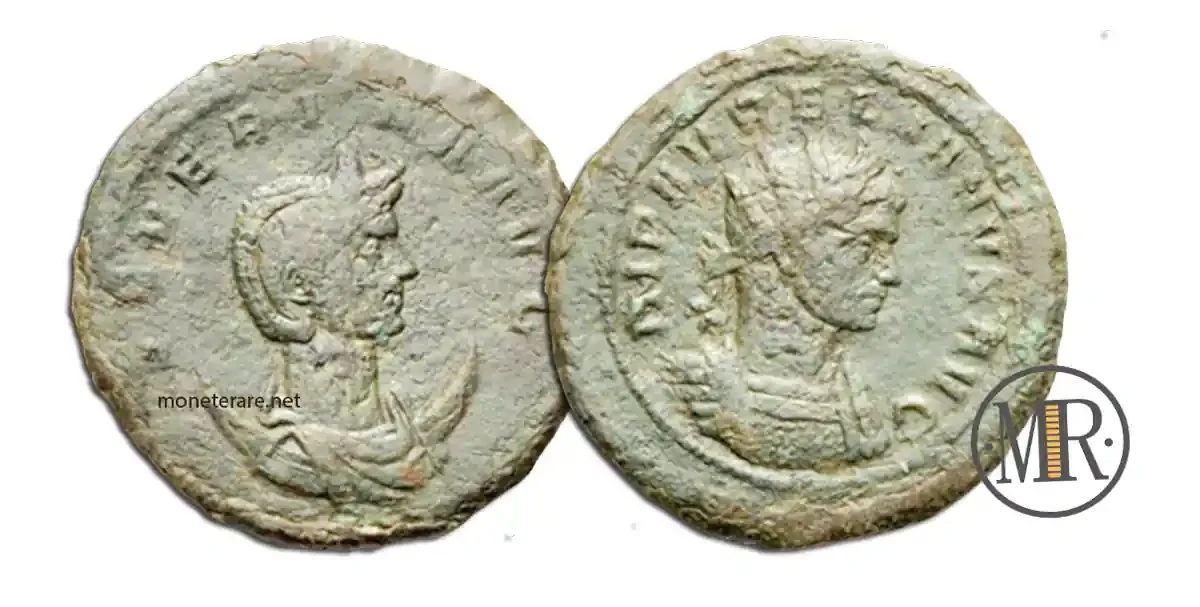
On the Sestertii of Gordian III, except for one instance where he appears on the obverse alongside his wife Tranquillina, his bust is always present.
On the Sestertius of Gordian III with his wife, the reverse features Tyche, the personification of fortune, holding a small boat. Above is a small archer, symbol of the Legio I Parthica.
On other Sestertii of Gordian III, Gordian himself appears, or a Winged Victory, or finally Mars with shield and spear.
History and Curiosities
There were three Emperors who bore the name Gordian, successors of Maximinus the Thracian. The first, Gordian I, and his son Gordian II, were appointed by the inhabitants of the province of Africa following the revolts of 238 AD. They reigned for only a few weeks. Gordian III, the grandson of Gordian I, ascended to the imperial throne at a very young age and reigned from 238 to 244 AD.
Value of the Roman Sestertius of Gordian
- A Sestertius of Gordian III with Apollo on the reverse, in quality qSPL, can be found for sale at around 80€.
Frequently asked questions
How much is a Roman sestertius worth?
It depends on the emperor, rarity, metal (bronze/orichalcum), and grade. Common pieces can cost a few dozen euros; rare specimens can reach thousands.
Where to sell or buy coins
Do you own coins like these, a lot, or a rare piece? Register on Catawiki and place your first bid, or submit a lot for sale — signing up is free. For years we have used this auction site, our partner. Browsing auctions is not enough: start with registration and a first action (a bid or a listing). Register and start.