
Discover the Value and Pricing of Gold Sovereigns
Updated:
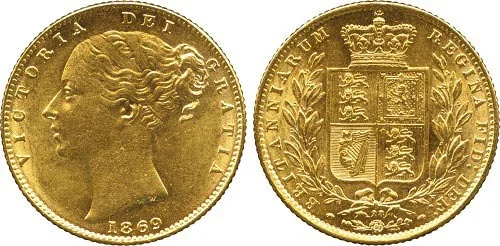
On this page, you will find all the information about the Gold Sovereign, its value, history, and pricing of this highly sought-after and legendary gold coin among modern rare coins.
The History of the Gold Sovereign.
Also known as the “English Sovereign” or “Sovereign“, this rare coin composed of 0.23 ounces of pure gold has ancient origins that date back several centuries. It was created in 1489 after King Henry VII authorized and requested its minting. The modern version was created in 1817, and on the reverse of the coin, the image of Saint George slaying a Dragon is depicted.
Since in 1496 the King was Henry VII, his image was depicted on the obverse of the coin along with a rose. The reverse featured a royal shield. From then on, the reigning sovereign would always be depicted on the obverse. This fact is thought to be the origin of the name “Sovereign”.
In 1817, the Royal Mint in London called upon Benedetto Pistrucci to create the design for the reverse of the new English Sovereign. The design in question is the iconic image of Saint George slaying the dragon. This design would then be retained in this version by Pistrucci, albeit with slight modifications, on the reverse of subsequent gold Sovereigns.
The representation of the reigning sovereign on the obverse of the gold coin has always remained, and the tradition has always been respected.
The Gold Sovereign after 1914
In 1914, when World War I broke out, gold Sovereigns were withdrawn from circulation because England abandoned gold as its monetary unit. Production outside Great Britain, such as that in Sydney, Bombay, etc., was also terminated in 1932.
In 1957, the minting of gold Sovereigns resumed to stop the creation of counterfeit coins coming from Italy and Syria, which had flourished after production ceased in 1914. Modern gold Sovereigns, those for investment, were only reproduced starting from the year 2000.
A little curiosity: the English mint also minted a denomination of 10 shillings (half sovereign), one of 2 pounds (double sovereign), and one of 5 pounds (fivefold sovereign).
Gold Sovereign Valuation: What Does It Depend On?
The valuation of the Gold Sovereign essentially depends on 2 factors, both fundamental:
The first factor is the current gold price and therefore also the amount of gold contained in the coin. The second factor that determines the valuation of the gold sovereign is the numismatic value of the rare coin itself. In particular, the value depends on the condition of the individual coin, the year of minting, and other minor factors.
These characteristics are subjective to each coin and therefore vary from piece to piece, from coin to coin. For example, a minting that has a greater “Numismatic” value compared to those produced before is that of the year 1957.
Also known as the “New Coin,” it was initiated to combat counterfeiting of coins and was not freely circulated.
The valuation of the gold sovereign depends on the combination of these two described factors. Since the factor that considers the value of gold is not constant, it follows that the valuation of the coin is not always the same but is subject to variations, albeit minor, in the short term.
Gold Sovereign Value: How Much Is It Worth?
As we mentioned in the previous paragraph, the value of Gold Sovereigns mainly depends on two factors: the current gold price and the condition of the coin (numismatic aspect). However, these are not the only elements to consider when calculating the value of a Gold Sovereign. In fact, the value of the Sovereign also depends on whether it is a numismatic coin or an investment coin.
A numismatic gold sovereign is a coin that has some particular features. For example, it may have some minting defects or may have been minted in particular years, during which a limited number were issued. Depending on these elements, the value of a rare coin, in this case the gold sovereign, can increase or decrease.
A gold sovereign for investment, on the other hand, is defined by clear characteristics. The coin must have legal tender status in the country where it was produced. The gold sovereign must have a purity of 900 thousandths. The coin must have a difference between the quotation and the selling price (spread) equal to or less than 80%. The coin must have been minted after 1800.
All these factors, details, and specific requirements make it very difficult to provide a single unequivocal value for a Gold Sovereign.
Where to Buy Gold Sovereigns
If you want to have a specimen of “Sovereign” for investment purposes or due to their historical or numismatic value, you can easily buy a gold sovereign coin by checking the list of specimens at the auction on this site. Check if you find the coin you are looking for, then register and make a bid right away. We have explained in detail how to manage a coin auction on this page.
The Weight of the Gold Sovereign
The Gross Weight of the Gold Sovereign is 7.98 grams. Usually, the weight of precious metals is measured using the troy ounce.
From this, the net weight of the gold is calculated. This calculation can be done by knowing the purity of the gold used for minting. The purity is 91.7%. From this, it can be inferred that the net weight in Gold of the Gold Sovereign is about 7.3 grams (0.23 ounces). The part that is not gold is copper, used to strengthen the coin. This is because pure gold is a soft metal and therefore fragile, especially for circulation from hand to hand.
The Quotation of the Gold Sovereign Today
The Gold Sovereign has always been and is currently a highly sought-after coin. Why? The purity of the raw material it is composed of makes it one of the safest safe havens to invest your money, alongside gold bars.
The quotation of the Gold Sovereign currently experiences some fluctuations. These variations can sometimes be quite significant. A primary determining factor that affects its quotation is naturally the value of gold. Currently, the value of gold is just over €36 per gram.
Since the Gold Sovereign is composed of 91.7% pure gold and has a net weight of 7.32 grams, its value in gold alone is approximately €265. Currently, the value of the Gold Sovereign amounts to about €265 for demand and €300 for supply. There are small variations of a few euros between the new and old minting of the coin. In practice, owning a Gold Sovereign is “almost” like having a pure gold bar at home, weighing the same as the coin.
Table of Designs and Minting Dates of the Gold Sovereign
| Monarch | Obverse Design | Reverse Design | Date |
|---|---|---|---|
| George III | Laureate Head | St. George and the Dragon | 1817-1820 |
| George IV | Laureate Head | St. George and the Dragon | 1821-1825 |
| George IV | Bare Head | Shield | 1825-1830 |
| William IV | Bare Head | Shield | 1831-1833, 1835-1837 |
| Victoria | Young Head | Shield | 1838-1839, 1841-1866, 1868-1887 |
| Victoria | Young Head | St. George and the Dragon | 1871-1887 |
| Victoria | Jubilee Head | St. George and the Dragon | 1887-1893 |
| Victoria | Old Head or Veiled Head | St. George and the Dragon | 1893-1901 |
| Edward VII | Bare Head | St. George and the Dragon | 1902-1910 |
| George V | First Type (Head in Profile) | St. George and the Dragon | 1911-1928 |
| George V | Second Type | St. George and the Dragon | 1929-1932 |
| George VI | Bare Head | St. George and the Dragon | 1937 |
| Elizabeth II | First Portrait | St. George and the Dragon | 1957-1959, 1962-1968 |
| Elizabeth II | Second Portrait | St. George and the Dragon | 1974, 1976, 1978-1984 |
| Elizabeth II | Third Portrait | St. George and the Dragon | 1985-1988, 1990-1997 |
| Elizabeth II | Sovereign Portrait | St. George and the Dragon | 1989 |
| Elizabeth II | Fourth Portrait | St. George and the Dragon | 1998-2001, 2003, 2004, 2006-2009 |
| Elizabeth II | Fourth Portrait | Shield | 2002 |
| Elizabeth II | Fourth Portrait | St. George and the Dragon (modern design) | 2005 |
4 Rules to Understand if a Gold Sovereign is Fake
Do you remember when we mentioned the “New Coinage” of 1957? It was precisely on that occasion that efforts were made to limit the damage caused by the counterfeiting of Gold Sovereigns. The minting of gold coins was mainly carried out in Syria and Italy.
Therefore, one must always be very cautious when buying or selling Gold Sovereigns or any rare coins in general. A rule that is always valid to avoid encountering a fake coin is to rely on professional operators or services.
This is a list of 4 notes that will help you determine if your rare coin is fake or authentic. Always keep these 4 factors in mind:
- Touch the coin and examine it by feel. Counterfeit Gold Sovereigns are softer to the touch and have sharper edges compared to genuine coins.
- Listen to the coin and examine it by sound. Obtain a genuine coin to use as a sample and use it like a tuning fork. Holding it firmly between your thumb and index finger, lightly strike it with another coin on the edge. Now do the same with the coin you are analyzing. If the sounds are different, doubt its authenticity.
- Check the dates: using the table above, verify the production dates of the coin. Very often, in years when genuine coins were not minted, counterfeit ones are produced.
- Check the weight, size, and thickness of the coin using this table as a reference.
We have talked about the valuation of the Gold Sovereign, but we have not yet discussed its real value depending on the year of its minting.
Value of the Gold Sovereign of 1841
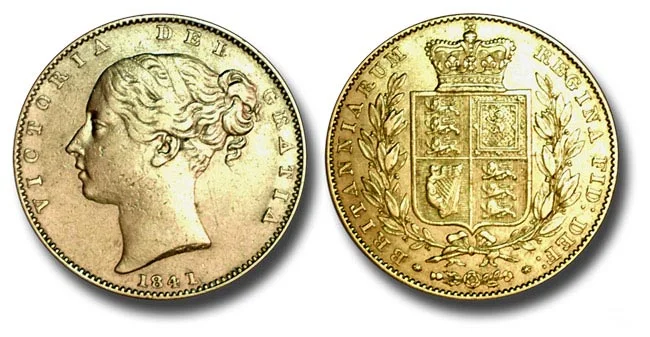
The value is £5,000 but some specimens have reached at auction £25,000.
Gold Sovereign Value of 1917
The value is £385 but some specimens have reached £10,000 at auction.
Value of the Gold Sovereign of 1958
The gold sovereign of 1958 is one of the most sought-after and traded among all gold sovereigns. The obverse features the first portrait of Queen Elizabeth II (the one with the bow) and the reverse displays a design of Saint George slaying the dragon.
The value of the 1958 gold sovereign is approximately 250 euros for an item in good condition, and 300 if in excellent condition.
Value of the Gold Sovereign from 1966 and 1967
The value of the gold sovereign from 1966 is around €315 if kept in good condition. The value of the gold sovereign from 1967 reaches up to €350 because it has a lower mintage. These two coins are quite easy to find within collector circuits, where specimens in excellent condition are often available.
Value of the Gold Sovereign from 1974
The value of the Gold Sovereign from 1974 is determined between 300 and 310 euros. This coin features the second portrait of Queen Elizabeth II on the obverse, while the reverse depicts the usual St. George slaying the Dragon. It is not a particularly rare coin nor difficult to find among collectors or dealers of ancient coins.
Gold Sovereign Value of 1989
This coin features Queen Elizabeth II and was produced to commemorate the 500th anniversary of the striking of the first coin "Sovereign of England." Its value is over 500% of the gold content and is around 900-1000 euros.
Value of the Gold Sovereign of 2014 and 2015
The value of the gold sovereign from 2014 is around 300/350 euros. The coin features the fourth portrait of Queen Elizabeth II on the obverse. The “Sovereign of England” 2015 has a value of around 400 euros and displays the fifth portrait of the Queen on the obverse.
Investing in Gold Sovereigns?
The English gold sovereign is among the most sought-after coins in the world, both by numismatic collectors and investors. It follows that the Sovereign can be an excellent investment.
So if you have the opportunity to purchase one, keep in mind all the advice we have given you above. The rarest Gold Sovereigns worth investing in are these:
- Gold Sovereign 1817, the first modern Sovereigns.
- The Gold Sovereign in FDC or UNC quality from the reigns of George II, George IV, and William IV.
- Gold Sovereign of 1838 featuring Queen Victoria.
- The Gold Sovereign of 1841, the rarest among Queen Victoria's coins.
- The Gold Sovereign of 1917 minted in London in the last year of production by the Royal Mint.
- Gold Sovereign of 1989 with Elizabeth II commemorating the 500th anniversary.
Curiosity: The most expensive gold sovereign ever purchased was taken at an auction in 2014 for the record amount of £516,000. It was one of the only two existing “trial” specimens of a “Sovereign 1937” that was minted for the coronation of King Edward VIII, who abdicated before the coin went into production.
The Spread for Buying and Selling Gold Coins.
The spread in the buying and selling of gold coins is an important concept to understand. In 2009, an ounce of gold was sold for 600 Pounds (£150 for 0.23 ounces). That same year, gold sovereigns, which contain 0.23 ounces of gold, were sold for 299 pounds. In practice, the gold sovereign was worth double the value of the gold it contained.
Therefore, it is important to buy and sell at the right time and consider the spread. We have discussed gold coin investments extensively on this page: buy gold.
The Variants of Gold Sovereigns
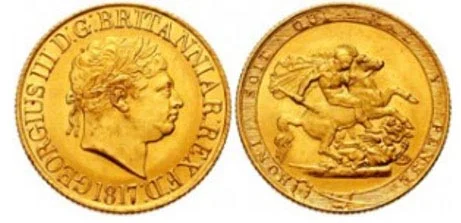
In the variants of the “Sovereign”, the reigning monarch always appears on the obverse of the Gold Sovereign. The reverse of the Gold Sovereign, however, always depicts Saint George fighting the dragon (in some cases, there is the British royal coat of arms).
The different variants of gold sovereigns are as follows:
Gold Sovereign “KING GEORGE III” (1817-1820)
King George III was the first sovereign to have a Sovereign minted in 22 carats and 7.3224 g of pure gold, a standard still used today for gold sovereigns.
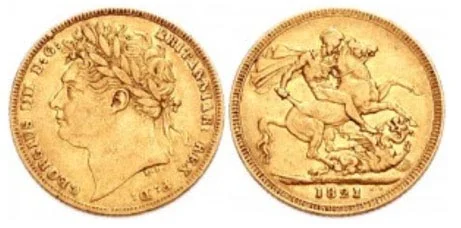
- King George IV with a laurel crown (obverse) and Saint George on horseback (reverse) – (1821-1825)
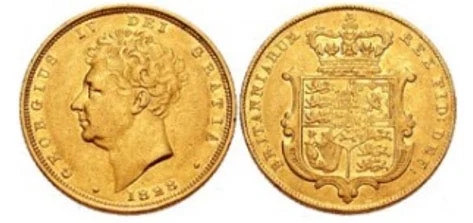
- King George IV with a less prominent crown (obverse) and the British royal coat of arms (reverse) (1825-1830)
Other Variants:
- Gold Sovereign “KING WILLIAM IV” (1831-1837)
- The Gold Sovereign “QUEEN VICTORIA” (1838-1901)
- Gold Sovereign “KING EDWARD VII” (1902-1910)
- The Gold Sovereign “KING GEORGE V” (1911-1932 plus 1949, 1951, 1952)
- The Gold Sovereign “KING EDWARD VIII” (1936)
- Gold Sovereign “KING GEORGE VI” (1936-1952)
- Gold Sovereign “QUEEN ELIZABETH II” (1957 – present)
There are as many as 5 Versions of the last one:
- 1st portrait – 1958 – 1959 and 1962 – 1968
- 2nd portrait – 1974, 1976, 1978 – 1982
- 3rd portrait – present only in some mirror-finish collector sovereigns.
- 4th portrait – 2000 – 2004, 2006 – 2011, 2013, 2014, 2015
- 5th Portrait: starting from 2016
Didn’t find what you were looking for? Check these topics:
- Here we talked about how to invest in and buy gold
- To learn everything about the gold marengo, click here.
- If you are looking for Rare Euro Coins then click here.
- If you want info on Ancient Coins and their value, you can find it here.
- Rare Lire and their great value have been discussed here.
- To Sell or Buy Rare Coins online, read these tips.
- All information about 500 silver lire can be found here.
Where to sell or buy coins
Do you own coins like these, a lot, or a rare piece? Register on Catawiki and place your first bid, or submit a lot for sale — signing up is free. For years we have used this auction site, our partner. Browsing auctions is not enough: start with registration and a first action (a bid or a listing). Register and start.