
10 Cents
Updated:
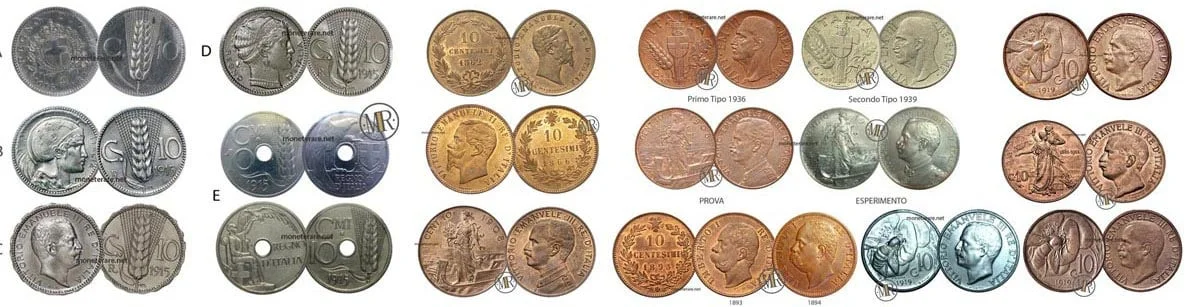
With the 10 cents, we are facing another page of Italian numismatics and the history of our country. We do this by presenting a coin rich in history, peculiarities, and curiosities, which includes some of the rarest specimens, PROOFS, and experiments of great interest. The latter are fully part of the group of rare and highly valuable ten cents that we will present to you.
The Classic Period 1861 – 1911
The Classical period, from a monetary perspective, was rich in significant changes. One of these changes concerns the image of the King, who until now had been praised in the legends of the coins with the noble titles acquired by his house over the previous centuries. With the minting of the new coins, however, only the Kingdom of Italy could be mentioned. Furthermore, the King was depicted for the first time with the bare neck truncation and no longer with the collar of the royal uniform.
Hence the distinctions between coins with “Long Neck” or “Short Neck” that are so dear to numismatic enthusiasts.
In 1863, the new monetary law came into effect, which lowered the title of silver coins for the divisions and brought the new title to 835, with an order to withdraw the coins issued in the two previous years.
This is why the coins of 1861 and 1862 are much rarer to find and of lower quality.
10 Centesimi Experiment
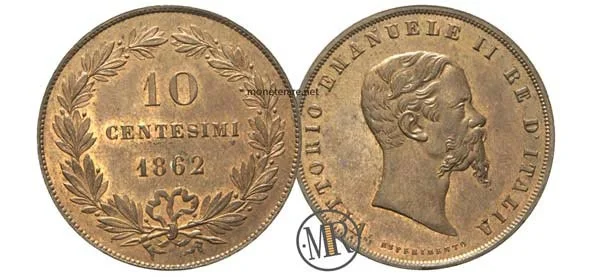
The first 10 Centesimi coin minted in 1862 is defined as “Experiment“. The reason for this wording, engraved on the coin itself, is uncertain. Some believe it was an experiment by the Naples mint to introduce the new decimal system to the population, a mint that is said to have minted 20,000 specimens and then immediately withdrew them; moreover, the die related to this coin does not appear in the official catalogs of the mint.
What is certain is that this coin was minted by someone and in bronze. To date, few circulated specimens can be found in a condition of BB and MB at most.
The Obverse represents the profile of the King facing left with the inscription VITTORIO EMANUELE II RE D'ITALIA around. Below the neck truncation is the inscription EXPERIMENT.
The Reverse bears the inscription 10 CENTESIMI 1862 on three lines in a central banner inscribed within the circle formed by laurel branches with arrow tips united by a bow.
- Nominal: 10 Centesimi
- Material: Cu 960 Sn 40
- Edge: Smooth
- Diameter: 30 mm
- Weight: 10 g
- Mint: Naples (?)
- Mintage: 20,000 (?)
10 Centesimi Experiment | Value
- Asta Varesi 55 on April 8, 2010: 10 Centesimi EXPERIMENT 1862 R3 in FDC sold for €13,225
- Asta Nomisma 40 on October 11, 2009: Specimen R3 in FDC of Ten Centesimi EXPERIMENT 1862 sold for €12,190
- Nomisma Auction 34 on March 26, 2008: 10 Centesimi EXPERIMENT 1862 R3 in qBB sold for €4,025
10 Centesimi Vittorio Emanuele II
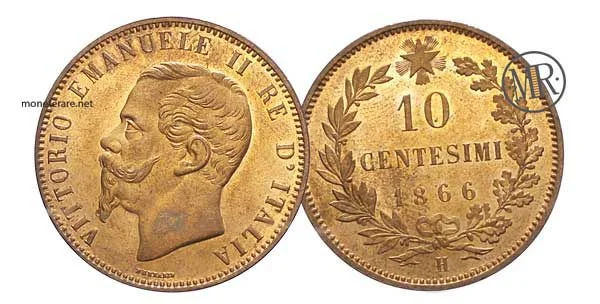
The 10 Centesimi coin Vittorio Emanuele II, also known as “Soldone“, “Due Soldi” and “Palancone”, was the first official ten-cent coin minted in 1862 to facilitate small daily exchanges. A large number of small denomination coins needed to be circulated, and the Italian mints were unable to meet the demand in a short time, so they were also minted at foreign public mints such as Paris and Brussels. The mints in Paris and Brussels did not engrave their identifying mark on the coins, which was done by the private mints in Birmingham and Strasbourg, which were also involved in the production of the new Italian coins.
Mints for the years 1862/1867:
- Milano: M
- Napoli: N
- Torino: T
- Birmingham: H
- Parigi: absent
- Bruxelles: absent
- Strasburgo: OM
The 10 Centesimi 1862 were minted by the mints of Milan and Strasbourg, while the 10 Centesimi 1863 only at the mint of Strasbourg. The 10 Centesimi 1866 and the 10 Centesimi 1867 were produced at all the aforementioned mints.
A peculiarity of these coins is that often the minted dates do not correspond to the actual year of production of the coin.
On the Obverse, the profile of the King without a crown is engraved, with mustache and goatee looking to the left. Around the inscription VITTORIO EMANUELE II RE D'ITALIA and below the neck line is the signature of the engraver Ferraris.
On the Reverse, the inscription 10 CENTESIMI and the year appear on three lines in a central banner. Around, forming a circle, are the two branches of laurel on the left and oak on the right, united at the bottom by an ornamental bow. Below the bow is the space for the mint mark.
- Nominal: Ten Centesimi
- Material: Cu 960 Sn 40
- Edge: Smooth
- Diameter: 30 mm
- Weight: 10 g
10 Centesimi Vittorio Emanuele II | Value
Among the 10 Centesimi Vittorio Emanuele II coins, the rarest are the Ten Centesimi 1866 R5, the 10 Centesimi 1867 PROOF R5. Here are some auctions that featured some specimens of 10 Centesimi Vittorio Emanuele II:
- Asta Negrini 28 on December 11, 2008: 10 Centesimi Vittorio Emanuele II qFDC of 1862 mint of Paris, sold at auction for €552
- Nomisma Auction 44 on October 29, 2011: Specimen of 10 Centesimi 1867 in FDC from the mint of Strasbourg sold for €805
- Asta Negrini 27 on June 11, 2008: 10 Centesimi Vittorio Emanuele II coin in FDC of 1867 mint of Turin sold for €403
10 Centesimi Umberto I
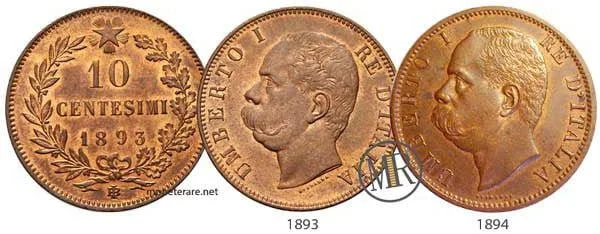
The ten-cent coin Umberto I was minted in 1893 and 1894 by the Rome Mint with the help of the Birmingham Mint. The peculiarity of this coin is that in the two years the hair of the King is different.
In fact, in the version of the 10 Centesimi 1894, the hair seems to have a more pronounced part on the left and is shorter and styled compared to the version of the 10 Centesimi 1893 coin, which on the contrary has more tousled and slightly longer hair. Furthermore, in the 1894 version, the signature of Speranza is under the neck, while in the 1893 version it is along the lower edge.
Subsequently, between 1901 and 1905, an order was issued for the withdrawal of 20,000,000 coins among those of 10 and 5 cents of lira to be replaced with an equal number of coins in nickel, which never happened, as they were never minted again with other alloys.
On the Obverse, the head of King Umberto I in profile with a mustache looking to the left is engraved. In front of his gaze is the inscription UMBERTO I and behind the head RE D'ITALIA, below the signature of the engraver Speranza.
On the Reverse, in a central banner, the inscription 10 CENTESIMI and the year appear on three lines, around the circle formed by the two branches of laurel and oak united at the bottom by the bow and the star of Italy at the top. The mint mark is at the bottom of the face under the knot of the bow.
- Nominal Value: Ten Centesimi
- Edge: Smooth
- Material: Cu 950 Sn 50
- Diameter: 30 mm
- Weight: 10 g
10 Centesimi Umberto I | Value
The 10 Centesimi 1893 and the 10 Centesimi 1894 minted in Rome are worth more than those minted in Birmingham.
- Nomisma 46 on October 27, 2012: Ten Centesimi Umberto I 1893 in FDC sold for €80.50
- Sintoni 7 on August 31, 2013: 10 Centesimi NC Umberto I 1893 in FDC sold for €240
- Nomisma 46 on October 27, 2012: 10 Cent coin Umberto I in FDC sold for €322
10 Centesimi Bow of Vittorio Emanuele III – Sample
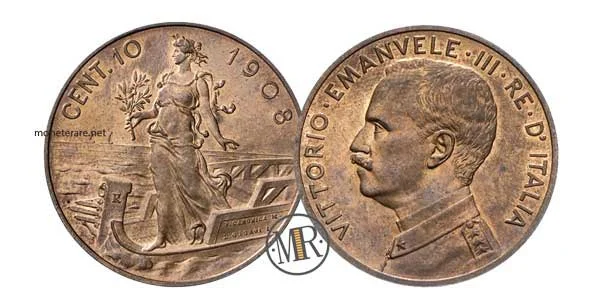
On the Obverse, the profile of Vittorio Emanuele III in star uniform. Around the inscription VITTORIO EMANUELE III RE D'ITALIA
On the Reverse, the inscription CENT. 10 1908 and in the center, the Maritime Italy offering to the wind on the bow of a Roman ship, holding an olive branch in her right hand. On the bow, the R of the Roman mint is embossed, and on the right, the inscription P. CANONICA M. // L. GIORGI I. In the background, the horizon of the sea with two other sailing boats in the background.
- Nominal Value: Ten Centesimi
- Material: Cu 950
- Year: 1908
- Edge: Smooth
- Weight: 10 g
- Diameter: 30 mm
- Axis: French
This is a very discussed coin and not recognized as such by everyone. In fact, this ten-cent coin on the bow was minted in 1908 for a special occasion: The laying of the foundation stone of the new headquarters of the Rome Mint on the Esquiline Hill. Only 3 specimens were minted, never put into circulation; in fact, the first was placed on the foundation stone of the new building, the second specimen was given to King Vittorio Emanuele III, and the third remained at the Museum of the Rome Mint.
Later, the die was used without authorization in 1926 for a small quantity of very rare coins to find. Few scholars are able to distinguish the differences between the 1908 coin and that of 1926, as the differences are perceptible only to expert eyes.
For this reason, the coin can be considered a Sample coin classified as R5.
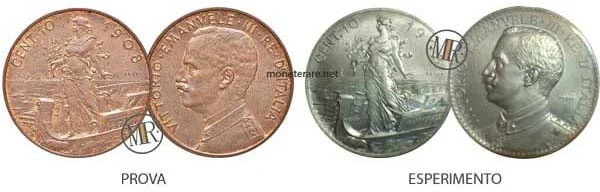
There is also a proof version of this coin that bears the inscription PROOF on the right, after the hand of the sailor and above the horizon line of the sea. In the PROOF coin, the R mint mark of the Rome mint is missing from the bow of the ship and is classified as R4.
The “experiment” coin
Among the proofs, there is also an EXPERIMENT version minted in aluminum that uses for the Obverse the die of the “4 bese proof of Somalia”, which indeed shows the half-bust of the King different from the other coins, and also has the word proof on both sides. This EXPERIMENT version is classified as R4.
10 Centesimi bow | Value and Auctions
- Nomisma 56 Auction on October 17, 2017: Specimen R5 of 10 Centesimi bow in FDC sold for €135,700
- Nomisma Auction 50 on October 15, 2014: Coin R5 of 10 Centesimi bow in FDC sold for €129,800
- Künker 237/239, Auction on October 7, 2013: Specimen R4 of 10 Centesimi bow PROOF qFDC sold for €12,915
- Negrini 32, Auction on December 3, 2010: 10 Centesimi bow PROOF R4 in FDC+ purchased for €12,650
- Nomisma 48, Auction on October 26, 2013: 10 Centesimi bow PROOF R4 in SPL+ sold for €11,500
- Nomisma Auction 48 on October 26, 2013: FDC 10 Centesimi bow EXPERIMENT R4 of 1908 sold for €37,950
- Nomisma Auction 44 on October 29, 2011: Specimen EXPERIMENT in aluminum R4 of 10 Cents bow sold for €20,700
The Modern Period 1911 – 1945
The Modern period spans from 1911 to 1945 and is a time of war that causes the near disappearance of coins such as the 1 and 2 centesimi, generally small denomination coins made of nickel. This is because nickel was valuable as it was primarily intended for the manufacture of weapons useful for the war. The problem was solved by resurrecting the nickel coins of Umberto I, those previously withdrawn, which were used as a basis for a recoinage. In fact, some designs of the Ten Centesimi of 1915 were printed on the 20 Centesimi Umberto I.
10 Centesimi Cinquantenario
Commemorative Coin of 10 Centesimi Cinquantenario of Vittorio Emanuele III, minted for the 50th Anniversary of the Kingdom of Italy
The peculiarity of this coin is that the metal used to mint it was derived from the melting down of the Ten Centesimi withdrawn from circulation due to excessive wear.
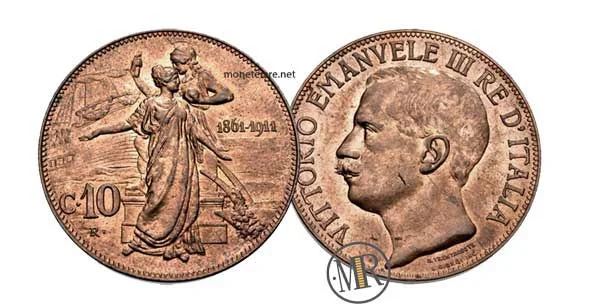
The Obverse features King Vittorio Emanuele III in profile with a bare neck, surrounded by the inscription VITTORIO EMANUELE III RE D'ITALIA and below the King's neck the signature of the author D. Trentacoste and the engraver L. Giorgini.
On the Reverse, two figures are depicted, a female figure in front representing Italy and a male figure behind on a pedestal with a helmet and globe in hand symbolizing the city of Rome. To the right of the pedestal, a plow with ears of wheat and fruit is clearly visible, and in the background, to the left, the bow of a merchant ship in navigation with sails furled. On the lower left, the face value C.10 and below the symbol of the mint of Rome R. Above the horizon line of the sea, the inscription 1861-1911.
Note: In many numismatic catalogs, the allegories of Italy and Rome present on these coins are both female representations.
- Face value: Ten Centesimi
- Edge: Smooth
- Material: Cu 950
- Weight: 10 g
- Diameter: 30 mm
- Axis: German style
- Mint: Rome (R)
10 Centesimi Cinquantenario | Value and Auctions
- Numismatic Auction Felsinea 4 of July 4, 2016: Coin of 10 Centesimi Cinquantenario 1911 in BU sold for 99.45€
- Numismatica Felsinea 5 of February 1, 2017: 10 Centesimi Cinquantenario 1911 in BU sold for 76.05€
- Asta Varesi 61 of November 22, 2012: Ten Centesimi Cinquantenario 1911 in SPL+ purchased for 58€
10 Centesimi Cinquantenario PROVA
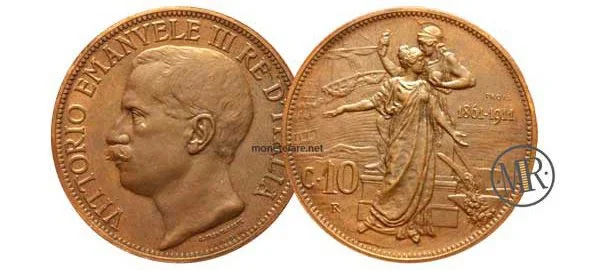
The 10 Centesimi Cinquantenario PROVA of Vittorio Emanuele III minted in 1911 bears the inscription PROVA on the Reverse above the inscription 1861-1911.
10 Centesimi Cinquantenario PROVA | Value and Auctions
- Nomisma 45, Auction of May 15, 2012: Ten Centesimi Cinquantenario PROVA 1911 R in BU sold for 863€
- Nomisma 52 of August 30, 2016: coin of Ten Centesimi Cinquantenario PROVA 1911 R in BU sold for 1,300€
10 Centesimi Ape
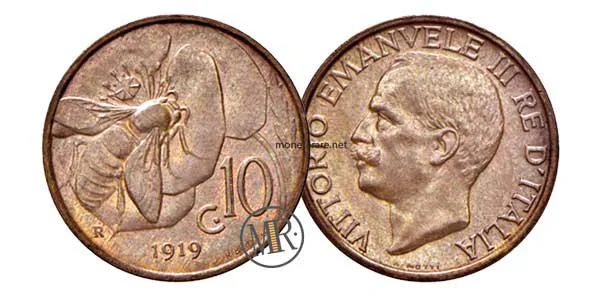
Coin of 10 Centesimi from 1919 under the reign of King Vittorio Emanuele III, minted until 1937.
On the Obverse, it depicts the bare head of the King looking to the left and around the inscription VITTORIO EMANVELE III RE D'ITALIA. Along the edge of the coin below the neck is the signature of the author A. Motti.
On the Reverse, a beautiful depiction of a Bee on a flower collecting pollen. To the right, the face value of the coin C.10 and below the year of minting. The symbol of the mint of Rome R is under the tip of a leaf on the left, and the signature of R. Brozzi is on the right along the edge.
- Material: Cu 950
- Face value: Ten Centesimi of lire
- Edge: Smooth
- Diameter: 2.5
- Thickness: 1.9 mm
- Weight: 5.4 g
- Mint: Rome R
- Axis: French style
10 Centesimi Ape | Value and Auctions
- Numismatica Ranieri 3 of November 11, 2011: 10 Centesimi Ape 1919 in red copper (R) in BU sold for 1,093€
- Nomisma 46 of October 27, 2012: Ten Centesimi Ape 1919 (R) in BU sold for 863€
- Varesi 61 of November 22, 2012: Coin of 10 Centesimi Ape 1919 (R) in BU bought for 650€
- Varesi 55 of April 8, 2010: Coin of Ten Centesimi Ape in BU from 1932 sold for 173€
- In Auction 36 of September 7, 2010: 10 Centesimi Ape in BU from 1937 sold for 81.65€
- In Auction 46 of September 19, 2012: Ten Centesimi 1921 Ape in BU sold for 46€
10 Centesimi Ape PROVA
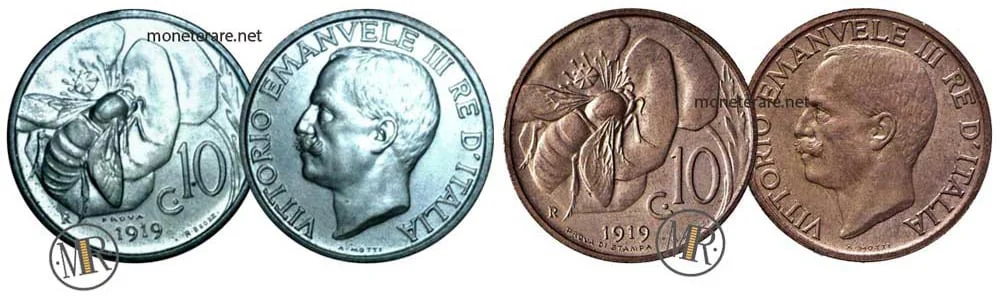
The 10 Centesimi Ape PROVA DI STAMPA from 1919 is the test coin to verify the yield on different alloys and the effect of the new minting. In fact, on the Reverse of the coin, the inscription PROVA DI STAMPA appears along the lower edge or in the version with only PROVA above the year of minting. These coins are classified as R2 and R3
Dieci Centesimi Ape PROVA | Value and Auctions
- Negrini 10 of April 28, 1999: Unique coin R3, 10 Centesimi Ape 1919 PROVA FDC in nickel sold for 4,600,000 Lire
- Asta Nomisma 48 of October 26, 2013: Example R2 of 10 Centesimi Ape PROVA in BU sold for 1,955€
- Varesi 59 of November 23, 2011: 10 Centesimi Ape 1919 R2 with the inscription PROVA on the date, in BU sold for 1,035€
- Nomisma 48 of October 26, 2013: R2 10 Centesimi Ape of 1919 “PROVA DI STAMPA” BU sold for 2,070€
10 Centesimi Impero 1° Tipo Rame
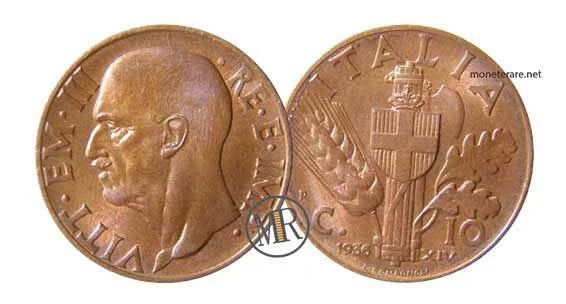
Coin of 10 Centesimi Impero of King Vittorio Emanuele III 1st Type minted to celebrate the new Empire. This coin was minted in copper from 1936 until 1939 and is red in color.
On the Obverse, the bare head of the King facing left. On the left, the inscription VITT- EM – III and on the right – RE – E – IMP –
On the Reverse, the Savoy coat of arms with a bundle and Royal Crown is engraved. On the left, an ear of wheat and on the right, an oak branch. At the bottom left, the symbol of the Mint of Rome R and the inscription C. 10 and the year on the right, the inscription 10 and XIV (year of the fascist era). At the bottom of the coin, along the edge, the signature of G. Romagnoli.
- Nominal: Ten Centesimi
- Edge: Smooth
- Material: Cu 950
- Weight: 5.4 g
- Diameter: 22.5 mm
- Axis: French style
- Mint: Rome
Dieci Centesimi Impero 1° Tipo Rame | Value and Auctions
- Negrini 38 of November 15, 2013: Coin of 10 Centesimi Impero 1936 NC in BU in red copper sold for 80.50€
- Varesi 55 of April 8, 2010: 10 Centesimi Impero 1937 in BU sold for 51.75€
- In Auction 21 of July 1, 2007: BU coin in red copper of 10 Centesimi Impero 1937 purchased for 57.50€
- In Auction 40 of June 28, 2011: Example BU in red copper of 10 Cents. Impero 1938 sold for 37.95€
- Varesi 61 of November 22, 2012: Coin BU of Ten Centesimi Impero of 1939 sold for 34.80€
10 Centesimi Impero 2° Tipo Bronzital
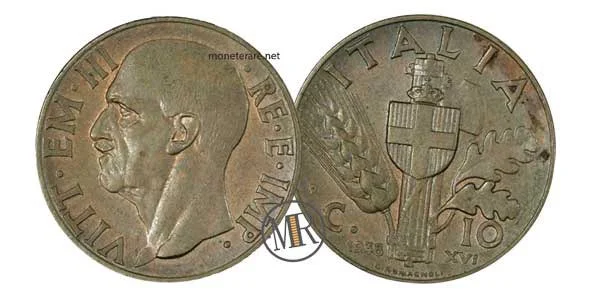
Coin of 10 Centesimi Impero 2nd Type minted in Bronzital from 1939 to 1943. It uses the same die as the 1st type coin. Only the alloy used for minting changes, as the color takes on a yellowish hue. However, there are known specimens such as the 10 Centesimi 1940 mistakenly minted in copper instead of bronzital, surely an error due to a mix-up of blanks with those of the previous type in use until the previous year. These coins are easily recognizable by their red color.
On the Obverse, the profile of the King without a crown facing left with the inscription VITT-EM-III -RE-E-IMP-
On the Reverse, in the center, the Savoy coat of arms with a bundle and crown, on the sides, the ear of wheat and the oak branch. On the left, the year of minting, the mint symbol R and the C. indicating the cents. On the right, the year of the fascist era and the 10 of the face value. Below, the signature of the author Romagnoli.
- Face value: Ten Centesimi
- Material: Bronzital
- Mint: Rome
- Diameter: 22.5 mm
- Weight: 4.9 g
- Axis: French style
Dieci Centesimi Impero 2° Tipo Bronzo | Value and Auctions
- In Auction 45 of February 22, 2012: BU 10 Centesimi Impero 2nd Type 1939 Bronzital sold for 28.75€
- Varesi 55 of April 8, 2010: BU coin of 10 Centesimi Impero 2nd Type 1940 in Bronzital sold for 34.50€
- In Auction 41 of September 13, 2011: BU coin of 10 Centesimi Impero 2nd Type 1941 Bronzital awarded for 40.25€
- In Auction 40 of June 28, 2011: BU 10 Centesimi Impero 2nd Type 1942 in Bronzital sold for 29.90€
- In Auction 38 of February 15, 2011: 10 Centesimi Impero 2nd Type Bronzital BU of 1943 sold for 34.50€
10 Centesimi Impero PROVA
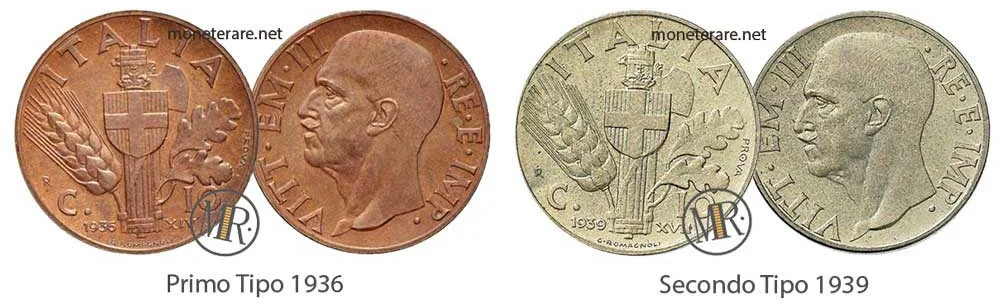
The 10 Centesimi Impero PROVA are classified as R3 the 1st Type and R4 the 2nd Type.
The inscription PROVA is found on the Reverse along the right edge between the two oak leaves.
The PROVA of 1936 is in copper and the PROVA of 1939 is in bronze and aluminum.
However, there exists a 10 Centesimi Impero PROVA of 1942 and one of 1943 minted in aluminum, these are classified as R5 and probably there is only one specimen for '42 and one for '43.
Dieci Centesimi Impero PROVA | Value and Auctions
- Heritage 3032 of April 10, 2014: BU 10 Centesimi Impero PROVA 1936 Copper R3 sold for 1,101€
- In Auction 44 of May 19, 2012: R3 Coin in BU PROVA 10 Centesimi Impero 1936 Copper sold for 1,093€
- Asta Nomisma 45 of May 12, 2012: Example R4 in BU 10 Centesimi Impero PROVA 1939 Bronze awarded for 2,070€
- Nomisma 43 of May 7, 2011: Coin BU in bronze R4 10 Centesimi Impero PROVA of 1939 sold for 2,300€
- Negrini 10 of April 28, 1999: 10 Centesimi Impero PROVA R5 and BU, unique specimen of 1942 in Aluminum sold for 1,265,000 Lire weight 1.70g
- Asta Negrini 10 of April 28, 1999: R5 unique specimen of 1943 10 Centesimi Impero PROVA in Aluminum sold in BU for 1,265,000 Lire weight 1.60g
10 Centesimi PROGETTI
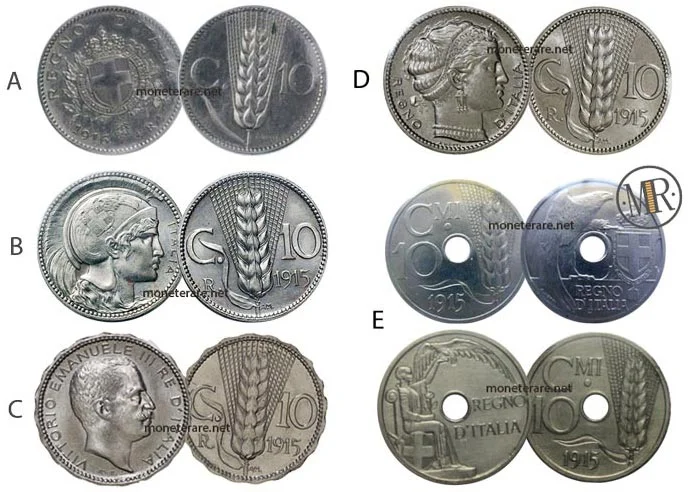
The above are designs for the coins of 10 Centesimi Impero of 1915, minted in different alloys, in some cases unique specimens and classified as R2, R3 and even R4
10 Centesimi 1915 Progetto A
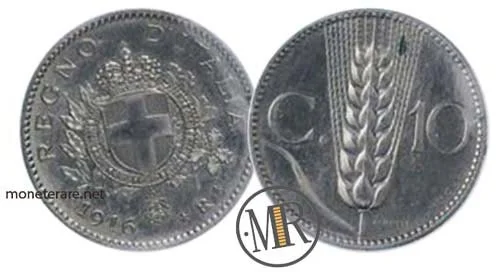
Coin minted in 1915 and 1916 with the Crowned Savoy Coat of Arms, with laurel branches and the collar of the Annunziata on the Obverse. On the Reverse, the ear of wheat and the decimal value. Classifiable R4 in 1915 and R3 in 1916.
- Asta Nomisma 57 of May 19, 2018: Coin of 1915 in BU R4 sold for 8,732€
10 Centesimi Progetto B
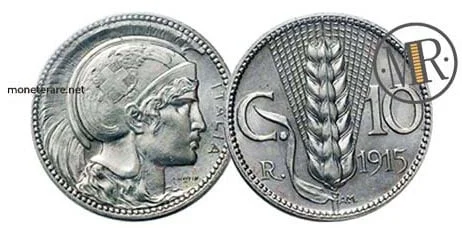
Coin minted in nickel in 1915 that features on the Obverse the head with helmet shown in profile looking to the right. Long hair and Savoy coat of arms on the helmet. Classified as R2.
- Nomisma 57 of May 19, 2018: Example weighing 2.98 g awarded for 1,770€
- Asta Nomisma 45 of May 12, 2012: test weighing 3 g in BU sold for 1,265€
- Varesi 59 of November 23, 2011: Coin qFDC sold for 920€
10 Centesimi 1915 Progetto C
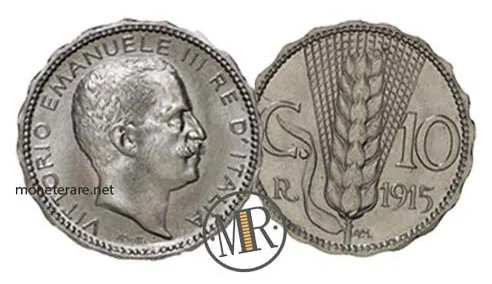
Test on Nickel with the bare head of the King on the Obverse and ear of wheat on the Reverse. Classified as R2.
- Nomisma 53 of October 20, 2015: Example with wavy edge in BU awarded for 7,316€
- Numismatica Felsinea 4 of March 29, 2019: BU weighing 2.98g sold for 840€
- Bolaffi 25 of April 20, 2000: coin in BU 960€
10 Centesimi 1915 – Progetto D
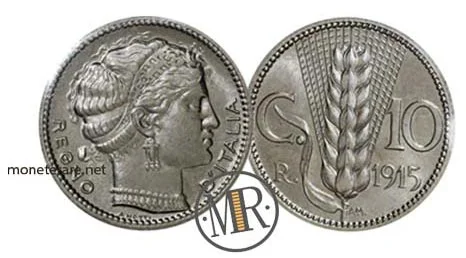
Coin minted in 1915 with a woman's head facing right on the Obverse. On the Reverse, an ear of wheat, the decimal value, and also the year. Classifiable R2
- Nomisma 43 of May 7, 2018: example with wavy edge in BU awarded for 2,300€
- Montenegro 13 of March 29, 2019: in BU sold for 840€
- Nomisma 45 of May 12, 2012: Coin in BU sold for 978€
10 Centesimi 1915 Progetto E
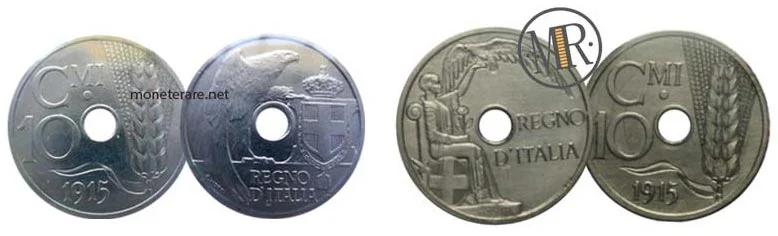
Test with hole of 3.5 mm on Nickel with female figure or Eagle on the Obverse and Ear of Wheat on the Reverse.
Classified as R3 and R4.
- Nomisma 53 of October 20, 2015: R4 with female figure in BU sold for 1,888€
- Montenegro 13 of March 29, 2019: R3 Eagle reprint on coin of 20 centesimi Umberto I in qFDC sold for 3,840€
- Montenegro 13 of March 29, 2019: R3 with Eagle Coin in BU sold for 1,380€
Rare 10 Centesimi
The rare 10 centesimi are various, most are Print Proofs, Designs, Experiments, or Sample Coins:
- 10 Centesimi 1866 R5 (Paris or Strasbourg)
- PROOF Ten Centesimi 1867 Brussels
- R3 10 Centesimi 1862 EXPERIMENT
- 10 Centesimi 1894 R – Rome
- 10 Centesimi 1908 SAMPLE COIN
- PROOF 10 Centesimi 1908
- 10 Centesimi 1915 R2/R3/R4 – DESIGNS
- Bee Ten Centesimi 1919 R
- PROOF 10 Centesimi 1919 Bee R2
- 10 Centesimi 1936 R3 – Proof on Copper
- R3 Ten Centesimi Bee – Proof in Nickel
- R4 10 Centesimi 1939 – Proof on Bronzital
- 10 Centesimi 1942 R5 – Proof on Aluminum
- R5 10 Centesimi 1943 – Proof on Aluminum
Where to sell or buy coins
Do you own coins like these, a lot, or a rare piece? Register on Catawiki and place your first bid, or submit a lot for sale — signing up is free. For years we have used this auction site, our partner. Browsing auctions is not enough: start with registration and a first action (a bid or a listing). Register and start.