
Austria Euro Coins
Updated:
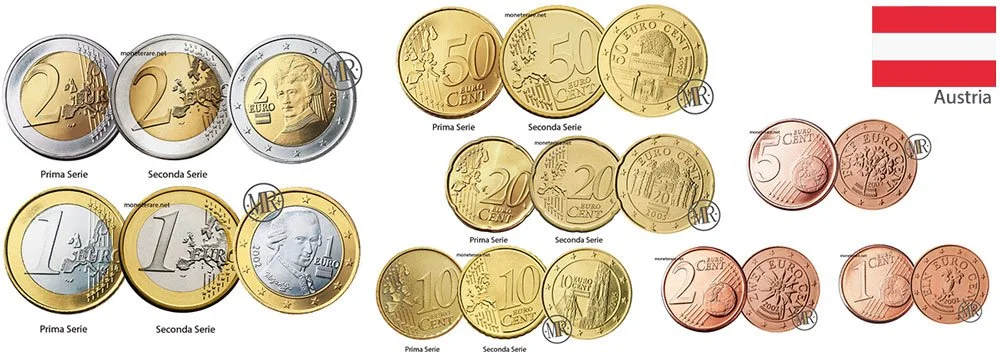
In this article, we will analyze the Austrian Euros to evaluate not only their technical characteristics but also all the peculiarities regarding these coins.
Before doing this, however, it is essential to take a journey into the history of Austrian Numismatics to understand how this country actually arrived at the Euro.
Looking for this guide in German? See the German edition on MoneteRare Deutschland.
€2 commemorative catalog: 2 Euro commemorative coins Austria
History of Austrian Numismatics
Of course, our journey will cover the recent history, specifically that which immediately preceded the introduction of the Euro.
After the end of World War I in 1918, Austria went through a period in which it was moving towards the establishment of a new republican government. However, the new Republic faced several problems due to the post-war situation.
Among these was the devaluation of the Crown, which was the official currency at the time. It was precisely due to this situation that the State decided to introduce a new official currency, namely the Schilling, which came into effect on January 1, 1925.
One Schilling was made up of 100 Groschen, which are nothing more than our common cents. However, with the outbreak of World War II, Austria was annexed in 1938 to the Third Reich, and for this reason, the issuance of the national currency ceased.
This was resumed at the end of the conflict, specifically on November 30, 1945, with the reconstitution of the republic and the introduction of the Schilling.
Subsequently, on January 1, 1999, the Euro officially came into effect with an exchange rate fixed at 1 Euro = 13.7603 Schillings.
On January 1, 2002, Euro banknotes and coins officially came into circulation with a phase of dual circulation lasting until February 28, 2002.
Well, after analyzing the history of recent Austrian Numismatics, it is time to explore this fantastic collection by examining each coin one by one.
1 Euro Cent Austria
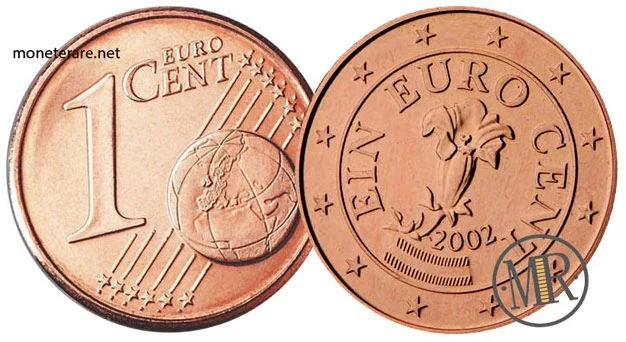
The first coin we will analyze is the 1 Euro Cent Austria. Specifically, this coin was designed by Joseph Kaiser. Minted in 2002.
On the Obverse, we can see a wonderful depiction of the gentian, which symbolizes respect for the environment and the ecological policies implemented by Austria.
Surrounding it is the inscription EIN EURO CENT, and at the bottom, the year of minting accompanied by the Austrian flag. All around are the 12 five-pointed stars representing the European states.
The Reverse is the same as the 1 euro cent coins, identical for all Eurozone countries.
Now let's take a look at the technical specifications.
- Materials: The material used is a steel alloy plated with copper (steel 94.35% – copper 5.65%)
- Thickness: The thickness is 1.67 mm
- Weight: The weight is 2.30 g
- Diameter: The diameter is 16.25 mm
- Edge: The edge is completely smooth
- Engraver: Joseph Kaiser
1 Euro Cent Austria | Value and Mintage
| Year | Rarity | Mint | Mintage | Price BU |
|---|---|---|---|---|
| 2002 | CC | 378.400.000 + 100.000 Fdc + 10.000 Fs | ||
| 2003 | C | 10.800.000 + 130.100 Fdc + 25.000 Fs | ||
| 2004 | CC | 115.000.000 + 100.000 Fdc + 20.000 Fs | ||
| 2005 | CC | 174.700.000 + 100.000 Fdc + 20.000 Fs | ||
| 2006 | CC | 48.300.000 +100.000 Fdc + 20.000 Fs | ||
| 2007 | CC | 111.900.000 + 75.000 Fdc + 20.000 Fs | ||
| 2008 | C | 50.900.000+ 50.000 Fdc + 15.000 Fs | ||
| 2009 | CC | 158.900.000 + 75.000 Fdc + 15.000 Fs | ||
| 2010 | CC | 168.500.000 + 50.000 Fdc + 15.000 Fs | ||
| 2011 | CC | 189.600.000 + 50.000 Fdc + 15.000 Fs | ||
| 2012 | CC | 169.300.000 + 50.000 Fdc + 10.000 Fs | ||
| 2013 | CC | 179.200.000 + 50.000 Fdc + 10.000 Fs | ||
| 2014 | CC | 185.500.000 + 52.500 Fdc + 10.000 Fs | ||
| 2015 | CC | 118.000.000 + 50.000 Fdc + 10.000 Fs | ||
| 2016 | R | 50.000 Fdc + 10.000 Fs | 0,50€ | |
| 2017 | C | 37.700.000 + 50.000 Fdc + 10.000 Fs | ||
| 2018 | R | 35.500 + 50.000 Fdc + 10.000 Fs | 0,50€ | |
| 2019 | R | 50.000 Fdc + 10.000 Fs | 0,50€ |
2 Euro Cents Austria
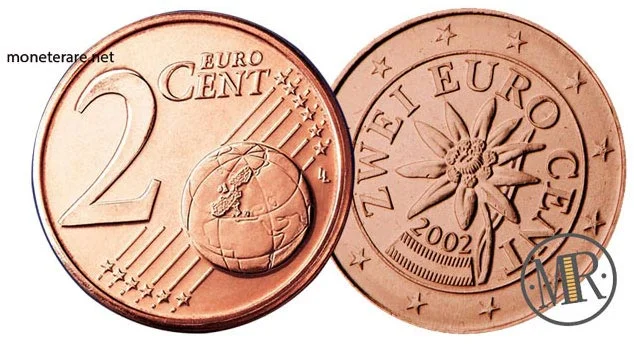
We now move on to the second coin in this collection, namely the 2 Euro Cents Austria. The author is again the same, Joseph Kaiser, although the depicted subject changes. It was minted for the first time in 2002.
On the Obverse, we find the Alpine Star, another plant that signifies respect for the environment and the environmental policies implemented by Austria. Surrounding it in an arc is the inscription ZWEI EURO CENT.
At the bottom, we see the year of minting and the Austrian flag. As always, surrounding the depicted subject, we can notice the 12 five-pointed stars representing the European states.
The Reverse is the Common Side for 2 euro cents, the same for all Eurozone countries.
Let’s analyze the technical specifications.
- Materials: In this case, the material is copper-plated steel (steel 94.35%, copper 5.65%)
- Thickness: The thickness remains the same at 1.67 mm
- Weight: The weight increases to 3.06 g
- Diameter: The diameter also increases to 18.25 mm
- Edge: Horizontal milled edge
- Engraver: Joseph Kaiser
2 Euro Cents Austria | Value and Mintage
| Year | Rarity | Mint | Mintage | Price BU |
|---|---|---|---|---|
| 2002 | CC | 326.400.000 + 100.000 Fdc + 10.000 Fs | ||
| 2003 | CC | 118.500.000 + 130.100 Fdc + 25.000 Fs | ||
| 2004 | CC | 156.400.000 + 100.000 Fdc + 20.000 Fs | ||
| 2005 | CC | 163.200.000 + 100.000 Fdc + 20.000 Fs | ||
| 2006 | C | 39.800.000 +100.000 Fdc + 20.000 Fs | ||
| 2007 | C | 72.200.000 + 75.000 Fdc + 20.000 Fs | ||
| 2008 | CC | 125.100.000 + 50.000 Fdc + 15.000 Fs | ||
| 2009 | CC | 120.400.000 + 75.000 Fdc + 15.000 Fs | ||
| 2010 | CC | 104.200.000 + 50.000 Fdc + 15.000 Fs | ||
| 2011 | CC | 148.600.000+ 50.000 Fdc + 15.000 Fs | ||
| 2012 | CC | 78.100.000 + 50.000 Fdc + 10.000 Fs | ||
| 2013 | CC | 121.500.000 + 50.000 Fdc + 10.000 Fs | ||
| 2014 | CC | 14.500.000 + 52.500 Fdc + 10.000 Fs | ||
| 2015 | C | 118.000.000 + 50.000 Fdc + 10.000 Fs | ||
| 2016 | R | 50.000 Fdc + 10.000 Fs | 0,50€ | |
| 2017 | C | 57.200.000 + 50.000 Fdc + 10.000 Fs | ||
| 2018 | C | 85.650.000 + 50.000 Fdc + 10.000 Fs | ||
| 2019 | C | 91.200.000 + 50.000 Fdc + 10.000 Fs | ||
| 2020 | R | 3,50€ |
5 Euro Cents Austria
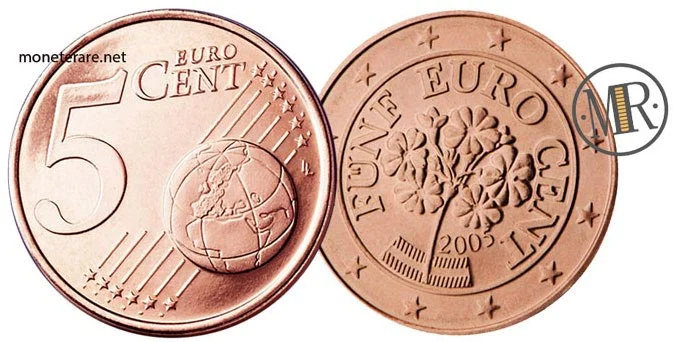
The next coin from 2002 that we will analyze is the 5 Euro Cents Austria. Once again, the author is Joseph Kaiser, but this time the subject represented is different, although with the same intent.
On the Obverse, we find the representation of the Alpine Primrose, another plant that indicates the respect for the environment that Austria has always upheld. At the bottom, there is once again the year of minting and the representation of the Austrian flag.
Surrounding the subject is the inscription in large FUNF EURO CENT, while all around the coin are the classic 12 five-pointed stars representing the European states.
The Reverse is the same for all 5 euro cent coins circulating within the Euro Zone.
Technical characteristics:
- Materials: Once again, the material is copper-plated steel distributed as follows: 94.35% for steel and 5.65% for copper
- Thickness: The thickness remains the same at 1.67 mm
- Weight: The weight increases to 3.92 g
- Diameter: The diameter is equal to 21.25 mm
- Edge: The edge is completely smooth
- Engraver: Joseph Kaiser
5 Euro Cents Austria | Value and Mintage
| Year | Rarity | Mint | Mintage | Price BU |
|---|---|---|---|---|
| 2002 | CC | 217.000.000 + 100.000 Fdc + 10.000 Fs | ||
| 2003 | CC | 108.500.000 + 130.100 Fdc + 25.000 Fs | ||
| 2004 | CC | 89.300.000 + 100.000 Fdc + 20.000 Fs | ||
| 2005 | C | 66.100.000 + 100.000 Fdc + 20.000 Fs | ||
| 2006 | C | 5.600.000 +100.000 Fdc + 20.000 Fs | ||
| 2007 | CC | 52.700.000 + 75.000 Fdc + 20.000 Fs | ||
| 2008 | CC | 96.700.000 + 50.000 Fdc + 15.000 Fs | ||
| 2009 | C | 5.800.000 + 75.000 Fdc + 15.000 Fs | ||
| 2010 | CC | 63.700.000 + 50.000 Fdc + 15.000 Fs | ||
| 2011 | CC | 66.600.000 + 50.000 Fdc + 15.000 Fs | ||
| 2012 | CC | 35.300.000 + 50.000 Fdc + 10.000 Fs | ||
| 2013 | CC | 36.100.000+ 50.000 Fdc + 10.000 Fs | ||
| 2014 | CC | 48.000.000 + 52.500 Fdc + 10.000 Fs | ||
| 2015 | C | 61.000.000 + 50.000 Fdc + 10.000 Fs | ||
| 2016 | R | 50.000 Fdc + 10.000 Fs | 0,50€ | |
| 2017 | CC | 35.200.000 + 50.000 Fdc + 10.000 Fs | ||
| 2018 | R | 50.000 Fdc + 10.000 Fs | 0,50€ | |
| 2019 | R | 50.000 Fdc + 10.000 Fs | 0,50€ |
10 Cents Euro Austria
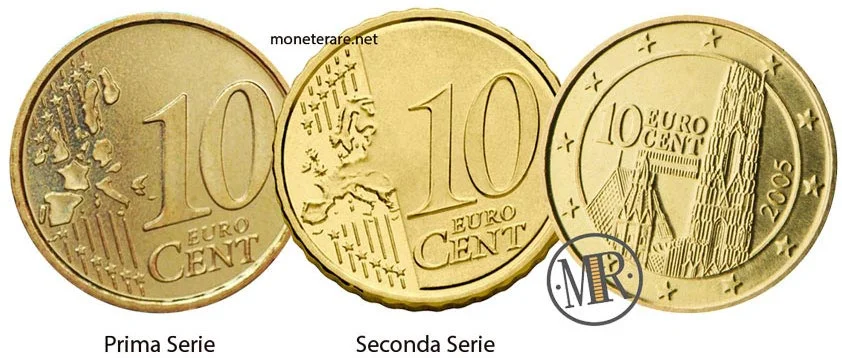
Let’s move immediately to the next coin, namely the 10 Cents Euro Austria. In this case, the author is the same, Joseph Kaiser. In the First Version of 2002 and the Second Version of 2008.
On the Obverse, we can notice a truly faithful representation of the St. Stephen's Cathedral in Vienna, crafted in such a way that highlights the detail of the tower's roof. To the left is the inscription 10 EURO CENT, with the Austrian flag just below. On the right, there is the mint year.
Surrounding it, as with all European coins, are the 12 five-pointed stars that represent the member states of the European Union.
On the Reverse, it is distinguished by the First Series of 2002/2007, which features the old Common Side with all the countries separated.
In contrast, the Second Series of 2008 uses the new Common Side with the Eurozone map represented with the countries united.
However, let’s look at the technical specifications.
- Materials: The material used this time is Nordic Gold, consisting of 89% copper, 5% aluminum, 5% zinc, and 1% tin.
- Thickness: The thickness increases to 1.93 mm
- Weight: The weight also increases to 4.10 g
- Diameter: The diameter, however, slightly decreases to 19.75 mm
- Edge: The edge is reeded with a thick milling
- Engraver: Joseph Kaiser
10 Cents Euro Austria | Value and Mintage
| Year | Rarity | Mint | Mintage | Price BU |
|---|---|---|---|---|
| 2002 | CC | 441.600.000+ 100.000 Fdc + 10.000 Fs | ||
| 2003 | NC | 10.000 + 130.100 Fdc + 25.000 Fs | 1€ | |
| 2004 | C | 5.200.000 + 100.000 Fdc + 20.000 Fs | ||
| 2005 | C | 5.200.000+ 100.000 Fdc + 20.000 Fs | ||
| 2006 | CC | 40.000.000 +100.000 Fdc + 20.000 Fs | ||
| 2007 | CC | 81.300.000 + 75.000 Fdc + 20.000 Fs |
20 Cents Euro Austria
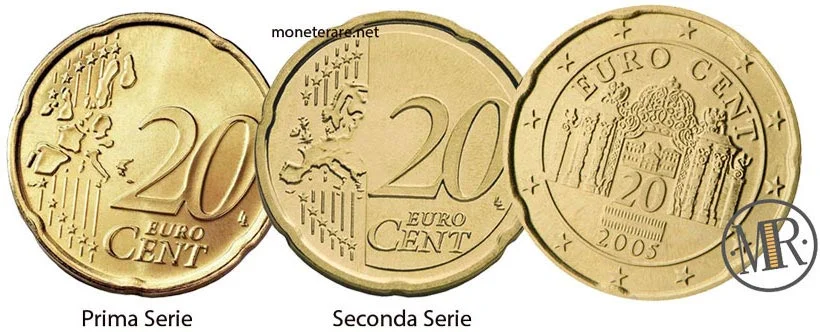
We arrive at the coin of 20 Cents Euro Austria. Once again, the author is confirmed to be the same as all the other coins, namely Joseph Kaiser, while continuing to change the subjects represented. The First Series is from 2002 and the Second Series from 2008.
This time, on the Obverse, we can see the depiction of the Belvedere Palace located in the historic center of Vienna and one of the most beautiful princely residences in Europe. Above the palace, there is the inscription EURO CENT, while immediately below is the number 20. Continuing further down, we find the Austrian flag and the year of minting.
As usual, all around, we can notice the 12 five-pointed stars representing the European States.
The Reverse is characterized by the Common Side shared by all 20 euro cent coins of the Euro Zone.
The First Series from 2002/2007 depicts the old map of Europe with the European States spaced apart.
The Second Series, minted from 2008, uses the New Common Side which shows the Euro Zone States united without borders.
Let's see what there is to know from a technical point of view.
- Materials: The material used is once again Nordic Gold, consisting of 89% copper, 5% zinc, 5% aluminum, and 1% tin.
- Thickness: The thickness is 2.14 mm.
- Weight: The weight increases a bit more, reaching 5.74 g.
- Diameter: The diameter is 22.25 mm.
- Edge: The edge is characterized by a wide reeding.
- Engraver: Joseph Kaiser
20 Cents Euro Austria | Value and Mintage
| Year | Rarity | Mint | Mintage | Price BU |
|---|---|---|---|---|
| 2002 | CC | 203.400.000 + 100.000 Fdc + 10.000 Fs | ||
| 2003 | CC | 50.900.000 + 130.100 Fdc + 25.000 Fs | ||
| 2004 | CC | 54.800.000 + 100.000 Fdc + 20.000 Fs | ||
| 2005 | C | 4.100.000+ 100.000 Fdc + 20.000 Fs | ||
| 2006 | C | 8.200.000+100.000 Fdc + 20.000 Fs | ||
| 2007 | CC | 45.000.000 + 75.000 Fdc + 20.000 Fs |
50 Cents Euro Austria
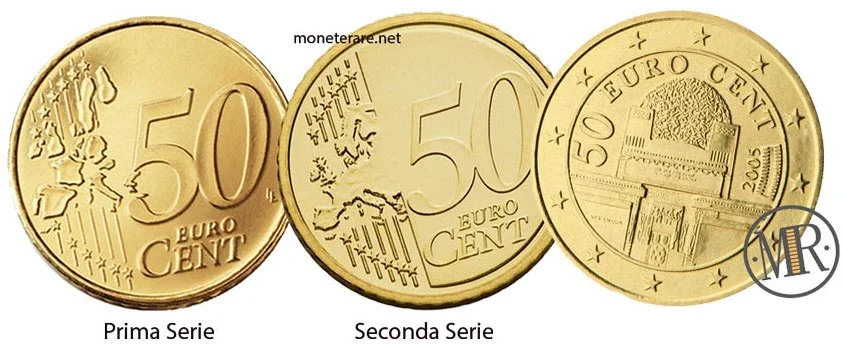
Here we are with the 50 Cents Euro Austria coin. The author, as expected, is Joseph Kaiser, who delights in a new representation for this coin. The First Series was minted in 2002, while the Second was minted in 2008.
On the Obverse, the Secession Palace in Vienna is depicted, commemorating the birth of Art Nouveau in Austria and generally marking the beginning of a new historical and artistic period. Additionally, a symbolic bridge alludes to a new monetary period for the country.
Above, in an arch, the inscription 50 EURO CENT is present, while on the right are the mint year and the Austrian flag. Surrounding it, as usual, are the classic 12 five-pointed stars representing the European states.
The Reverse is the same as the other 50 euro cent coins, the Common Side shared by all Eurozone countries.
For the First Series from 2002 to 2007, the Old Common Side is used, depicting a map of Europe with the European countries separated from each other.
In contrast, the Second Series, from 2008, features the New Common Side with the Eurozone states no longer separated but united.
Let’s also take a look at the technical characteristics of this coin.
- Materials: Once again, we are talking about the material used, which is Nordic Gold consisting of 89% copper – 5% zinc – 5% aluminum – 1% tin.
- Thickness: The thickness slightly increases to 2.38 mm
- Weight: The weight significantly increases to 7.80 grams
- Diameter: The diameter also experiences a slight increase, reaching 24.25 mm
- Edge: The edge is reeded with a thick milling
- Engraver: Joseph Kaiser
50 Cents Euro Austria | Value and Mintage
Le monete rare da 50 eurocent Austria sono quelle del 2012/2013/2014/2015 il loro valore si aggira tra 5€ e 6€
| Year | Rarity | Mint | Mintage | Price BU |
|---|---|---|---|---|
| 2002 | CC | 169.100.000 + 100.000 Fdc + 10.000 Fs | ||
| 2003 | C | 9.100.000 + 130.100 Fdc + 25.000 Fs | 1€ | |
| 2004 | C | 3.100.000 + 100.000 Fdc + 20.000 Fs | 1€ | |
| 2005 | C | 3.100.000+ 100.000 Fdc + 20.000 Fs | 1€ | |
| 2006 | C | 3.200.000 +100.000 Fdc + 20.000 Fs | 1€ | |
| 2007 | C | 3.000.000 + 75.000 Fdc + 20.000 Fs | 1€ |
1 Euro Austria
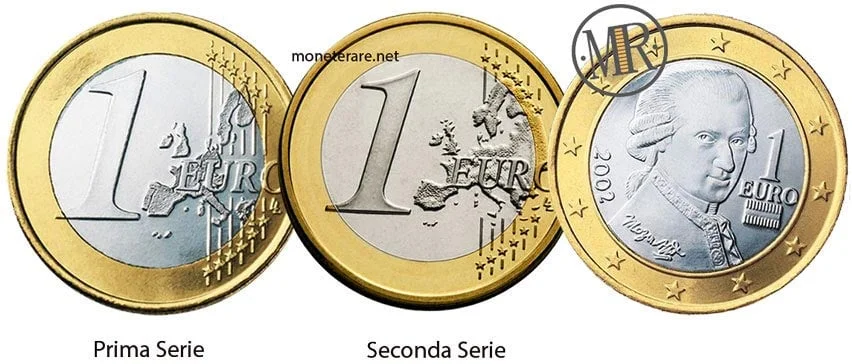
We have arrived at the penultimate coin of this collection. Specifically, we are talking about the bimetallic 1 Euro Austria. For this coin, Joseph Kaiser was chosen as the designer, who once again selected a different subject. First Series of 2002 and Second of 2008.
On the Obverse, we can find the wonderful representation of Wolfgang Amadeus Mozart, the famous Austrian composer. On the right shoulder, there is an engraving of Mozart's signature.
To the left is the mint year, while to the right is the inscription 1 Euro, followed at the bottom by the Austrian flag.
All around are once again the 12 five-pointed stars representing the European states.
On the Reverse, the Common Side shared by all European countries.
The First Series (2002/2007), features the Old Common Side where the European countries are depicted separately.
The Second Series, that of 2008, begins to use the New Common Side with the version of the map showing the Eurozone states symbolically united without distances.
We also see the technical specifications of this specific coin.
- Materials: Regarding this coin, we are talking about a double material. The outer part is made of nickel-brass, that is, 75% copper, 20% zinc, and 5% nickel. The inner part, on the other hand, is made of copper-nickel, which means 75% copper and 25% nickel.
- Thickness: The thickness decreases slightly to 2.33 mm.
- Weight: The weight also decreases compared to the previous coin, coming in at 7.50 grams.
- Diameter: The diameter similarly undergoes a slight decrease, reaching 23.25 mm.
- Edge: The edge is discontinuously ridged.
- Engraver: Joseph Kaiser
1 Euro Austria | Value and Mintage
As you can see from the value tables, the most interesting rare coins are:
- 1 Euro Austria 2012 worth €18
- The 1 Euro coin Austria 2013, valued at €18
- 1 Euro Austria 2014, worth €11
| Year | Rarity | Mint | Mintage | Price BU |
|---|---|---|---|---|
| 2002 | CC | 223.500.000 + 100.000 Fdc + 10.000 Fs | 1€ | |
| 2003 | NC | 150.000 + 130.100 Fdc + 25.000 Fs | 3€ | |
| 2004 | C | 2.600.000 + 100.000 Fdc + 20.000 Fs | 1€ | |
| 2005 | C | 2.600.000 + 100.000 Fdc + 20.000 Fs | 1€ | |
| 2006 | C | 3.200.000 +100.000 Fdc + 20.000 Fs | 1€ | |
| 2007 | CC | 41.100.000 + 75.000 Fdc + 20.000 Fs | 1€ |
2 Euro Austria
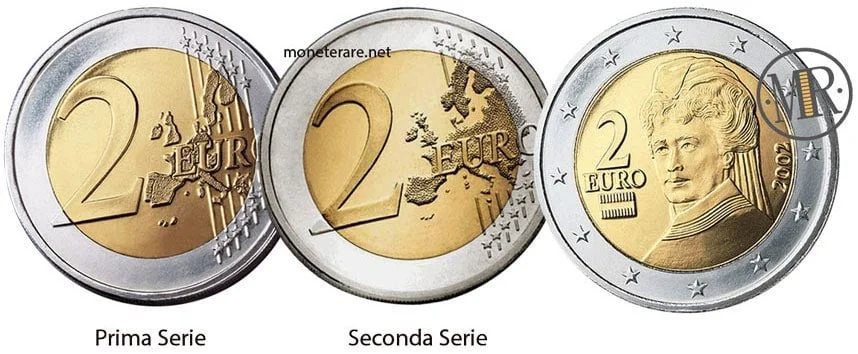
Here we are at the last coin of this truly interesting collection. Specifically, we are talking about the bimetallic 2 Euro Austria coin. We are discussing the circulating coin, so if you have another Austrian 2 euro coin different from this one, you should check the page of 2 euro Austria (Commemorative). In this case, the designer is Joseph Kaiser, as with all other Austrian Euro coins. The first Series was minted in 2002 and the Second in 2008.
On the Obverse of the 2 euro Austria coin, we find the portrait of Berta Von Suttner, a well-known Austrian writer who was awarded the Nobel Peace Prize in 1905, among other honors. To the left, we see the inscription 2 Euro with the Austrian flag just below it. To the right is the mint year.
This coin also features the 12 five-pointed stars representing the member states of the European Union.
On the Reverse, the Common Side of the 2 Euro coins used in European countries.
For the First Series, that of 2002/2007, the Common Side represents a map of Europe with European countries separated by border lines.
Then, starting from the Second Series, from 2008, the New Version of the Common Side is used, showing the Eurozone states all united without separations between them.
Now let's look at the technical specifications of this last coin.
- Materials: In this case, we must also mention a dual material for the inner and outer parts. The outer part is made of copper-nickel (75% copper – 25% nickel), while the inner part is made of nickel-brass (75% copper – 20% nickel – 20% zinc).
- Thickness: The thickness is 2.20 mm.
- Weight: The weight is 8.50 g, making it the heaviest coin in the entire collection.
- Diameter: The diameter is 25.75 mm.
- Edge: The edge features the inscription 2 Euro followed by three stars. The peculiarity is that the inscription alternates between upright and inverted.
- Engraver: Joseph Kaiser.
2 Euro Austria | Value and Mintage
The 2 Euro Austria 2019 coins are the rarest, with a value of approximately €12.
Where to sell or buy coins
Do you own coins like these, a lot, or a rare piece? Register on Catawiki and place your first bid, or submit a lot for sale — signing up is free. For years we have used this auction site, our partner. Browsing auctions is not enough: start with registration and a first action (a bid or a listing). Register and start.