
Italy Euro Coins
Updated:
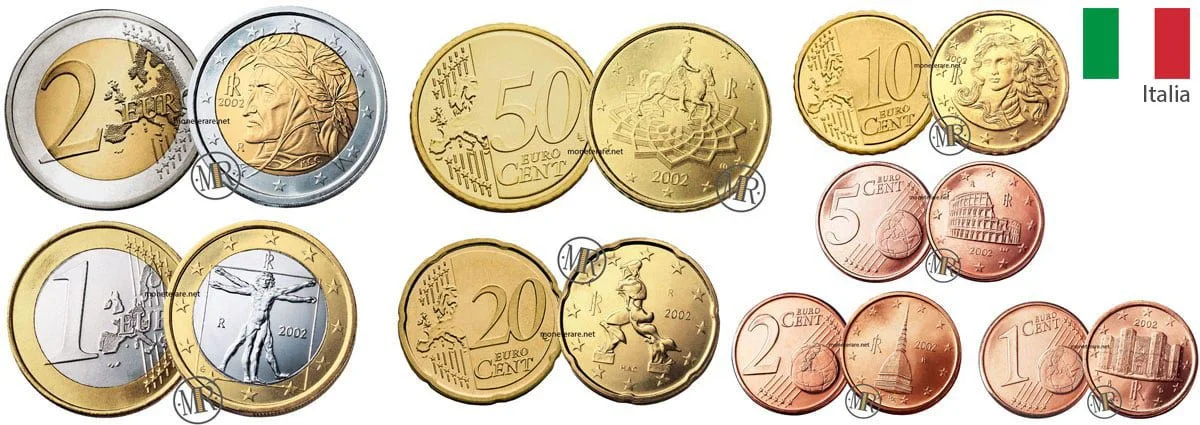
In this page, we will discuss the Euro Italy coins, which are all the Italian euro coins that are part of the circulating coins. If you are looking for the commemorative €2 coins (which are many, many more), you can find them on this page: Commemorative €2 Italy.
As usual, we will look at not only the characteristics of the various coins but also their rarity and value.
€2 commemorative catalog: Commemorative €2 Italy
Introduction to Italian Coins
Before we begin discussing “euros,” it is essential to provide a brief but necessary introduction to Italian coins. The history of Italian numismatics can be fundamentally divided into 3 distinct eras.
First Era
The first relates to the period between 1861 and 1946. Indeed, 1861 is the year of the famous Unification of Italy, which aimed to provide Italy with its first national currency.
At that time, the Lira was already in use in the Kingdom of Sardinia, which was later adopted by the other regions now unified under a single flag. It is important to emphasize that various mints located in the main Italian cities were employed for the creation and production of coins.
The last to operate was the Mint of Milan, which ceased production in 1892 when it was decided to centralize coin production and entrust this activity to a single State Mint located in the Capital.
Second Era
The second era of Italian numismatics spans the period from 1946 to 2001. In 1946, the Lira was introduced in the Italian Republic.
Third Era
Finally, the third era marks the introduction of the Euro starting in 2002. It is worth noting that Italy was one of the very first countries to introduce the Euro, modifying its monetary system right away while naturally allowing the parallel use of Lire and Euros for a limited time after January 1, 2002, the official date of the introduction of the Single Currency.
What we are interested in analyzing throughout this article are the various Italian Euro coins, evaluating their characteristics, materials, weight, and details.
It is important to highlight that, with the exception of the 1 Euro coin, all subjects represented on Italian coins were chosen by the population through a television broadcast aired on February 8, 1998.
The subject of the 1 Euro coin was instead chosen by the then Minister of Economy Carlo Azeglio Ciampi.
Additionally, each coin was created by a different artist.
Let's get started!
1 Euro Cent Italy
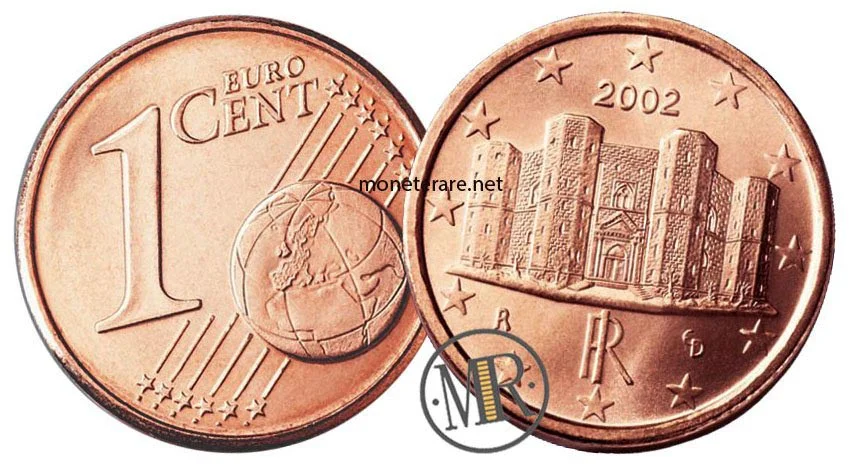
Let's start naturally with the smallest coin, namely the 1 cent Euro Italy. In particular, this coin was designed by Eugenio Driutti, as can be seen from the initials.
The Obverse features the Castel del Monte in Andria, Puglia, commissioned by Frederick II of Swabia in the 13th century. At the bottom, you can see the inscription “RI” indicating “Repubblica Italiana,” while at the top is the year of minting.
As mentioned, the initials of the author Eugenio Driutti (ED) are present on the right, surrounded by 12 five-pointed stars representing the European Union.
On the Reverse, the classic symbol of 1 cent is depicted, which is present on the coins of all European Union countries, along with the inscription “1 Euro Cent” and the representation of Europe.
Now, let's move on to the technical specifications.
Specifications of the 1 Euro Cent Italian Coin
- Materials: The material used for this coin is copper-plated steel. Specifically, steel makes up 94.35% while copper accounts for 5.65%.
- Thickness: The thickness is not very high, measuring 1.67 mm
- Weight: The weight is also very limited, at 2.30 g
- Diameter: The diameter is 16.25 mm
- Edge: The edge is completely smooth without any details
- Engraver: Eugenio Driutti
1 Euro Cent Italy Value and Mintage
| Year | Rarity | Mint | Mintage | Price BU |
|---|---|---|---|---|
| 2002 | CC | 1,348,599,500 + 150,000 BU | - | |
| 2003 | C | 9,367,000 + 100,000 BU + 10,000 FS | - | |
| 2004 | CC | 99,925,000 + 65,000 BU + 10,000 FS | - | |
| 2005 | CC | 179,943,900 + 49,500 BU + 6,600 FS | - | |
| 2006 | CC | 158,951,700 + 42,500 BU + 5,800 FS | - | |
| 2007 | CC | 158,951,700 + 39,000 BU + 5,510 FS | - | |
| 2008 | CC | 179,956,400 + 38,600 BU + 5,000 FS | - | |
| 2009 | CC | 174,953,900 + 40,600 BU + 5,500 FS | - | |
| 2010 | CC | 125,448,100 + 38,000 BU + 5,000 FS | - | |
| 2011 | CC | 125,448,100 + 36,500 BU + 5,000 FS | - | |
| 2012 | CC | 217,971,010 + 25,000 BU + 3,990 FS | - | |
| 2013 | CC | 249,975,180 + 22,000 BU + 2,820 FS | - | |
| 2014 | CC | 149,975,580 + 21,600 BU + 2,820 FS | - | |
| 2015 | CC | 219,974,180 + 23,000 BU + 2,820 FS | - | |
| 2016 | CC | 159,978,560 + 19,400 BU + 2,040 FS | - | |
| 2017 | CC | 259,980,200 + 18,000 BU + 1,800 FS | - | |
| 2018 | 20,000 BU + 3,000 FS | - | ||
| 2019 | - | €0.10 |
2 Euro Cents Italy
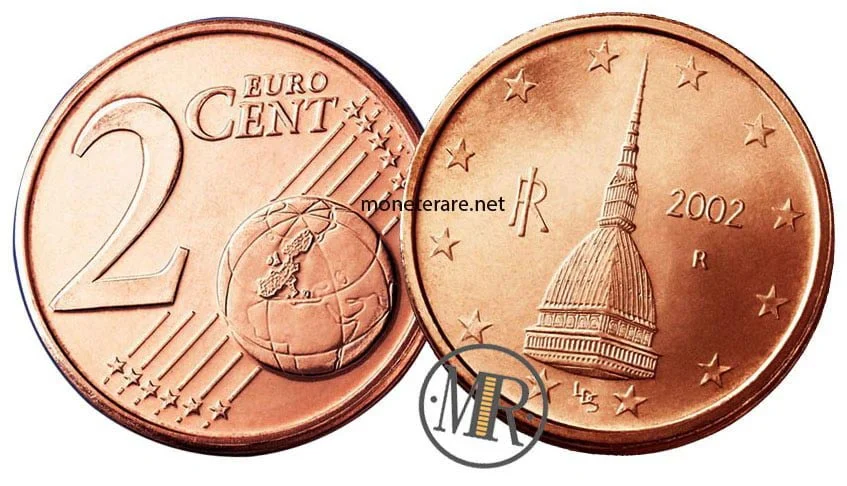
Now let's move on to the next coin, namely the 2 euro cents. This coin was designed by a woman, Luciana De Simoni.
On the Obverse, the Mole Antonelliana in Turin is depicted in all its splendor. This is accompanied on the right by the year of minting at the top and just below it the mint mark, which is the letter “R”.
To the left of the Mole is the symbol of the Italian Republic “RI” while below (under the Mole) are the initials of the designer “LDS”. All of this is naturally surrounded by the 12 five-pointed stars representing the European Union.
As for the Reverse, it is identical to the other 2 euro cent coins present in other European countries, featuring the representation of Europe.
But let's move on to the technical specifications:
Specifications of the 2 Euro Cents Italian Coin
- Materials: Just like the 1 euro cent coin, the 2 euro cents coin is made of steel coated with copper. Specifically, the steel makes up 94.35% while the copper accounts for 5.65%
- Thickness: The thickness is identical to the previous one, 1.67 mm
- Weight: The weight is slightly higher at 3.06 g
- Diameter: The diameter is 18.75 mm
- Edge: The edge is made with a horizontal incuse line
- Engraver: Luciana De Simoni.
2 Euro Cents Italy Value and Mintage
| Year | Rarity | Mint | Mintage | Price BU |
|---|---|---|---|---|
| 2002 | CC | 1,098,866,250 + 150,000 BU | - | |
| 2003 | C | 21,555,000 + 100,000 BU + 12,000 FS | - | |
| 2004 | CC | 119,925,000 + 65,000 BU + 10,000 FS | - | |
| 2005 | CC | 119,943,900 + 49,500 BU + 6,600 FS | - | |
| 2006 | CC | 195,951,700 + 42,500 BU + 5,800 FS | - | |
| 2007 | CC | 139,955,490 + 39,000 BU + 5,510 FS | - | |
| 2008 | CC | 134,956,400 + 38,600 BU + 5,000 FS | - | |
| 2009 | CC | 184,953,900 + 40,600 BU + 5,500 FS | - | |
| 2010 | CC | 120,243,400 + 38,000 BU + 5,000 FS | - | |
| 2011 | CC | 108,958,500 + 36,500 BU + 5,000 FS | - | |
| 2012 | CC | 79,971,010 + 25,000 BU + 3,990 FS | - | |
| 2013 | CC | 149,975,180 + 22,000 BU + 2,820 FS | - | |
| 2014 | CC | 114,975,580 + 21,600 BU + 2,820 FS | - | |
| 2015 | CC | 119,974,180 + 23,000 BU + 2,820 FS | - | |
| 2016 | CC | 139,978,560 + 19,400 BU + 2,040 FS | - | |
| 2017 | CC | 149,980,200 + 18,000 BU + 1,800 FS | - | |
| 2018 | 20,000 BU + 3,000 FS | - | ||
| 2018 | - | €0.20 |
5 Euro Cents Italy
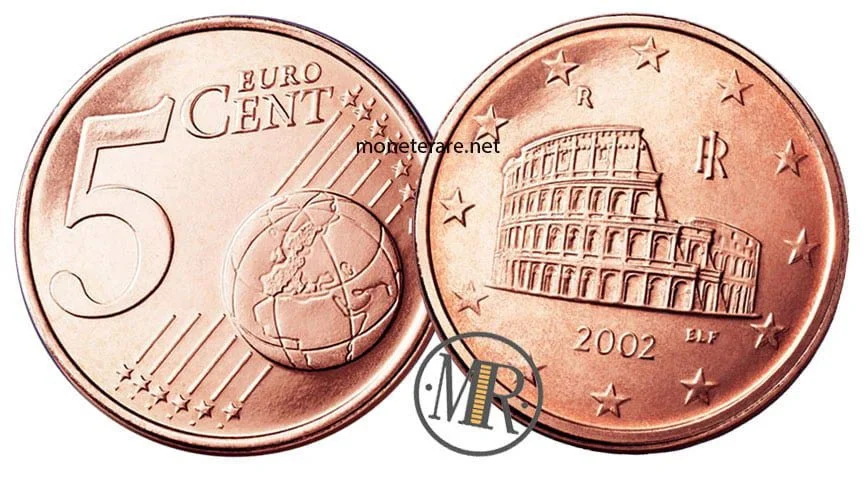
Now let's talk about the 5 Euro cents Italian coin. This was designed by Ettore Lorenzo Frapiccini and features slightly different characteristics compared to the first two coins we have seen so far.
On the Obverse, the Colosseum, or Flavian Amphitheater, is depicted, which Emperor Vespasian began constructing around 75 AD and was inaugurated by Emperor Titus in 80 AD. At the top left, there is the letter “R”, symbol of the Mint, while on the right is the symbol “RI” representing the Italian Republic. At the bottom center, the year of minting is shown along with the initials of the author “ELF”.
On the Reverse, the coin depicts Europe in the world, like all other 5 cent European coins.
Let's take a look at the technical specifications:
Specifications of the 5 Euro Cents Italian Coin
- Materials: In this case, the material used is copper-plated steel, with steel making up 94.35% and copper 5.65%
- Thickness: The thickness is the same as the previous two coins, which is 1.67 mm
- Weight: The weight slightly increases to 3.92 g
- Diameter: The diameter also increases significantly, specifically to 21.25 mm
- Edge: The edge is completely smooth again
- Engraver: Ettore Lorenzo Frapiccini
5 Euro Cents Italy – Value and Mintage
| Year | Rarity | Mint | Mintage | Price BU |
|---|---|---|---|---|
| 2002 | CC | 1,341,442,204 + 150,000 BU | - | |
| 2003 | NC | 1,844,000 + 100,000 BU + 12,000 FS | 15€ | |
| 2004 | CC | 9,925,000 + 65,000 BU + 10,000 FS | - | |
| 2005 | CC | 69,943,900 + 49,500 BU + 6,600 FS | - | |
| 2006 | CC | 118,951,700 + 42,500 BU + 5,800 FS | - | |
| 2007 | CC | 84,955,490 + 39,000 BU + 5,510 FS | - | |
| 2008 | CC | 89,956,400 + 38,600 BU + 5,000 FS | - | |
| 2009 | CC | 84,953,900 + 40,600 BU + 5,500 FS | - | |
| 2010 | CC | 67,618,100 + 38,000 BU + 5,000 FS | - | |
| 2011 | C | 36,958,500 + 36,500 BU + 5,000 FS | - | |
| 2012 | CC | 75,971,010 + 25,000 BU + 3,990 FS | - | |
| 2013 | CC | 79,975,180 + 22,000 BU + 2,820 FS | - | |
| 2014 | C | 39,975,580 + 21,600 BU + 2,820 FS | - | |
| 2015 | C | 29,974,180 + 23,000 BU + 2,820 FS | - | |
| 2016 | CC | 69,978,560 + 19,400 BU + 2,040 FS | - | |
| 2017 | CC | 79,980,200 + 18,000 BU + 1,800 FS | - | |
| 2018 | 20,000 BU + 3,000 FS | - | ||
| 2019 | - | 0.50€ |
10 Euro Cents Italy
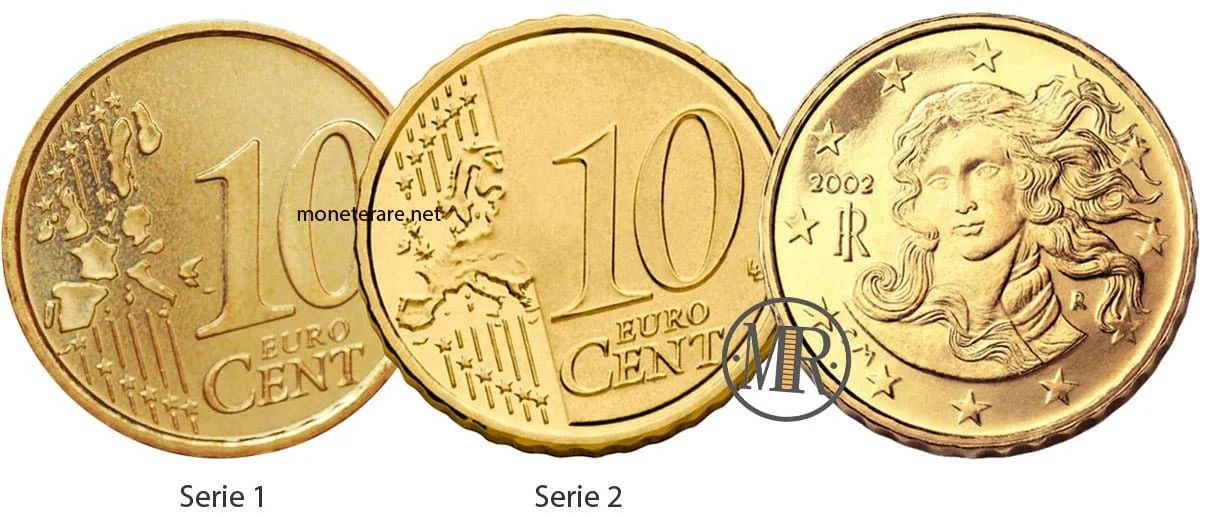
Here we are with the Italian 10 Euro cents coin. Specifically, this was designed by Claudia Momoni.
On the Obverse, the coin features a detail from the work “The Birth of Venus” created by Sandro Botticelli and housed in Florence at the Uffizi Gallery. The detail of the artwork is accompanied on the left by the monogram of the Italian Republic “RI” and just above it is the year of minting.
Located between the neck and hair of Venus is the mint mark “R”, while between stars number 7 and number 8 of the 12 that make up the starry circle are the initials of the author “CM”.
Regarding the Reverse, there are two series. The first dates from the period between 2001 and 2007, while the second is from 2008 onwards.
The distinction between the number 10 and the representation of Europe changes between the two versions.
Let’s take a look at the technical specifications:
Specifications of the 10 Euro Cents Italian Coin
- Materials: The material changes completely compared to previous coins. In this case, it is Nordic Gold characterized by 89% copper, 5% aluminum, 5% zinc, and 1% tin.
- Thickness: The thickness slightly increases compared to the others, reaching 1.93 mm
- Weight: The weight also further increases to 4.10 g
- Diameter: The diameter, on the other hand, slightly decreases compared to the previous coin. Specifically, it is 19.75 mm
- Edge: The edge is ridged with thick milling
- Engraver: Claudia Momoni
10 Euro Cents Italy and Value and Mintage
| Year | Rarity | Mint | Mintage | Price BU |
|---|---|---|---|---|
| 2002 | CC | 1,142,083,000 + 150,000 BU | - | |
| 2003 | CC | 29,714,000 + 100,000 BU + 12,000 FS | - | |
| 2004 | C | 4,925,000 + 65,000 BU + 10,000 FS | - | |
| 2005 | CC | 99,943,900 + 49,500 BU + 6,600 FS | - | |
| 2006 | CC | 179,951,700 + 42,500 BU + 5,800 FS | - | |
| 2007 | CC | 104,955,490 + 39,000 BU + 5,510 FS | - |
20 Euro Cents Italy
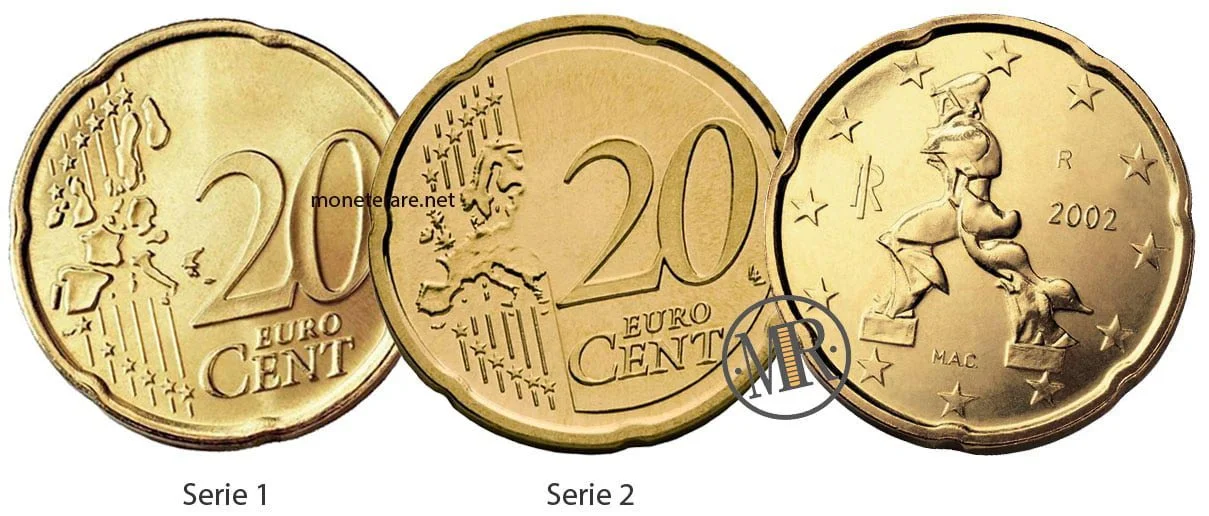
Let's move on to the 20 Euro cents coin designed by Maria Angela Cassol.
Specifically, on the Obverse, this coin features a work of art. It depicts the piece “Unique Forms of Continuity in Space” created in 1913 by the futurist sculptor Umberto Boccioni (1882 – 1916). On the left is the symbol of the Italian Republic “RI” while on the right, at the top, is the symbol of the Mint “R” and at the bottom is the year of minting.
Immediately below the sculpture, the initials of the author “M.A.C.” are engraved.
As for the Reverse, it is identical to all other 20 cent coins, although there are two series: one dating from 2001 to 2007 and the second from 2008 onwards.
Now, let's move on to the technical specifications:
Specifications of the 20 Euro Cents Italian Coin
- Materials: The 20 cent coin is also made of Nordic Gold (copper 89%, zinc 5%, aluminum 5%, tin 1%)
- Thickness: The thickness is significantly higher than others at 2.14 mm
- Weight: The weight also makes a significant jump, reaching 5.74 g
- Diameter: The diameter is 22.25 mm
- Edge: Wide reeding
- Engraver: Maria Angela Cassol
20 Euro Cents Italy Value and Mintage
| Year | Rarity | Mint | Mintage | Price BU |
|---|---|---|---|---|
| 2002 | CC | 1,411,536,000 + 150,000 BU | - | |
| 2003 | C | 25,893,000 + 100,000 BU + 12,000 FS | - | |
| 2004 | C | 4,925,000 + 65,000 BU + 10,000 FS | - | |
| 2005 | C | 4,943,900 + 49,500 BU + 6,600 FS | - | |
| 2006 | C | 4,951,700 + 42,500 BU + 5,800 FS | - | |
| 2007 | C | 4,955,490 + 39,000 BU + 5,510 FS | - |
50 cent Euro Italy
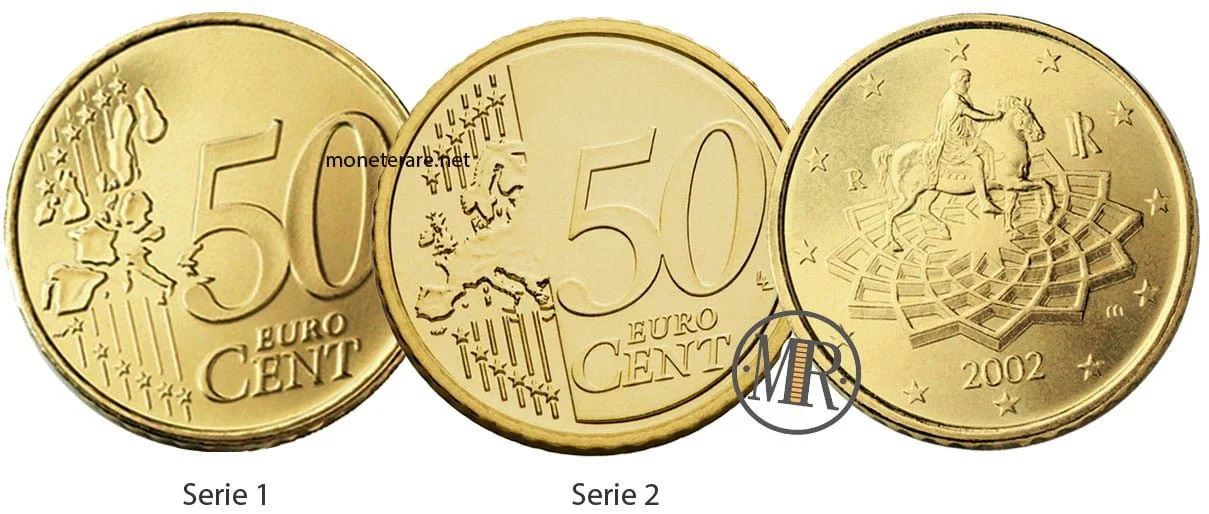
The 50 cent Euro coin from Italy features some very interesting characteristics (especially on the Obverse). It was specifically designed by Roberto Mauri.
Specifically, the Obverse depicts the equestrian sculpture of Marcus Aurelius combined with the Michelangelo-style paving present in the Piazza del Campidoglio in Rome. To the right of the monument is the symbol of the Italian Republic “RI” while to the left is that of the State Mint “R”.
At the bottom, the year of minting is placed, while in the lower right is the initial of the author's surname, which is the letter “M”.
As for the Reverse, it is identical to the other 50 cent coins with the representation of Europe. In this case, there are also two series, one from 2001 to 2007 and the other from 2008 onwards.
Now let's move on to the technical specifications:
Specifications of the 50 cent Euro Italian Coin
- Materials: The material used is Nordic Gold (copper 89% – aluminum 5% – zinc 5% – tin 1%)
- Thickness: The thickness slightly increases compared to the previous coin. It is 2.38 mm
- Weight: The weight also increases considerably, reaching 7.80 g
- Diameter: The diameter is 24.25 mm
- Edge: The edge is ridged with thick milling
- Engraver: Roberto Mauri
50 cent Euro Italy Value and Mintage
| Year | Rarity | Mint | Mintage | Price BU |
|---|---|---|---|---|
| 2002 | CC | 1,136,418,000 + 150,000 BU | - | |
| 2003 | C | 44,563,000 + 100,000 BU + 12,000 FS | - | |
| 2004 | C | 4,925,000 + 65,000 BU + 10,000 FS | - | |
| 2005 | C | 4,943,900 + 49,500 BU + 6,600 FS | - | |
| 2006 | C | 4,951,700 + 42,500 BU + 5,800 FS | - | |
| 2007 | C | 4,955,490 + 39,000 BU + 5,510 FS | 2.10€ |
1 Euro Italy
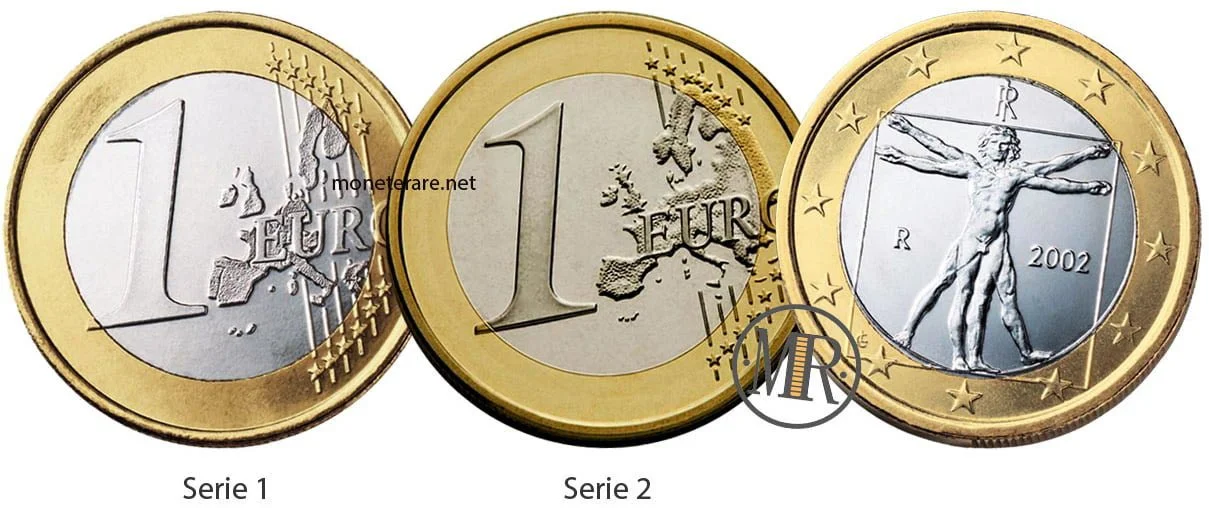
We have arrived at the Italian 1 Euro coin. This was created by Laura Cretara and the subject, as mentioned at the beginning of the article, is the only one chosen by Carlo Azeglio Ciampi.
The Obverse of the Italian 1 Euro piece specifically features the Vitruvian Man by Leonardo da Vinci. This is nothing more than a representation of the proportional measurements of the human body.
Located just above the man's head is the symbol of the Italian Republic “RI”.
On the left, the mintmark “R” is represented, while to the right of the depiction is the year of minting. It is important to emphasize that the 1 Euro coin has two sections. On the inner section is the Vitruvian Man, while on the outer section are represented the 12 five-pointed stars depicting the European Union, among which (specifically on star number 7) are the initials of the author “LC”.
The Reverse is practically identical to the other 1 Euro coins, and in this case, there are also two editions. The first spans from 2001 to 2007 and the second from 2008 onwards.
But let's move on to the technical specifications.
Characteristics of the 1 Euro Italian Coin
- Materials: The 1 Euro coin features two sections made of different materials. The outer part is a nickel-brass alloy (75% copper – 20% zinc – 5% nickel), while the inner part is a copper-nickel alloy (75% copper – 25% nickel)
- Thickness: The thickness is slightly reduced compared to the previous one, 2.33 mm
- Weight: The same goes for the weight 7.50 g
- Diameter: The diameter is 23.25 mm
- Edge: Interrupted milling
- Engraver: Laura Cretara
1 Euro Italy Value and Mintage
Below are the quotes, mintages, and values of the Italian 1 Euro coins. Note the 1 Euro coins from Italy 2016, 2017, and 2019 which have an interesting value. The 1 Euro coins from 2002 and 2008 are quoted at their face value.
| Year | Rarity | Mint | Mintage | BU Price |
|---|---|---|---|---|
| 2002 | CC | 965,725,300 + 150,000 BU | - | |
| 2003 | CC | 66,230,000 + 100,000 BU + 12,000 FS | - | |
| 2004 | C | 4,925,000 + 65,000 BU + 10,000 FS | - | |
| 2005 | C | 4,943,900 + 49,500 BU + 6,600 FS | - | |
| 2006 | CC | 107,951,700 + 42,500 BU + 5,800 FS | - | |
| 2007 | CC | 134,955,490 + 39,000 BU + 5,510 FS | - |
2 Euro Italy
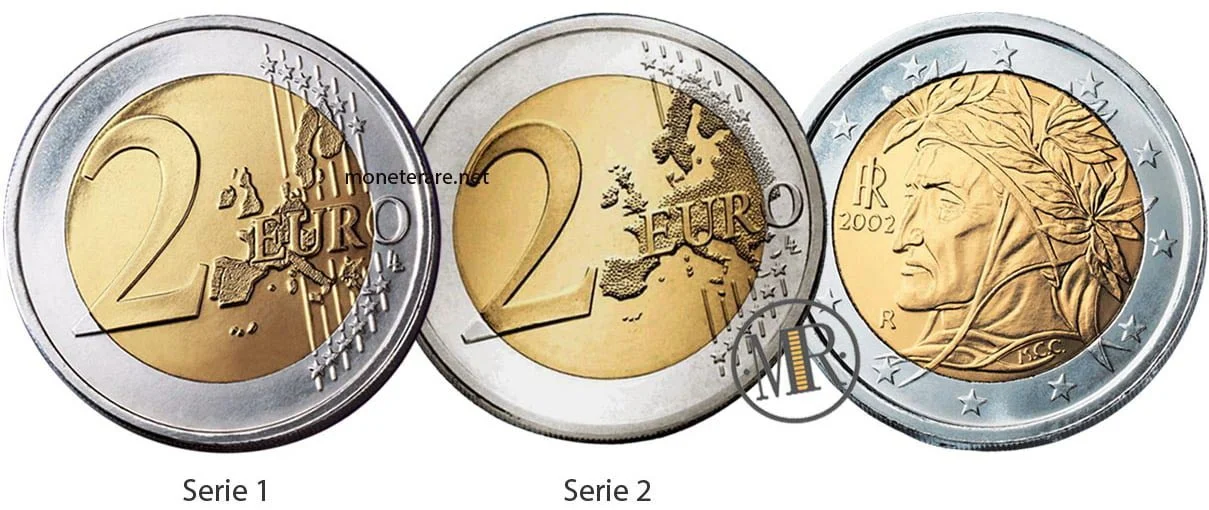
Finally, the last coin, which is the 2 Euro. Obviously, on this page, we are talking about the Italian 2 Euro circulating coin. If you are interested in seeing all the Italian commemorative 2 Euro coins, you need to go to this page: 2 Euro Italy.
In particular, the Italian two euro coin was designed by Maria Carmela Colaneri.
On the Obverse, the coin features the bust of Dante Alighieri, taken from the Parnassus by Raphael Sanzio, located in the Stanza della Signatura in the Vatican Museums. To the left of the bust, the symbol of the Italian Republic “RI” is positioned at the top, and just below it is the year of minting. Also to the left, but slightly lower near Dante's chin, is the mint mark “R”.
At the bottom right, the initials of the author are indicated, thus “M.C.C.” On the outer edge, of course, are the 12 five-pointed stars representing the European Union.
As for the Reverse, it is the same as that of the other 2 Euro coins in Europe.
In this case, there is also a double version, one dating from the years between 2001 and 2007 and the second dating from after 2008.
Now let's look at the technical specifications:
Specifications of the Italian 2 Euro Coin
- Materials: Again, the material differs between the outer and inner parts. The outer part is made of copper-nickel (75% copper – 25% nickel), while the inner part is made of nickel-brass (75% copper – 20% nickel – 20% zinc).
- Thickness: The thickness is 2.20 mm.
- Weight: The weight is the highest, at 8.50 g.
- Diameter: The diameter is 25.75 mm.
- Edge: The edge is the most distinctive, consisting of six five-pointed stars and six alternating number 2s.
- Engraver: Maria Carmela Colaneri.
2 Euro Italy Value and Mintage
Below is the value of the Italian 2 euro coins. The 2 euro Italy 2002 has a value of “only” 2 euros. Please note the value of the rare Italian 2 euros from 2018 and 2019, which instead is very high.
Frequently asked questions
What are the rare Italian euro coins?
Among the Italian circulating coins, the most sought-after pieces depend on the year and mintage: in particular, some 1 euro coins (e.g., years with limited mintage) and the €2 circulating coins from 2018–2019 have values above face value. For the commemorative €2 coins (different series), consult the dedicated catalog.
What are the values of rare Italian 1 euro coins?
The FDC value varies by year: some years remain close to face value (e.g., 2002 and 2008 in common circulation), while 2016, 2017, and 2019 are among the most sought after by collectors. Check the '1 Euro Italy' section on this page for updated mintages and values.
Where can I find the commemorative €2 Italy coins?
This hub covers the circulating coins (1 cent–€2). The complete catalog of Italian commemorative €2 coins, with values and details, is on the dedicated page linked at the top of this article.
What do the Euro Italy coins (1 cent–€2) represent?
Each denomination features a chosen national subject (Castel del Monte, Mole Antonelliana, Colosseum, Botticelli's Venus, Boccioni, Marcus Aurelius, Vitruvian Man, Dante). Materials, weight, and diameter are European standards; artistic details and engraver initials are described in the sections of this page.
How to distinguish between circulating and commemorative €2 coins?
The circulating €2 Italy coin features the bust of Dante (permanent circulating design). The commemorative coins change subject every year (or twice a year) and have a separate catalog and values: use the link 'Commemorative €2 Italy' from this hub.
Where to sell or buy coins
Do you own coins like these, a lot, or a rare piece? Register on Catawiki and place your first bid, or submit a lot for sale — signing up is free. For years we have used this auction site, our partner. Browsing auctions is not enough: start with registration and a first action (a bid or a listing). Register and start.