
Greece Euro Coins
Updated:
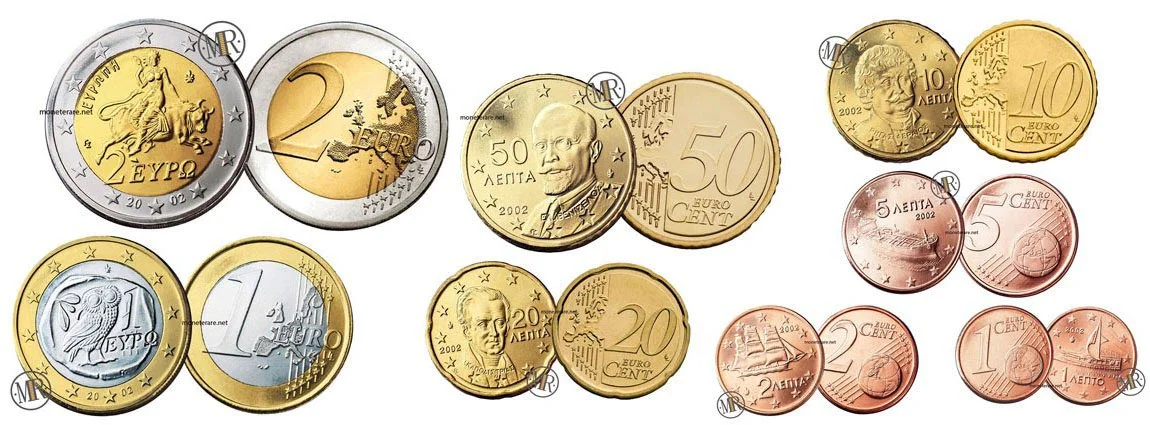
If you want to learn about all the Euro Coins of Greece, you are on the right page. Below you can read the history, characteristics, and values of the Greek division coins among the euro collection.
€2 commemorative catalog: 2 Euro commemorative coins Greece
Brief History of Greek Currency
The first Greek currency we encounter in history is the Drachma in 1832, ten years after the Greeks gained independence from Ottoman dominance. In this way, Greece officially became a Republic.
This Drachma remained in circulation for a very long time, in fact, it disappeared only with the introduction of the euro in 2002, the year in which the first coins of this new currency were minted.
During the twentieth century, the previous Greek Drachma experienced two moments of devaluation. The first during World War II, and the second a few years later, in 1953. Essentially, “new” drachmas were minted to replace the previous ones but with very high exchange rates. The first was 1:50,000,000,000, and the subsequent one was 1:1000.
Introduction of the Euro in Greece
The Cents and Euro Greece became the official currency of this state in 2002.
In fact, Greece entered the Eurozone two years earlier, in 2000, along with 11 other countries, but like them, it was unable to mint coins due to the high quantity required. Therefore, to remedy this initial and temporary imbalance, a number of coins were minted in different countries and thus commissioned to other mints.
One of these countries is Finland. Here, the currencies of 1 Euro and 2 Euro were minted, which are marked with the mint mark S. The 20 Cents coin was instead minted in Spain, as these coins bear the mint mark E. Finally, regarding the Cents 1, 2, 5, 10, and 50 minted and circulating in 2002, they have the mint mark F, as the minting location is France.
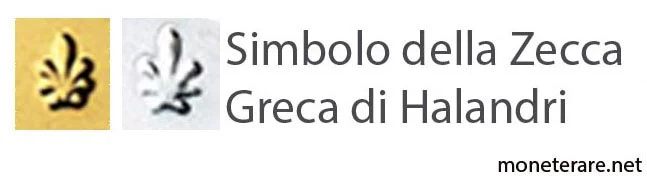
However, with this exception, all Greek coins are minted by the Mint of Athens, the Greek mint in Halandri. There is no identifying letter for the Greek Mint other than the Anthemion, which is the stylized flower present on all faces of Greek coins.
Features of the Euro Coins Greece
The Euro coins of Greece each feature a different subject for each denomination. Different but with a common theme.
What unites the “red” cents, namely the values of 1, 2, and 5, is the depiction of famous Greek ships. On the other hand, the 10, 20, and 50 Cents pieces are united by portraits of illustrious Greek personalities. Finally, on the two larger denominations, namely the 1 and 2 Euro coins, images related to history and, in particular, to Greek mythology are present.
On this side of the coin, there is a particularity that makes them different from the coins of other Eurozone countries. Specifically, the value of the coin itself is also included, written in the Greek alphabet.
The symbols were chosen by the Minister of Economy and the Governor of the Bank of Greece from numerous proposals presented by a national commission of technicians and artists.
But let’s delve into the singularities and specificities of these currencies to better understand their peculiarities.
1 Euro Cent Greece
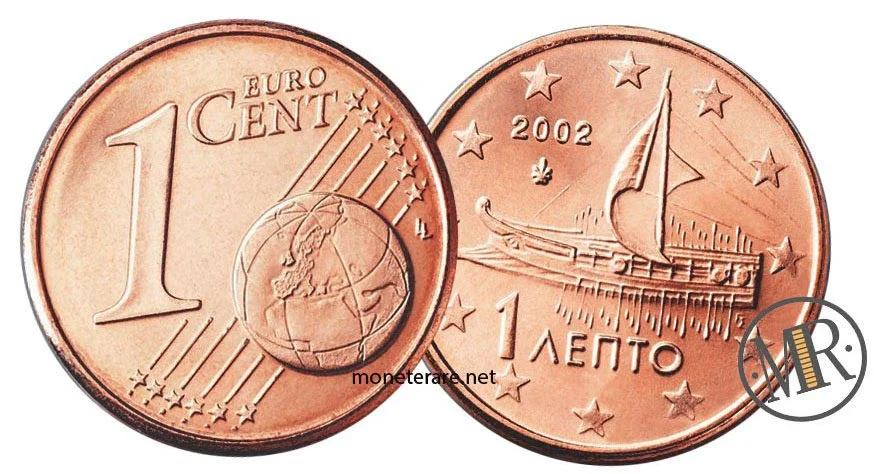
The 1 Euro Cent Greece coin is the smallest Greek coin.
On the Reverse, it features the same common face as all 1 Cent coins from Eurozone countries.
On the Obverse, the center of the coin displays the model of the ancient trireme, which was the largest warship for over 200 years. It dates back to the time of Athenian democracy in the 5th century BC.
The large sailing ship is depicted in profile, with sails unfurled and oars extending outward. Above the hull, the minting year is engraved, and below it, the symbol of the Mint of Athens, which is the Anthemion, a flower represented in a stylized form. Below, we find the image of the number “1” followed by the inscription in Greek characters “ΛEΠTO” (LEPTO).
To the right are the initials of the author “ΓΣ”, which stands for Georgios Stamatopoulos. Framing all of this, on the outer part of the coin, are engraved 12 five-pointed stars as a symbol of the European Union. On coins dated 2002, if minted by the French Mint, there is an additional mint mark, the letter F. It is placed inside the star at “10 o'clock”.
- Materials: Copper-plated steel (steel 94.35% – copper 5.65%)
- Thickness: 1.67 mm
- Weight: 2.3 g
- Diameter: 16.25 mm
- Edge: smooth
- Engraver: Areti Michelioudaki
1 Euro Cent Greece Value and Mintage
| Year | Rarity | Mint | Mintage | Price BU |
|---|---|---|---|---|
| 2002 | C | 100.940.055 + 59.945 Fdc | 1€ | |
| 2002 | C | F | 15.000.000 | - |
| 2003 | C | 35.100.700 + 99.300 Fdc | 1€ | |
| 2004 | C | 49.970.000 + 30.000 FDC | 1€ | |
| 2005 | C | 14.950.000 + 50.000 Fdc | 1€ | |
| 2006 | C | 44.950.000 + 50.000 Fdc | 1€ | |
| 2007 | C | 60.001.681 + 25.000 Fdc | 1€ | |
| 2008 | C | 24.001.977 + 25.000 Fdc | 1€ | |
| 2009 | C | 49.975.000 + 25.000 Fdc | 1€ | |
| 2010 | C | 26.975.000 + 25.000 Fdc | - | |
| 2011 | C | 34.965.000 + 35.000 Fdc + 2.500 Fs | - | |
| 2012 | C | 47.967.500+ 30.000 Fdc + 2.500 Fs | - | |
| 2013 | C | 43.980.000 + 20.000 Fdc 4.000 Fs | - | |
| 2014 | C | 45.000.000 + 13.000 Fdc + 2.500 Fs | - | |
| 2015 | C | 25.000.000 + 15.000 Fdc + 2.000 Fs | - | |
| 2016 | C | 49.000.000 + 15.000 Fdc + 2.000 Fs | - | |
| 2017 | C | 30.000.000 + 15.000 Fdc + 1.200 Fs | - | |
| 2018 | C | 39.000.000 + 15.000 Fdc + 2.000 Fs | - |
2 Cents Greece
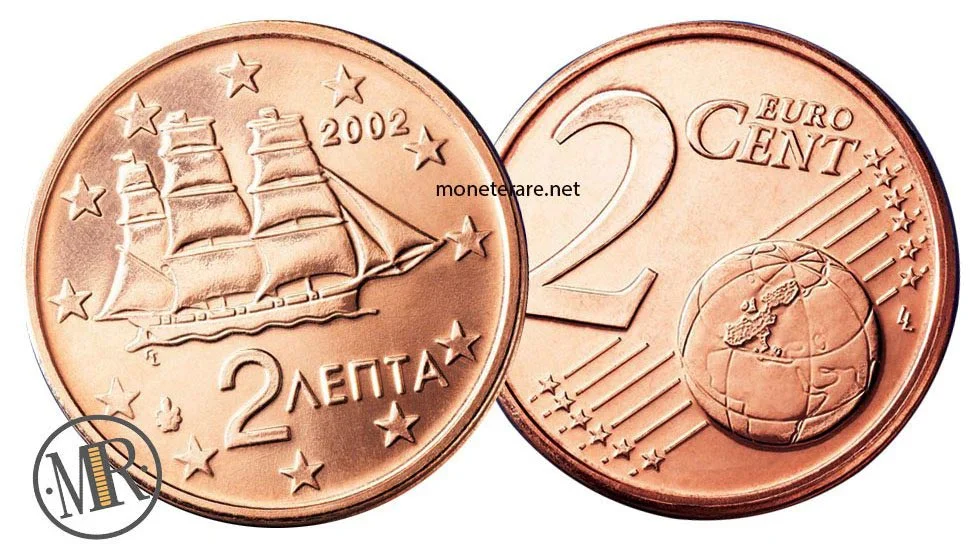
Increasing in value, we find the coin of 2 Euro Cents Greece.
Like the first, at the center of the coin, on the Obverse, a ship is depicted. In this case, however, the hull is very different from the first. In fact, we are facing a Corvette, a vessel used during the War of Independence in the years 1821-1827. The ship is engraved head-on, with the stern and bow opposite to that present on the 1 Cent coin, which sails the sea with its sails spread.
Starting from the lowest part of the currency, we find the inscription of the number “2”, accompanied by the Greek word “ΛEΠTA” (LEPTA). To the left of the number are the initials of the engraver “ΓΣ”, which stands for Georgios Stamatopoulos, and the Anthemion, as well as a flower represented in a stylized form which symbolizes the mint mark of Athens.
At the top right, above the ship, the minting year is engraved. In 2002, if the coin was minted by the French mint, within the 2nd star the letter F (France) is indicated. On the outer part of the coin, surrounding this design, there are 12 five-pointed stars, symbol of the European Union.
On the Reverse, we find the common face shared by all 2 cents coins of the currencies of the Eurozone countries.
- Materials: Copper-plated steel (steel 94.35% – copper 5.65%)
- Thickness: 1.67 mm
- Weight: 3.06 g
- Diameter: 18.75 mm
- Edge: Horizontal milled
- Engravers: Areti Michelioudaki and Nikos Nikolaou
2 Euro Cents Greece Value and Mintage
| Year | Rarity | Mint | Mintage | Price BU |
|---|---|---|---|---|
| 2002 | CC | 175.940.055 + 59.945 Fdc | 1€ | |
| 2002 | NC | F | 18.000.000 | - |
| 2003 | C | 9.400.700 + 99.300 Fdc | 2€ | |
| 2004 | C | 24.970.000 + 30.000 FDC | 1€ | |
| 2005 | C | 14.950.000 + 50.000 Fdc | 1€ | |
| 2006 | C | 44.950.000 + 50.000 Fdc | 1€ | |
| 2007 | C | 25.000.103 + 25.000 Fdc | 1€ | |
| 2008 | C | 68.009.877 + 25.000 Fdc | 1€ | |
| 2009 | C | 15.975.000 + 25.000 Fdc | 1€ | |
| 2010 | C | 30.975.000 + 25.000 Fdc | - | |
| 2011 | C | 46.965.000 + 35.000 Fdc + 2.500 Fs | - | |
| 2012 | C | 33.967.500 + 30.000 Fdc + 2.500 Fs | - | |
| 2013 | C | 40.980.000 + 20.000 Fdc 4.000 Fs | - | |
| 2014 | C | 25.000.000 + 13.000 Fdc + 2.500 Fs | - | |
| 2015 | C | 32.000.000 + 15.000 Fdc + 2.000 Fs | - | |
| 2016 | C | 52.000.000 + 15.000 Fdc + 2.000 Fs | - | |
| 2017 | C | 34.000.000 + 15.000 Fdc + 1.200 Fs | - | |
| 2018 | C | 14.000.000 + 15.000 Fdc + 2.000 Fs | - |
5 Cents Euro Greece
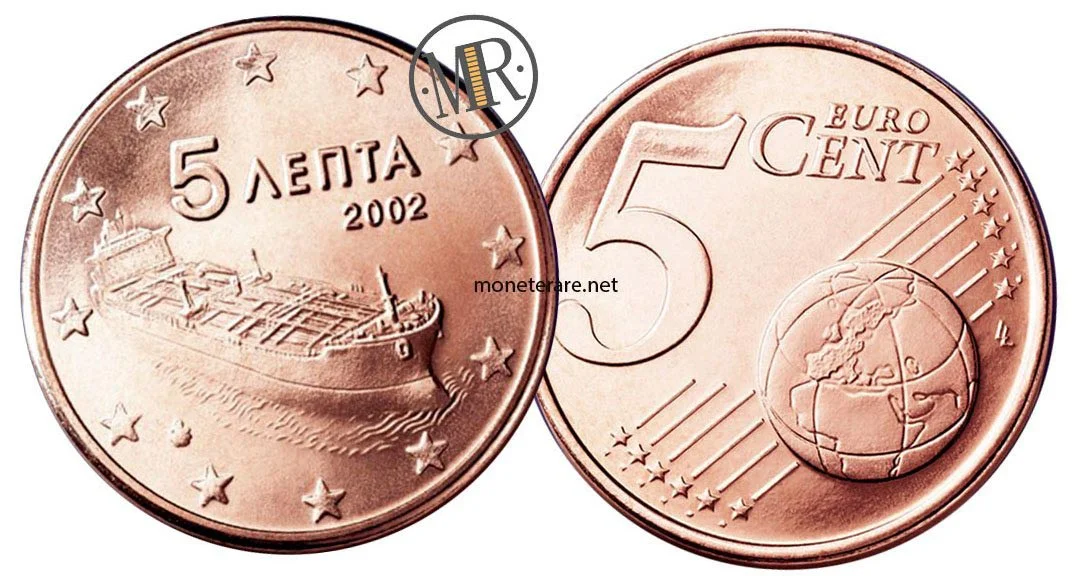
With the 5 Cents Euro Greece, we conclude the description of the “red” cents.
On the Reverse, it features the common design found on all Euro coins, with the inscription 5 Cents of the Countries of the European Union.
As for the Obverse, similar to the previous currencies, we find, for the last time, depicted a hull. In this case, at the center of the coin, a tanker is represented. It symbolizes the entrepreneurial spirit of sailors, as well as the skills of the Greek merchant navy. The ship is depicted in such a way as to give a sense of depth and motion. This is achieved both by the movement of the sea waves and by the position in which it has been drawn.
Above the tanker, the number “5” is engraved, accompanied by the inscription “ΛEΠTA” (LEPTA). Below it, we find the minting year. Beneath the ship, to the left, is the symbol of the Athens Mint, the Anthemion, a flower represented in a stylized form.
Below the bow of the hull, the initials of the author “ΓΣ” are engraved, which stands for Georgios Stamatopoulos. All of this is “embraced” by 12 five-pointed stars, depicted on the outer part of the coin, in a circle. They represent the symbol of the European Union.
In the currencies of the year 2002, if minted by the French Mint, there is an additional mint mark F (France) inserted in the star at “2 o'clock”.
- Materials: Copper-plated steel (steel 94.35% – copper 5.65%)
- Thickness: 1.67 mm
- Weight: 3.92
- Diameter: 21.25 mm
- Edge: Smooth
- Engraver: Maria Antonatou
5 Cents Euro Greece Value and Mintage
| Year | Rarity | Mint | Mintage | Price BU |
|---|---|---|---|---|
| 2002 | C | 210.940.055 + 59.945 Fdc | 1€ | |
| 2002 | C | F | 90.000.000 | - |
| 2003 | NC | 650.700 + 99.300 Fdc | 7€ | |
| 2004 | NC | 220.000 + 30.000 FDC | 7€ | |
| 2005 | C | 950.000 + 50.000 Fdc | 5€ | |
| 2006 | C | 49.950.000 + 50.000 Fdc | 2,50€ | |
| 2007 | C | 55.005.598 + 25.000 Fdc | 1€ | |
| 2008 | C | 50.000.713 + 25.000 Fdc | 1€ | |
| 2009 | C | 37.975.000 + 25.000 Fdc | 1€ | |
| 2010 | C | 4.975.000 + 25.000 Fdc | - | |
| 2011 | C | 33.965.000 + 35.000 Fdc + 2.500 Fs | - | |
| 2012 | C | 4.967.500 + 30.000 Fdc + 2.500 Fs | - | |
| 2013 | R2 | 20.000 Fdc 4.000 Fs | - | |
| 2014 | C | 18.000.000 + 13.000 Fdc + 2.500 Fs | - | |
| 2015 | C | 10.000.000 + 15.000 Fdc + 2.000 Fs | - | |
| 2016 | C | 27.000.000 + 15.000 Fdc + 2.000 Fs | - | |
| 2017 | C | 8.000.000 + 15.000 Fdc + 1.200 Fs | - | |
| 2018 | C | 15.000.000 + 15.000 Fdc + 2.000 Fs | - |
10 Cents Euro Greece
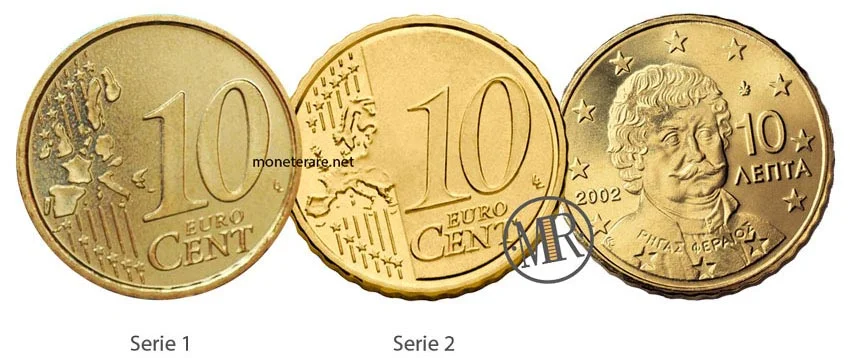
With the 10 Cents Euro Greece, we move on to the description of the “yellow” cents.
Unlike the “red” cents, the design on the Obverse of the currency changes theme. In fact, we can see that various important personalities have been depicted.
Regarding the 10 Cents coin, the illustrious figure in question is Rigas Feraios (1757-1798). His portrait occupies the entire central part of the coin. Feraios was a precursor of Greek Enlightenment and a supporter of the Balkan Confederation and the first to foresee its liberation. To the left of his face, the minting year is engraved. To the right, there is the inscription of the number “10” and next to it the word “ΛEΠTA” (LEPTA) in uppercase letters. Below is the Anthemion, a flower represented in a stylized form, which symbolizes the Mint of Athens.
At the bottom of the bust, the initials of the author “ΓΣ”, that is Georgios Stamatopoulos, and the inscription in Greek characters “PHΓAΣ ΦEPAIOΣ”, as well as the name of the depicted subject (Rigas Feraios), can be found.
On the outer edge, 12 five-pointed stars are engraved, which represent the European Union.
In 2002, if the coin was minted by the French Mint, inside the eighth star there is the letter F (France).
On the Reverse, as with all currencies of the Eurozone countries, the same common face as the 10 Cents is found. In the 1st series, the Eurozone countries are depicted separately, while in the 2nd Series, that of 2007, they are shown united.
- Materials: Nordic Gold (copper 89% – aluminum 5% – zinc 5% – tin 1%)
- Thickness: 1.93 mm
- Weight: 4.1 g
- Diameter: 19.75 mm
- Edge: Ribbed with milling
- Engraver: Pericles Sotiriou
10 Cents Euro Greece Value and Mintage
La Prima Serie
La Seconda Serie
| Year | Rarity | Mint | Mintage | Price BU |
|---|---|---|---|---|
| 2002 | CC | 138.940.055 + 59.945 Fdc | 1€ | |
| 2002 | CC | F | 100.000.000 | - |
| 2003 | NC | 500.700 + 99.300 Fdc | 8€ | |
| 2004 | C | 9.970.000 + 30.000 FDC | 2€ | |
| 2005 | C | 24.950.000 + 50.000 Fdc | 1€ | |
| 2006 | C | 44.950.000 + 50.000 Fdc | 1€ |
20 Cents Euro Greece
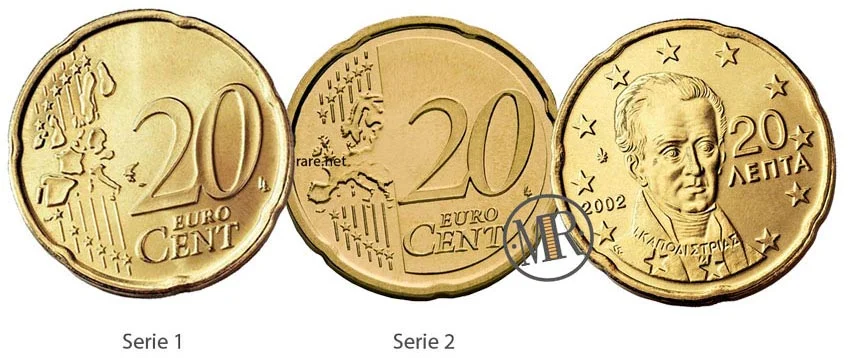
Continuing with the analysis of currencies, the 20 Cents Euro Greece are next.
On the Reverse, the same common face is depicted as all 20 Cents from the Eurozone countries. The 2002 series features the Eurozone countries separated, while in the 2nd series of 2007, the Eurozone is united.
On the Obverse, at the center of the coin, is engraved the portrait of Ioannis Kapodistrias (1776-1831), a distinguished politician and famous statesman of Greece and Europe. He was also the first Greek governor (1830-1831) after the War of Independence (1821-1827).
To the left of the face is engraved the mint year. Above it is the Anthemion, a flower depicted in a stylized form, as well as the symbol of the Mint of Athens. To the right of the politician is the number “20” with the Greek inscription “ΛEΠTA” (LEPTA) below it.
At the bottom, on the bust of the illustrious figure, is engraved in Greek the inscription “I.KAΠOΔIΣTPIAΣ” (I. KAPODISTRAIS) representing the name of the depicted man. The initials of the author “ΓΣ”, which stands for Georgios Stamatopoulos, are also engraved.
Framing all of this, on the outer edge, are 12 five-pointed stars representing the European Union.
In 2002, if the coin was minted by the Spanish mint, inside the eighth star there is the letter E (Spain).
- Materials: Nordic Gold (copper 89% – aluminum 5% – zinc 5% – tin 1%)
- Thickness: 2.14 mm
- Weight: 5.74 g
- Diameter: 22.25 mm
- Edge: Wide milling
- Engraver: Maria Antonatou
20 Cents Euro Greece Value and Mintage
La Prima serie
La Seconda serie
| Year | Rarity | Mint | Mintage | Price BU |
|---|---|---|---|---|
| 2002 | CC | 208.940.055 + 59.945 Fdc | 1€ | |
| 2002 | CC | E | 120.000.000 | - |
| 2003 | NC | 700.700 + 99.300 Fdc | 6€ | |
| 2004 | NC | 470.000 + 30.000 FDC | 8€ | |
| 2005 | NC | 950.000 + 50.000 Fdc | 2,50€ | |
| 2006 | NC | 950.000 + 50.000 Fdc | 2,50€ |
50 Cents Euro Greece
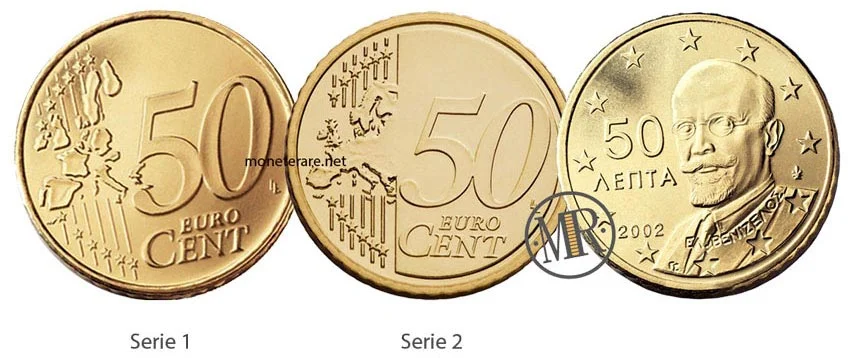
Finally, the 50 Cents Euro Greece are the last to be part of the “yellow” cents.
On the Obverse of this currency is engraved the portrait of Eleftherios Kyriaku Venizelos (1861-1935), one of the most important political figures in Greece. He is well known as a strong supporter of modernization of the country and for the liberalization of Northern Greece and the Aegean Islands. To the left of the denomination, you can see the Greek inscription “ΛEΠTA” (LEPTA) alongside the value “50”. Below these inscriptions, the mint year is indicated.
On the right side of the denomination, the symbol of the Athens Mint, the Anthemion, a flower depicted in a stylized form, is engraved. Continuing with the description, at the bottom, on the bust, there is an inscription in Greek characters “EΛ. BENIZEΛOΣ” (EL. BENIZELOS). Additionally, the Greek initials “ΓΣ” of the author, namely Georgios Stamatopoulos. are also present.
On the outer edge, there are 12 five-pointed stars, as well as the symbol of the European Union. If minted in 2002, by the Mint of France, the letter F, for France, is engraved inside the eighth star.
As for the Reverse of the coin, it features the common face shared by all 50 Cents coins from Eurozone countries.
The First series of 2002 with separate countries, the Second series of 2007 with the Eurozone without borders and with united countries.
- Materials: Nordic Gold (copper 89% – aluminum 5% – zinc 5% – tin 1%)
- Thickness: 2.38 mm
- Weight: 7.80 g
- Diameter: 24.25 mm
- Edge: Ribbed with thick milling
- Engraver: Nikos Nikolaou
50 Cents Euro Greece Value and Mintage
La prima serie
La seconda serie
| Year | Rarity | Mint | Mintage | Price BU |
|---|---|---|---|---|
| 2002 | CC | 92.940.055 + 59.945 Fdc | 1,40€ | |
| 2002 | CC | F | 70.000.000 | - |
| 2003 | NC | 600.700 + 99.300 Fdc | 6€ | |
| 2004 | NC | 470.000 + 30.000 FDC | 6,50€ | |
| 2005 | NC | 950.000 + 50.000 Fdc | 2,50€ | |
| 2006 | NC | 950.000 + 50.000 Fdc | 2,50€ |
1 Euro Greece
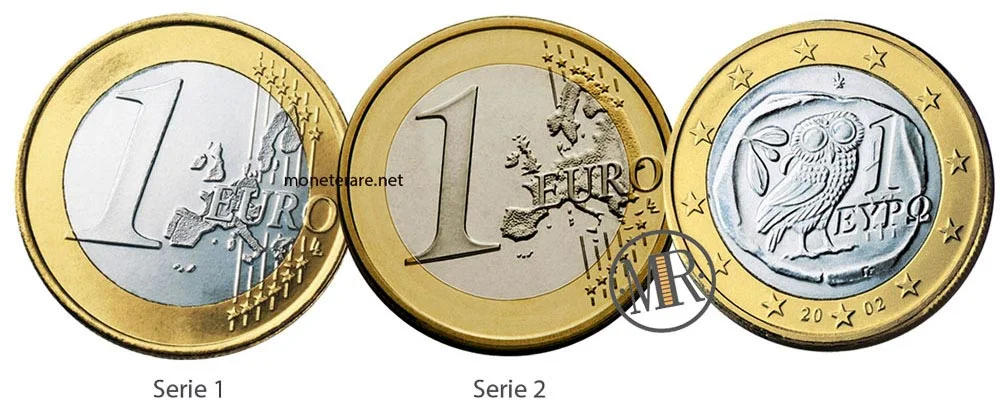
The 1 Euro Greece coin is a bimetallic coin and the largest denomination compared to those described so far. It is one of the 8 denominations of Euro coins.
Description
On the Reverse, it features the same common face as all 1 Euro coins from Eurozone countries.
In the First Series, the map of Eurozone countries marked the borders between each country, while in the second series of 2007, the countries are depicted without borders.
On the Obverse, there is an image related to Greek mythology, specifically an owl. This animal represents the Owl of Minerva, which already appeared on an ancient Athenian coin of 4 drachmas dating back to the 5th century BC. You can see the coin on this page: ancient Greek coin.
Minerva accompanies Athena, daughter of Zeus, in various events from Homer onwards.
However, she has a strong symbolic value. She symbolizes beauty, love, and harmony for knowledge and research in a broad sense.
To the right of the owl, the value “1” is engraved, with the Greek inscription “EYPΩ” (EIRO) below it.
At the top, there is the Anthemion, the symbol of the Athens Mint, depicted as a stylized flower.
Conversely, at the bottom, the initials “ΓΣ” are inscribed in Greek of the author and designer Georgios Stamatopoulos. Also at the bottom, within the crown, is the minting year, divided in two parts by the sixth star.
On the outer edge, 12 five-pointed stars have been engraved, representing the symbol of the European Union.
In 2002, if minted by the Mint of Finland, inside the 6th star there is an S, which stands for Suomi.
- Materials: Bimetallic. Outer part: nickel-brass (75% copper – 20% zinc – 5% nickel); inner part: copper-nickel (75% copper – 25% nickel)
- Thickness: 2.33 mm
- Weight: 7.50 g
- Diameter: 23.25 mm
- Edge: Interrupted milled
- Engraver: Georgios Stamatopoulos
1 Euro Greece Value and Mintage
La prima serie
La seconda serie
| Year | Rarity | Mint | Mintage | Price BU |
|---|---|---|---|---|
| 2002 | CC | 61.440.055 + 59.945 Fdc | 1€ | |
| 2002 | CC | S | 50.000.000 | 1€ |
| 2003 | C | 11.600.700 + 99.300 Fdc | 1€ | |
| 2004 | C | 9.970.000 + 30.000 Fdc | 1€ | |
| 2005 | C | 9.950.000 + 50.000 Fdc | 1€ | |
| 2006 | C | 9.950.000 + 50.000 Fdc | 1€ |
2 Euro Greece
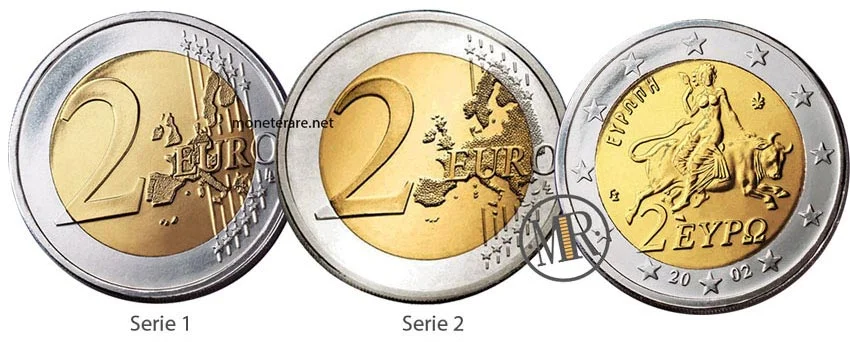
To conclude, the 2 Euro Greece are the last coins of the 8 Euro denominations. If you cannot find your Greek 2 euro coin on this page, it probably belongs to the commemorative 2 euro coins, which you can find here: 2 euro commemorative Greece.
Description
This bimetallic currency features on the Reverse the same common face as all 2 Euro coins from countries belonging to the Eurozone.
In the Eurozone map of the 1st Series, the borders between countries are depicted, while in the 2nd series map, the countries are united.
On the Obverse, as with the 1 Euro coin, there is an image that fully reflects mythology and thus Greek history. At the center of the currency is engraved a scene from the 3rd century BC mosaic of Sparta, namely Europa abducted by Jupiter, who takes the form of a bull. It is well known that Jupiter often enjoyed transforming into different forms, among other reasons, to seduce his “prey”.
To the left of this mythological figure, the initials “ΓΣ” are engraved, written in Greek, and belong to the author and designer Georgios Stamatopoulos. At the top left, there is an inscription, also in Greek characters, “ΕΥΡΟΠΗ” (EIROPE). Meanwhile, at the top but to the right, the Anthemion, the symbol of the Mint of Athens, is depicted, which is a flower represented in a stylized form.
At the bottom, the value “2” is followed by the inscription in Greek characters “EYPΩ” (EIRO).
On the edge, around the currency, the minting year is engraved, divided into two parts by the sixth star.
On the outer edge, there are 12 five-pointed stars which represent the symbol of the European Union.
In 2002, if minted by the Mint of Finland, inside the 6th star there is an S, which stands for Suomi.
- Materials: Bimetallic. Outer part: copper-nickel (copper 75% – nickel 25%); inner part: nickel-brass (copper 75% – zinc 20% – nickel 5%.
- Thickness: 2.20 mm
- Weight: 8.50 g
- Diameter: 25.75 mm
- Edge: Finely milled with the inscription “ΕΛΛΗΝΙΚΗ ΔΗΜΟΚΡΑΤΙΑ *” (Hellenic Republic)
- Engraver: Georgios Stamatopoulos
2 Euro Greece Value and Mintage
La prima serie
La seconda serie
| Year | Rarity | Mint | Mintage | Price BU |
|---|---|---|---|---|
| 2002 | C | 75.340.055 + 59.945 Fdc | 6€ | |
| 2002 | CC | S | 70.000.000 | 6€ |
| 2003 | NC | 450.700 + 99.300 Fdc | 9€ | |
| 2004 | R2 | 30.000 FDC | 30€ | |
| 2005 | NC | 950.000 + 50.000 Fdc | 9€ | |
| 2006 | NC | 9.950.000 + 50.000 Fdc | 9€ |
Where to sell or buy coins
Do you own coins like these, a lot, or a rare piece? Register on Catawiki and place your first bid, or submit a lot for sale — signing up is free. For years we have used this auction site, our partner. Browsing auctions is not enough: start with registration and a first action (a bid or a listing). Register and start.