
Estonia Euro Coins
Updated:
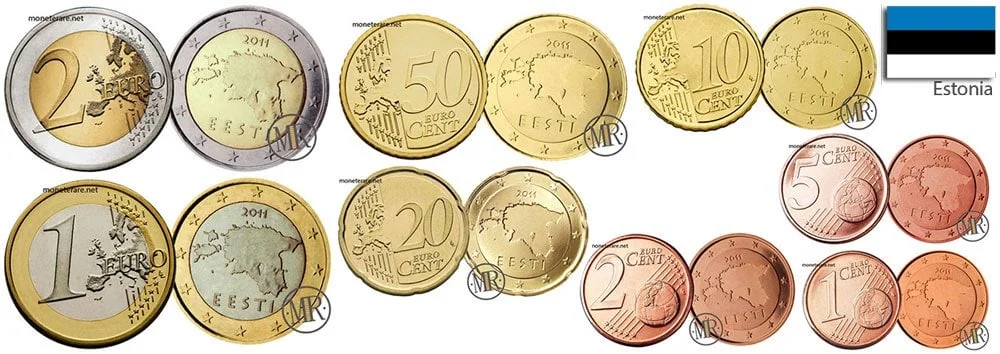
Today’s journey will explore Estonian Numismatics and Estonian Euro Coins. In particular, before we delve into the details of each individual coin, it is important to analyze the history of the currency of this country.
€2 commemorative catalog: Estonia 2 Euro commemoratives
Introduction to the Coins of Estonia
The historical currency of Estonia, at least regarding the more recent years, was the Kroon, or the crown. This same currency, however, experienced two distinct and separate periods known as the “first Kroon period” and the “second Kroon period.”
The first Kroon period began in 1928 when the kroon was introduced to replace the Estonian mark, the currency in circulation before then. Specifically, the fixed exchange rate was 100 Estonian marks = 1 kroon.
This remained in circulation until 1940, the year in which the invasion by the USSR occurred. From that moment on, the Soviet Ruble was declared the main currency with an exchange rate of 1 ruble = 0.8 kroon.
The second Kroon period began in 1992. In that year, the kroon was reintroduced at the expense of the Soviet ruble, which had been the official currency since 1940. This time, the exchange rate was set at 1 kroon = 10 rubles.
Since June 28, 2004, Estonia has been a member of the EU, and from that moment on, work has been done towards the introduction of the Single Currency.
Specifically, the definitive transition occurred on January 1, 2011, with an exchange rate of 1 Euro = 15.6466 kroons.
Estonia was the 17th country to adopt the euro.
After this brief but necessary introduction, let us now analyze the different Euro coins of Estonia. Throughout this article, we will discover their features, sizes, and peculiarities.
Let’s take a look together.
1 Euro Cent Estonia
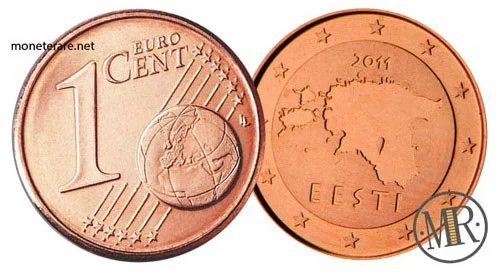
The first coin we will analyze is naturally the 1 Euro Cent Estonia. Specifically, this coin was designed by the author Lembit Lohmus.
On the Obverse, we can immediately notice the representation of the map of Estonia. At the top is the year of minting, while at the bottom is the inscription “EESTI,” which means Estonia.
All around are the 12 five-pointed stars representing the member states of the European Union.
On the Reverse, the coin features the same design as the other coins, depicting Europe in the world.
Let’s also take a look at the technical characteristics of this coin.
- Materials: The material used for this coin is copper-plated steel (steel 94.35% – copper 5.65%)
- Thickness: The thickness is equal to 1.67 mm
- Weight: The weight is equal to 2.30 grams
- Diameter: The diameter is 16.25 mm
- Edge: The edge is completely smooth
- Engraver: Lembit Lohmus
1 Euro Cent Estonia | Value and Mintage
Here is the table with the mintages and their respective values:
| Year | Rarity | Mint | Mintage | BU Price |
|---|---|---|---|---|
| 2011 | CC | 32,000,000 + 50,000 BU + 3,500 Proof | - | |
| 2012 | CC | 25,000,000 | - | |
| 2015 | CC | 14,000,000 | - | |
| 2016 | R2 | 20,000 BU | 2€ | |
| 2017 | CC | 29,000,000 | - | |
| 2018 | NC | 500,000 + 5,000 BU | - | |
| 2019 | NC | 10,000,000 | - |
2 Euro Cents Estonia
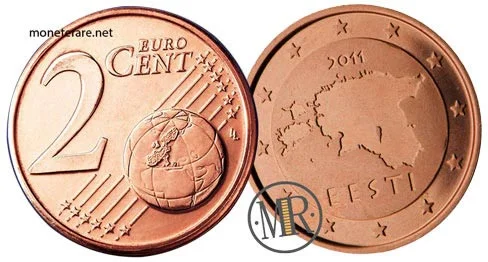
Let’s move on to the next coin, which is the 2 Euro Cents Estonia. In this case, the author is still the same, Lembit Lohmus.
On the Obverse, we again find the representation of the map of Estonia. At the top, you can see the year of minting, while immediately below is the inscription “EESTI,” which means “Estonia.”
All around, you can notice the classic 12 five-pointed stars representing the European States.
On the Reverse, we can find the same face present on the other 2 Euro Cents coins.
However, let’s immediately look at the technical characteristics of this coin.
- Materials: In this case, the material used is copper-plated steel (steel 94.35% – copper 5.65%)
- Thickness: The thickness is equal to 1.67 mm
- Weight: The weight increases to 3.06 grams
- Diameter: The diameter is 18.75 mm
- Edge: The edge is characterized by a horizontal line in incuse
- Engraver: Lembit Lohmus
2 Euro Cents Estonia | Value and Mintage
Below are the values and mintages of the 2 Euro Cents coins, divided by year:
| Year | Rarity | Mint | Mintage | Price BU |
|---|---|---|---|---|
| 2011 | CC | 30,000,000 + 50,000 BU + 3,500 Proof | - | |
| 2012 | CC | 25,000,000 | - | |
| 2015 | CC | 17,000,000 | - | |
| 2016 | R2 | 20,000 BU | 2€ | |
| 2017 | C | 9,000,000 | - | |
| 2018 | C | 8,500,000 + 5,000 BU | - |
5 Euro Cents Estonia
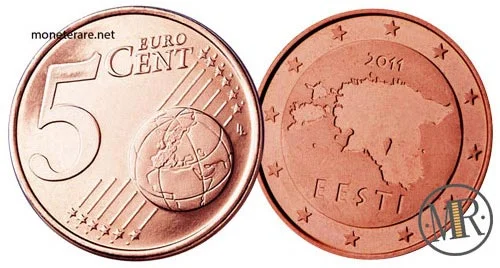
We now come to the next coin, namely the 5 Euro Cents Estonia. The author is the same, namely Lembit Lohmus.
On the Obverse, we find the depiction of Estonia with its borders and the perfect map. At the top, the year of minting is present, while at the bottom, we can read the inscription “EESTI,” which means “ESTONIA” in Estonian.
All around the design are the 12 five-pointed stars representing the European States.
On the Reverse, we can notice the same face present on practically any 5 Euro Cents coin in Europe.
However, let’s also look at the technical characteristics of this coin.
- Materials: Once again, the material is copper-plated steel, consisting of 94.35% steel and 5.65% copper
- Thickness: The thickness is still 1.67 mm
- Weight: The weight further increases to 3.90 grams
- Diameter: The diameter also increases to 21.25 mm
- Edge: The edge is completely smooth again
Engraver: Lembit Lohmus
5 Euro Cents Estonia | Value and Mintage
Here are the values for the 5 cent coins from Estonia year by year:
| Year | Rarity | Mint | Mintage | FDC Price |
|---|---|---|---|---|
| 2011 | CC | 30,000,000 + 50,000 FDC + 3,500 FS | - | |
| 2016 | R2 | 20,000 FDC | €3 | |
| 2017 | C | 4,550,000 | - | |
| 2018 | C | 4,500,000 + 5,000 FDC | - |
10 Cents Euro Estonia
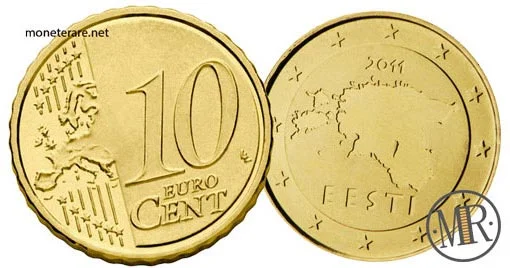
We have arrived at the 10 Cents Euro Estonia coin. This means we are at the fourth coin and perfectly halfway through our journey.
As for this coin, the author is Lembit Lohmus.
On the Obverse, we can immediately notice the representation of Estonia with the year of minting at the top. At the bottom, there is the inscription “EESTI,” which means “ESTONIA.”
Surrounding it are the 12 stars representing the European States.
On the Reverse, we can see that the face is the same as the other 10 Cents coins.
What we are interested in analyzing, however, are the technical characteristics of this coin.
- Materials: The material used this time is Nordic Gold, consisting of 89% copper – 5% zinc – 5% aluminum – 1% tin.
- Thickness: The thickness increases to 1.93 mm
- Weight: The weight also further increases to 4.10 grams
- Diameter: The diameter, however, decreases to 19.75 mm
- Edge: The edge is reeded with a thick milling
- Engraver: Lembit Lohmus
10 Cents Euro Estonia Value and Mintage
Mintage and values divided year by year:
| Year | Rarity | Mint | Mintage | Price BU |
|---|---|---|---|---|
| 2011 | CC | 30,000,000 + 50,000 BU + 3,500 Proof | - | |
| 2016 | R2 | 20,000 BU | 3€ | |
| 2018 | NC | 500,000 + 5,000 BU | 1€ |
20 Cents Euro Estonia
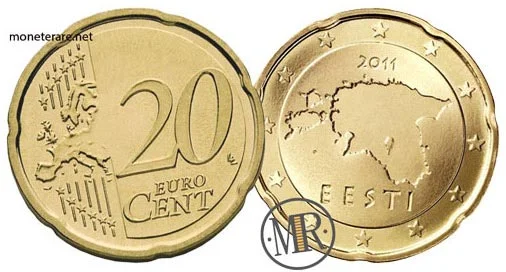
The next coin to analyze is the 20 Cents Euro Estonia. This specific coin is also designed by the same author, Lembit Lohmus.
On the Obverse, we can see that the coin perfectly features the representation of Estonia at its center. At the top, the year of minting is displayed, while at the bottom, we can see the inscription “EESTI,” which means “ESTONIA” in Estonian.
Surrounding it are the 12 five-pointed stars representing the European states.
On the Reverse, the coin has the same design as the other 20-cent European coins.
Now let’s move on to the technical specifications of this coin.
- Materials: Here too, the material used is Nordic Gold (89% copper – 5% zinc – 5% aluminum – 1% tin).
- Thickness: The thickness increases to 2.14 mm
- Weight: The weight undergoes a significant change, reaching up to 5.74 grams
- Diameter: The diameter also increases, reaching 22.25 mm
- Edge: The edge features a wide reeding
- Engraver: Lembit Lohmus
20 Cents Euro Estonia | Value and Mintage
Table divided by years of mintage with indicated values:
| Year | Rarity | Mint | Mintage | Price BU |
|---|---|---|---|---|
| 2011 | CC | 25,000,000 + 50,000 BU + 3,500 Proof | - | |
| 2016 | R2 | 20,000 BU | €3 | |
| 2017 | C | 3,250,000 | - | |
| 2018 | C | 4,000,000 + 5,000 BU | €1 |
50 Cents Euro Estonia
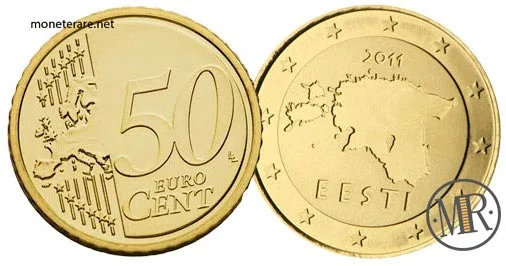
Here we are with the 50 Cents Euro Estonia coin. For this specific coin, we again talk about the same author, namely Lembit Lohmus.
On the Obverse, the coin features the representation of Estonia in a perfect central engraving. Above the geographical map is the year of minting, while below is the inscription “EESTI,” which translates to “ESTONIA” in Estonian.
This design is surrounded by the 12 five-pointed stars representing the European states.
On the Reverse, we can also notice the same face as the other European coins.
Let’s take a closer look at the technical specifications of this coin.
- Materials: Once again, the material used is Nordic Gold, consisting of 89% copper, 5% zinc, 5% aluminum, and 1% tin.
- Thickness: The thickness slightly increases to 2.38 mm
- Weight: The weight also significantly increases to 7.80 grams
- Diameter: There is a slight increase in diameter, which reaches 24.25 mm
- Edge: The edge is reeded with a thick milling
- Engraver: Lembit Lohmus
50 Cents Euro Estonia | Value and Mintage
This is the table with values and mintage:
| Year | Rarity | Mint | Mintage | Price BU |
|---|---|---|---|---|
| 2011 | CC | 20,000,000 + 50,000 BU + 3,500 Proof | - | |
| 2016 | R2 | 20,000 BU | 4€ | |
| 2018 | NC | 500,000 + 5,000 BU | 2€ |
1 Euro Estonia
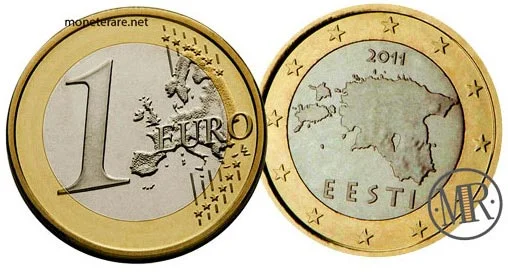
Here we are at the penultimate coin of this fantastic collection. Specifically, we now analyze the 1 Euro Estonia coin.
As with the other coins seen so far, the author is Lembit Lohmus.
On the Obverse, we can indeed notice the same subject, namely the representation of Estonia with its borders and mapping. At the top, the year of minting is present, while at the bottom we can see the inscription “EESTI,” which in the local language means “ESTONIA.”
All around, we can see the 12 five-pointed stars representing the European States.
On the Reverse, the coin, like the others seen, has the same face as the other 1 Euro coins, depicting Europe in the world.
However, let’s also look at the technical characteristics of this coin.
- Materials: Regarding this coin, we are talking about a dual material. The outer part is made of nickel-brass, which means 75% copper, 20% zinc, and 5% nickel. The inner part, on the other hand, is made of copper-nickel, that is, 75% copper and 25% nickel.
- Thickness: The thickness slightly decreases to 2.33 mm.
- Weight: The weight also slightly decreases to 7.50 grams.
- Diameter: There is a slight decrease in diameter, which reaches 23.25 mm.
- Edge: The edge is discontinuously ridged.
- Engraver: Lembit Lohmus
1 Euro Estonia | Value and Mintage
Table divided by years indicating values and mintages:
| Year | Rarity | Mint | Mintage | BU Price |
|---|---|---|---|---|
| 2011 | CC | 20,000,000 + 50,000 BU + 3,500 Proof | - | |
| 2016 | R2 | 20,000 BU | €6 | |
| 2018 | NC | 500,000 + 5,000 BU | €2 |
2 Euro Estonia
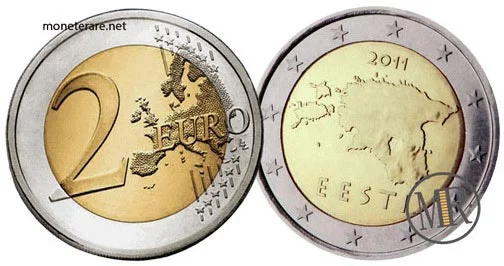
Finally, we have reached the last coin of this collection, the 2 Euro Estonia coin. As with this last coin, the author is still the same, namely Lembit Lohmus. If you can't find the 2 euro coin you are looking for on this divisional page, you should check the page 2 euro commemorative coins Estonia. You might find the coin among the commemoratives.
On the Obverse, once again we see the magnificent representation of the Estonian territory. At the top, we can notice the year of minting, while at the bottom is the inscription “EESTI,” which means “ESTONIA.”
Surrounding the design are the usual 12 stars, present on practically any European coin, symbolizing the European states.
On the Reverse, the coin is the same as all the other 2 Euro coins.
We conclude this collection by analyzing together the technical characteristics of this specific coin.
- Materials: This coin also features a dual material. The outer part is made of nickel-brass, which is 75% copper, 20% zinc, and 5% nickel. The inner part, on the other hand, is made of copper-nickel, meaning 75% copper and 25% nickel.
- Thickness: The thickness of this coin decreases further, reaching 2.20 mm.
- Weight: The weight, on the contrary, increases further, reaching 8.50 grams. This is the heaviest coin in the entire collection.
- Diameter: The diameter also slightly increases, measuring 25.25 mm.
- Edge: The edge is finely milled with the motif “E-E-S-T-I” that repeats in an inverted manner. The two inscriptions (the straight and the inverted) are interrupted by a small star.
- Engraver: Lembit Lohmus
2 Euro Estonia | Value and Mintage
- Among the Estonia euros, the 2 euro coin of 2016 is certainly one of the Rare Coins with the highest value, around €10 in BU.
Where to sell or buy coins
Do you own coins like these, a lot, or a rare piece? Register on Catawiki and place your first bid, or submit a lot for sale — signing up is free. For years we have used this auction site, our partner. Browsing auctions is not enough: start with registration and a first action (a bid or a listing). Register and start.